Tag: Mobile Phones

  • Smartphones become a mature market

    Smartphones become a mature market

    As Apple celebrates shipping a billion iPhones, the smartphone industry has entered maturity reports IDC.

    The analyst firm’s latest survey of the global smartphone industry reports only 0.3% growth over the equivalent period of last year.

    While both Apple and Samsung have had successes over the past year with new models, IDC believes growth now lies in shifting ‘flagship products’ at lower price points with enhanced features.

    A more mature industry opens opportunities for the cheaper Chinese brands and IDC is finding those companies are unsurprisingly proving successful in emerging markets. For the established brands redefining their price points and models is going to be the challenge.

    That mature marketplace is going to focus the minds of product managers, marketers and executives at all the manufacturers as capturing profit and investors’ imaginations in a mature market is very different to that when selling a new, high growth product.

    Similar posts:

    • No Related Posts
  • Sony hopes mobile phones are an IoT Trojan horse

    Sony hopes mobile phones are an IoT Trojan horse

    “We will never ever sell or exit from the current mobile business,” defiantly states CEO and president of Sony Mobile, Hiroki Totoki, in an interview with Arabian Business.

    “Smartphones are completely connected to other devices, also connected to people’s lives — deeply.” Totoki continues, “and the opportunity for diversification is huge. We’re heading to the IoT (Internet of Things) era and have to produce a number of new categories of products in this world, otherwise we could lose out on a very important business domain.”

    The smartphone has become the remote control for the smarthouse and connected car and that doesn’t appear to be changing as Totoki acknowledges.

    For companies like Sony it’s difficult to see the advantage of running their own hardware as it’s the software stack that matters in controlling the platforms with that battle long being settled as a contest between Google Android and Apple iOS for the user market.

    For Sony, the challenge is to find a niche to join players like BlackBerry’s QNX, Windows 10 and the other systems carving lucrative, but less visible, market sectors.

    Should Sony find a niche, it’s unlikely to based upon hardware unless they can find a modern equivalent of the 1970s Walkman.

    Whenever a corporation’s executives make a declaration like Totoki’s, it’s probably worthwhile for staff members in the affected divisions start brushing up their resumes. It’s not a good sign.

    Regardless of Totoki’s fighting words, it’s difficult to see how Sony’s mobile division can survive as a consumer vendor.

    It’s likely Sony will have to find something other than smartphones to be a Trojan horse into the Internet of Things.

    Similar posts:

    • No Related Posts
  • Thorstein Heins’ brave parachute jump

    Thorstein Heins’ brave parachute jump

    Six months ago I wondered if Blackberry CEO Thorsten Heins was the world’s bravest executive?

    It turns out his bravery wasn’t rewarded as Blackberry’s brave attempt to reclaim their smartphone market share failed and now their hopes of a private equity takeover has failed with Heins announcing his resignation.

    Heins is still a risk taker though with Business Insider reporting that he may have forgone up to fifty million dollars in termination payments.

    Still he walks away with several million dollars, so life isn’t too hard for Thorsten.

    For Blackberry though the struggle continues with the company hoping to raise a billion dollars through a convertible note issue. It would be an investor braver than Thorsten Heins who takes that offer.

    Similar posts:

    • No Related Posts
  • On being evil

    On being evil

    “Don’t be evil” are the opening words of Google’s corporate code.

    When it was framed in the late 1990s there was one company in particular everyone in the tech industry thought of when the word ‘evil’ was being used.

    At the time Microsoft defined evil in the technology industry. The main reason was their crushing of real or potential competitors like Netscape, Java or the troubled IBM joint venture of OS/2.

    Topping everything though was Microsoft’s tactic of fake error messages designed to scare customers away from the competing DR-DOS system in the early 1990s.

    So it’s rather delicious that Microsoft seems to be getting a taste of its own medicine twenty years later as Google Maps returns an error message on Windows Phones.

    This is particularly galling for Microsoft as Windows Phone is essential for the company’s resurgence and, as Apple have learned, maps are a critical feature for smart phone users.

    It’s too early to accuse Google of having become evil as Microsoft did during their period of dominance as Tim Wu discusses in Why Does Everyone Think Google Beat The FTC but the search giant is flexing its muscles on many fronts.

    For Microsoft, they are learning what life’s like when you’re not the toughest, meanest kid on the block.

    Karma can be a real bitch.

    Similar posts:

  • Windows Phone 8 launch

    Windows Phone 8 launch

    This week’s launch of Window 8 Phone is part of Microsoft’s strategy to remain relevant in a world where personal computers and laptops are being left behind by smartphones and tablet computers.

    In many ways, the tablet and mobile market is an opportunity lost by Microsoft – for a decade the market had been desperate for decent tablet computers and smartphones. The Windows tablet and PDA product in the early 2000s ran on was expensive, heavy and clunky hardware that discouraged even the most determined user.

    The failure of Microsoft and their partners cost the company dearly when the iPhone and then the iPad stole the market from them. Today Apple’s iPad owns the tablet computer market while the iPhone on its own makes more money than all of Microsoft’s products put together.

    Microsoft’s response to this threat to their core business has been slow and wasn’t helped by the company Windows Vista disaster, a mis-step that broke the PC upgrade cycle.

    Fortunately Windows 7 put Microsoft’s core business back on an even keel as they contemplated their customers’ move away from the personal computer.

    The strategy now for Microsoft with Windows 8 is the “run anywhere” philosophy where a document created on your tablet computer can be accessed just as easily on your PC or on a smartphone. This relies on a cloud computing service and the same operating system running on all devices – interestingly this “hybrid cloud” idea underpins Apple’s iCloud as well.

    Being able to run documents across all Windows devices was a key part of Microsoft’s launch today with a demonstration of how Office 2013 files can be accessed.

    To get the full features of Windows Phone though you’ll have to be running Windows 8 AND Microsoft 2013 on your tablet and personal computer.

    Vendor lock-in isn’t surprising as this strategy lies at the heart of Microsoft’s business model – the problem is the market is moving away from the Windows platform and many of the devices, and people, Windows Phone users will be communicating with are using Android or Apple systems so many of the gee-whiz functions are lost.

    One of the functions displayed is Rooms, which allows like minded people to share various features. As the Microsoft media release says;

    Sometimes you want to share and chat with one group, not your entire social network. Rooms allow you to create private groups of people who have Windows Phone 8 — like your family members best friends or fantasy football league — and easily connect with just them. Chat, share calendars, shopping lists or photos in an ongoing conversation where only those invited can join in. You can share some aspects of Rooms with friends and family on other smartphones as well.

    The problem is that when your family members, best friends or fantasy football league competitors aren’t using Windows 8, the Rooms function becomes little more than a glorified shared calendar – Dropbox and Google Docs provide more features.

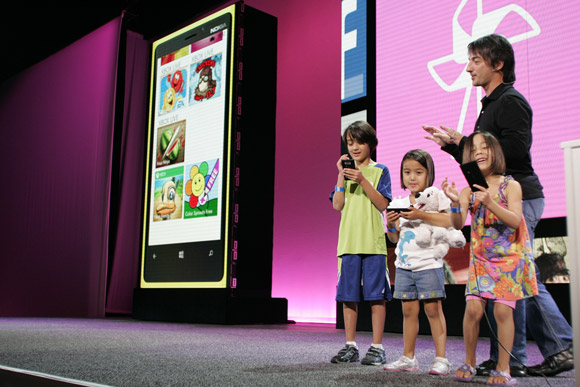
    For the family user Windows Phone 8 does have unique feature in allowing a children friendly profile called Kids Corner, where parents can quarantine the little ones from the main address books and features while allowing only certain apps to run. Unfortunately there’s only one Kids Corner so the little darlings will have to fight it out over the Angry Birds account.

    That Angry Birds app is the harbinger of where Microsoft’s multiple screen strategy will either succeed or die in the ditch as it will be the available applications which will determine whether customers will buy the device over the iPhone or Android competitors.

    Looking at the Samsung, HTC and Nokia phones that will be released running Windows Phone next month, all seem to be decent pieces of hardware although the Nokia 920 seems to be a hefty unit compared to the competition. Overall though all three phones seem to be decent competitors with their own strengths compared to the Android and Apple opposition.

    The success of Windows Phone will define Microsoft’s place in the post-PC world, now its up to the company and its partners to sell them.

    Similar posts: