Tag: motor car

  • Imagining a world with fewer cars

    Imagining a world with fewer cars

    Last weekend Uber founder Travis Kalanick told a tech conference in Munich, Germany how his company wants to take 400,000 cars off Europe’s road by the end of the year.

    On Monday, the Australian Bureau of Statistics reported the nation’s car sales were at best flat, a trend that’s been apparent for two years and one being repeated around the world as younger adults turn away from automobiles.

    The technology that defined the Twentieth Century was the motor car; it reshaped our cities, changed our lifestyles and drove the consumer economy.

    Now that economy is changing and the motor car, and consumerism in general, is in decline.

    Which leads to the thought of what our communities will look like if the motor car isn’t the defining feature?

    A challenge for governments

    One obvious answer is we won’t need as many roads and carparks so governments will have to shift their priorities towards public transit and shared car services.

    Governments are also faced with voters wanting more services closer to centres as the 1950s model of dad driving an hour to work or the 1970s model of the family driving to the shopping mall are no longer valid. This has serious ramifications for communities were land use has been zoned based upon twentieth century assumptions, not to mention their taxation bases.

    That zoning problem has ramifications for property developers as well, it’s possible to argue this is already happening as pressures mount to turn over more inner city areas to high rise buildings.

    Redefining retail

    For retailers, it means the end of suburban big box stores and more focus on smaller stores with delivery services – a trend we’re already seeing in larger cities.

    The finance industry as well is affected by the shift away from personal ownership of cars as automobile loans and leases have been a lucrative business for the last fifty years. If people are no longer fussed about owning a car then then there’s little demand for easy payment plans.

    With the motor car not being as important to people, we start to see a society with very different economic underpinnings to that we became used to in the late Twentieth Century. How do you think our communities and businesses will look in a world without cars?

    Similar posts:

  • Evolving cities and Silicon Valley’s private buses

    Evolving cities and Silicon Valley’s private buses

    One of the phenomenon of Silicon Valley’s development has been the rise of the ‘Google Buses’ – the private services run by the big tech companies to shuttle their workers between home and their workplaces.

    The Bay Area’s private bus shuttles are a real time illustration of how regions evolve around industries and economies and how cities and communities are in many ways dynamic, living creatures themselves.

    An effect of the Google Buses is that San Fransisco is experiencing a ‘reverse sprawl’ notes Eric Rodenbeck in his Wired Magazine story Mapping Silicon Valley’s Gentrification Problem Through Corporate Shuttle Routes

    It’s about more than gentrification as we’ve experienced it thus far: It’s about an entirely reconfigured relationship between density and sprawl, and it’s going to need new maps to help us navigate this landscape.

    Driving those buses is instructive as well and Buzzfeed has an interview with an anonymous driver employed by one of the bus companies.  The driver’s tale shows the scale of the phenomenon.

    This bus holds 52 people and that is 52 cars that are not on the road in one trip, and we have 70 routes in our system. That’s thousands of cars everyday.

    Driving cars is fundamental to the American – and Australian – lifestyle. The modern American city developed around the motor car and that mobility is the defining feature of the Twentieth Century.

    So maybe the Google Buses are an early part of the redefinition of our cities to meet the the needs of the 21st Century and cars are not the driving factor.

    In this vein, Jarrett’s Walker’s Human Transit blog teases out some of the issues behind these developments.

    Finally, this joke is on the lords of Silicon Valley itself.  The industry that liberated millions from the tyranny of distance remains mired in its own desperately car-dependent world of corporate campuses, where being too-far-to-walk from a Caltrain station — and from anything else of interest — is almost a point of pride.  But meanwhile, top employees are rejecting the lifestyle that that location implies.

    While I don’t agree with Jarrett’s proposition that the geeks riding these buses want to mingle with strangers given the locations they live – I’d argue they’re attracted to those locations because their peers live there and downtown amenity to good restaurants and bars – he raises a very good point about the mismatch between where the workers and the jobs are.

    Jarrett’s point touches on land use zoning and its effects on the evolution of cities. An excellent piece by Alexis Madrigal in The Atlantic tracked Silicon Valley’s iconic techonolgy sites, most of which have been demolished due to the pollution partly caused by zoning requirements for underground tanks.

    The issue of zoning is also raised by Rodenbeck who points out that zoning issues with carparks are what has made employee buses more attractive to the giant tech employees.

    Zoning different land uses makes sense on one level as no-one wants to live next door to a tannery, heavy metal waste dump or quarry, but there’s a risk with fixed ideas that our cities will become less responsive to economic developments, particularly in an era when people don’t want to, or can’t, dive across town to get to their jobs.

    What Silicon Valley’s corporate buses really show is that our cities are evolving around the needs of today, not yesterday. It’s something governments, businesses, investors and communities should keep in mind.

    Image of Google shuttle bus stop from David Orban through Flickr

    Similar posts:

    • No Related Posts
  • Towards the post car society

    Towards the post car society

    We don’t often think about it, but the design or our cities reflect the technologies of the day. Right now the way we live is built around the motor vehicle, but are we moving into a new era?

    After a visit to Ford Australia’s Centre of Excellence For Design and Engineering, Neerav Bhatt has some thoughts on the role of the motor car in an era where people don’t have to travel to their workplaces.

    One of Neerav’s points is that car use is falling among younger workers, a trend that’s happening across the western world.

    Much of this is put down to the generations of Millennials and Gen-Ys being more interested in technology purchases rather than cars along with changing work patterns.

    A more fundamental reason could be that we’re reaching the end of the motor car era.

    If there is one technology that represents the Twentieth Century it is the motor car; the automobile has shaped our cities, our lifestyles and our culture.

    However we are now in the Twenty-First Century.

    The three eras of motoring

    Roughly speaking, we could break the Twentieth Century’s love affair with the motor car into three phases; development, consolidation and dependency.

    In the first period, the automotive industry was developing with thousands of manufacturers experimenting with the technology and production methods. At the same time governments were beginning to build road networks and communities were demanding improved links.

    By the beginning of World War II, the motor car was an important part of life but ownership was largely restricted to affluent households and business.

    Following World War II governments made huge investments in road networks and automobiles became cheaper to own.

    This gave a generation a new taste of freedom as you could go anywhere with a tank of gas. It also changed the layout of our suburbs as people could now travel further to work, allowing them to move into bigger houses on the fringe of town.

    As government investment was focused on road building, passenger train and tram networks were starved of capital with many cities abandoning their transit systems altogether.

    Suburbs built in the early to mid Twentieth Century had evolved around trams and the legacy of that can still be seen today. However customers no longer wanted to fight for parking spots on crowded streets designed for horse drawn carriages and trams.

    Responding to this developers started building supermarkets and shopping malls which became popular largely because they offered easier parking. Cheaper goods made available by improved logistics systems – another effect of the motor car – was the other main reason.

    The beginning of dependency

    With the advent of the 1970s oil shock, the role of the motor car turned from being a tool of liberation into one of dependency. The suburbs of the 1960s and 70s had been built around the assumption of universal car ownership and cheap fuel. When fuel ceased being cheap, then households budgets were affected.

    Not coincidentally after the oil shock the reversal of ‘white flight’ – the movement of the middle classes to outer suburbs – started with the gentrification of inner suburbs that had been abandoned by the working class.

    Through the 1970s and 80s the cost of owning a motor car became more expensive as governments stopped externalising the costs of maintaining roads and saw car use and petrol taxes as a revenue source.

    At the same time the obvious effects of saturating society motor cars became obvious as roads increasingly became choked and planners began to realise that building more roads only attracted more traffic.

    Times of decline

    By the turn of the Twenty-first Century technology had also started to move away from centralised offices and factories. Today technologies like the internet and increasingly 3D printing mean that workers don’t have to commute vast distances. Automation also means many levels of management are no longer necessary.

    Changing work patterns is also affecting incomes, with car ownership being expensive many employees – particularly young workers – don’t want to buy automobiles.

    This all means that the era of the motor car is coming to an end, it’s not going to vanish quickly but the decline has started.

    For business, this means the post World War II assumptions that saw the rise of the supermarket, shopping mall and big box discount store are no longer valid.

    Some managers, most notably those of doomed department stores, won’t learn these lessons and will pass into history like the stagecoach companies.

    Just as the end of the horse and carriage era saw the demise of buggy whip makers and blacksmiths, the rise of the motor car saw an unprecedented rise in wealth, employment and productivity. Not only were the lost jobs created elsewhere, but many more were created.

    While the motor car isn’t going to disappear overnight, the decline has started and our society is adapting. For business and government leaders, the task is to understand those changes and adapt.

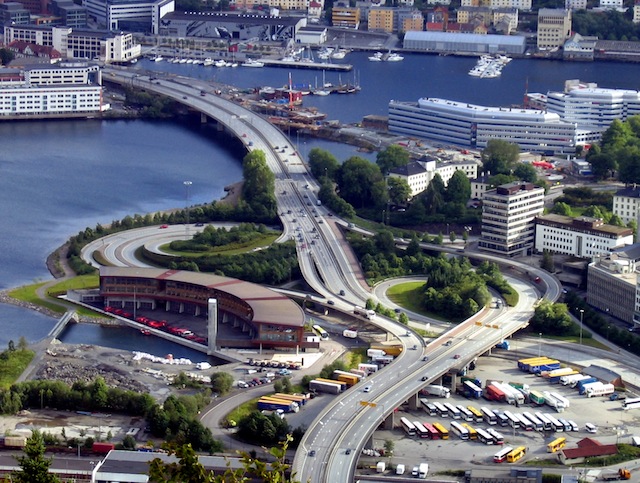
    Image courtesy of a Norwegian motorway by Ayla87 through SXC

    Similar posts:
  • I don’t get it

    I don’t get it

    “I don’t get Twitter or Facebook” says the talkback radio caller, “why would you want to tell the world what you’re having for dinner?”

    Once upon a time people didn’t get the motor car. There were many good reasons not to – compared to a horse a steam or petrol driven vehicle was expensive, unreliable and restricted in where it could go.

    The motor car ended up defining the 20th Century.

    Those who didn’t get it – like the stage coach lines and later the railway companies – eventually faded into irrelevance.

    Something we should remember though is that many of the entrepreneurs in the early days of the motor car who did “get it” went broke. As did those in earlier times building railways and canals.

    “Getting it” is one thing, but it doesn’t guarantee it will make you rich or guarantee your business’ survival.

    Similar posts: