Tag: nbn

  • Digital art is more than iPod wielding basket weavers

    Digital art is more than iPod wielding basket weavers

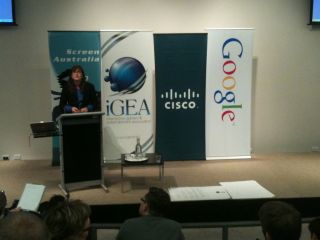
    This is a transcript of the digital arts opening keynote for the Digital Culture Public Sphere conference discussing the Australian government’s cultural strategy.

    Thank you Senator Lundy. A little bit more about me, as well as being a writer and broadcaster on change I spent 18 months with the NSW Department of Trade & Investment setting up the Digital Sydney project.

    Digital Sydneyis a program designed to raise the profile of Sydney as an international centre of the digital media industry.

    One of the problems with Digital Sydney was that it was very inner Sydney centric and this is a perennial question we face as to where does Australian culture, and art, spring from? The first idea I’d like to throw to the room is that ‘digital’ frees us from many narrow geographic boundaries.

    When we add the term ‘digital’ we hit another problem, that almost every aspect of our lives – be it in art, business or our personal lives – is being affected in some way by the Internet and digitalisation. In reality all art is becoming ‘digital’ in one way or another.

    As broadband becomes more pervasive, particularly as the National Broadband Network is rolled out, we’ll see art and the creative industries become even more digitised.

    In many ways we are today at the point in history not too dissimilar to that our great grandparents found themselves a hundred years ago. In 1911, our forebears couldn’t imagine the massive changes the century ahead would bring and we’re in a similar position in the first decades of the digital century.

    The first half of the Twentieth Century saw radio start a cultural shift which was accelerated in the second half as television radically changed and redefined our culture. Today the Internet is doing exactly the same in ways none of us quite understand.

    Given the massive disruption and technical advances we’re going through we need to be cautious about being too prescriptive as we can’t foresee many of the new technologies that will become normal to us over the next decade.

    This provides a challenge for government agencies supporting the arts as the established gatekeepers such as galleries, production studios and regional organisations become less relevant as the means of distribution evolve and become easier to access.

    We’re already seeing the traditional model of government support to big producers; be they factories, movie producers or games studios suffering as economic adjustment undermines many of their business model. The old economic development models are becoming irrelevant as history overtakes them.

    It may well be that the role of governments over the next decade is to create a framework that allows new mediums, creation tools and distribution channels to develop.

    One area we should be careful of when looking at the digital future of the arts is not to follow the UK’s Digital Economy Act where the protection of existing rights holders took precedence over the creative process.

    It is important that governments create legislative frameworks that balance the rights of all stakeholders, consumers and new content creators with the objective of encouraging new works and innovations to evolve.

    In an Australian context we need to acknowledge and develop our diverse population and the opportunities this presents. Our indigenous and immigrant communities with their artistic and cultural traditions give our national economy advantages that many other countries lack, this is one thing I regret I wasn’t able to push more in my role with the NSW government.

    Education is another critical area, this isn’t just in the arts but right across Australian society and industry as new entrants into the workplace are expected to spring forth with the skills making them as productive as experienced workers, this is clearly a flawed idea, particularly when many of the tools business expects students to be skilled in weren’t invented when the students started their studies.

    Over the next decade we’ll also have to confront one of the great Twentieth Century conceits; that artists are a separate breed from scientists, Engineers and business people.

    Prior to the beginning of the last Century it was accepted a tradesman or inventor could also be an artist and this damaging idea of silos between creative and so called ‘real’ industries, suited only to a brief period of our mass industrial development, will have to forgotten. This will be a challenge to our governments, educators and training providers.

    The digital arts are not about iPad wielding basket weavers, they about giving today’s workforce the creative tools and flexible, imaginative thinking to meet the challenges our mature, high cost workforce faces in a world where the economic rules are changing as fast as our technology.

    We have a great opportunity at events like today to determine how we as a nation will benefit from the next decade’s new technologies that will change our arts communities and society in general.

    The great challenge to policy makers will be dealing with the rapidly changing and evolving world that the digital economy has bought in the arts, in business and in society in general.

    Today I’m sure we can bring together ideas on how we, and our governments, can meet these challenges.

    Thank you very much Senator Lundy, Minister Crean and Pia Waugh for giving the community an opportunity to contribute to the development of this valuable policy.

    Similar posts:

  • How broadband won the Australian election

    How broadband won the Australian election

    In a dour and negative Australian election campaign, the National Broadband Network was the one issue separated the look alike policies of the two major parties. In the end, it decided the election.

    Privately developed communications networks are rare in the nation’s history for a combination of factors including Australia’s population distribution and commercial appetites for investment risk.

    Australian governments have always been critical to the development of regional communications, from the establishment of state operated railway networks, through the post office owned telegraph and telephone networks and eventually the road system.

    So the National Broadband Network is typical of Australian communications development where the government provides the infrastructure framework and the private sector grows around it.

    There’s no doubt regional communities understood the importance of being connected to the global economy, successive Federal governments have struggled with a patchwork of government programs such as the Universal Service Obligation and Broadband Connect in an effort to guarantee some level of service for all Australian communities.

    The NBN itself was conceived in the realisation that any solution that relied wholly on private funding was not going to deliver a national solution. This was view that regional organisations such as Digital Tasmania had held all along when agitating for their communities not being left behind.

    And Tasmania was were the vote mattered, the coalition failed to win any Tasmanian seats where three would have been won had the state followed the rest of the nation. Those three seats; Bass, Franklin and Braddon would have been enough to give the Liberal and National Parties power.

    Had the coalition focussed on the legitimate criticisms of the NBN such as the government’s failure to quantify the $43 billion price tag or NBNCo’s failure to produce a business plan then they may well have won the election.

    As the country Independents stated, the NBN was one of the key considerations in their decision to support the Labor government, so not getting their NBN policy right cost the coalition government in two ways.

    Now the NBN is going ahead we need to focus on what it can deliver, along with a sensible discussion on the right mix of fibre and wireless infrastructure, the proportion of private and public investment and exactly how much the project is going to cost.

    Now is the time to get on with building what will be the 21st Century equivalent of the roads and railways of the 20th and 19th Centuries.

    Similar posts:

  • Big, hairy broadband goals

    Big, hairy broadband goals

    fibre_opticThis column first appeared in SmartCompany. Since writing it, I’ve also done an ABC spot on the National Broadband rollout.

    The more I research and reflect on the proposal, the more I’m convinced this plan is a winner – assuming it goes ahead.

    I’m also more convinced than ever that Telstra is the big winner from the proposal as it relieves them of the Universal Service Obiligation and means they can avoid the massive costs of maintaining and upgrading the copper network. Not to mention the likelihood that the government will end up leasing space on Telstra’s existing fibre network.

    Jim Collins in his book “Good to Great” coined the phrase BHAG, or Big Hairy Audacious Goal. Few goals are bigger or more audacious than spending $43 billion to run fibre to every house, office, school, farm and factory in Australia.

    My first reaction to the national broadband plan was disappointment – on Twitter I commented “there goes the Rudd Government’s final strand of tech credibility.”

    Having had time to think about the plan, it’s clear I was wrong. The announcement is a huge change in policy and it will have immense ramifications on how we do business.

    Fibre-to-the-premises completes the gaps in our communications systems. When the rollout is complete, we can rely on our internet links and assume our customers and employees have the same dependable connections.

    For regional enterprises this is great news, as it will bring the world to the door to some of Australia’s best industries and businesses. It levels the playing field between big and small businesses, regardless of their location.

    For Telstra, the result is mixed. While it means more competition in regional areas, it also means it can save billions on upgrading the aging copper network. The criticism of the rollout’s cost ignores the massive replacement cost already required to replace the old phone lines.

    While perhaps not good news for management, the proposed break up of Telstra is good for shareholders. Sensis and BigPond, for example, would be worth far more when not shackled to a company fixated on maximising revenue from a ramshackle copper network.

    Another great change is in Canberra’s communications policy. Australia has suffered from communications and media being tied together, with the interests of well connected commercial groups being more important than good planning.

    The Keating government’s disastrous cable TV rollout was an attempt to provide modern infrastructure while appeasing the dominant media tycoons who saw technology as a threat to their empires.

    As a result we got a mess and the cable TV networks, which could have provided this infrastructure 15 years ago became a political and financial quagmire, which delivered little of what was promised.

    We shouldn’t understate the social benefits of the plan either. As the recession bites, the need for skilled and unskilled labour to build the rollout will assist in keeping unemployment down.

    It’s certainly billions of dollars better spent than propping up shopping centre developers, banks or the manufacturers of cars that no-one wants.

    The biggest change though is ideology. Until now, it’s been difficult to imagine a government proposing a massive infrastructure project without the ticket clippers of the merchant banks and other cronies skimming a fat share.

    In every respect, this is the best communications plan and one of the most visionary ideas we’ve seen out of Canberra in generations. While it’s going to cost, history will show it’s money well spent.

    Whether the broadband rollout becomes reality or not, fast, reliable communications are already a business necessity and will become even more so.

    Think about what fast broadband means for your business and plan how you can take advantage of it. Those who don’t grasp the opportunities are going to be left behind.

    So have a think about it. You might come up with some BHAGs of your own.

    Similar posts:

    • No Related Posts
  • The broadband explosion

    For a typical exciting Sunday afternoon, I’ve been trolling through the Telstra annual report.

    One statistic that leaps out at me is the growth in consumer broadband subscribers of nearly 60%, even if we assume all the 373,000 customers who ditched their dial up plans went over to broadband, that’s still a whopping 35% growth in customers.

    According to the Australian Bureau of Statistics, the nine month growth in consumer broadband connections from June 2006 to March 2007 (not quite the same period) was 46%.

    The decline in dial up connection was 26% over the nine months, as opposed to Telstra’s decline of 36.3% over the twelve months.

    Interestingly, Telstra’s dial up decline would have been greater if their systems allow customers to transfer their existing dial up email address to broadband. As it stands, they have to retain their dial up account and we steer customers to Bigpond’s Casual User Plan as a cheap way of doing this.

    So Telstra’s performance isn’t out of the line with the industry. What it does show is the massive take up of broadband. It’s also profitable, as Telstra’s report also shows their income has grown by over 66%.

    Over the next few weeks I’ll have a look at how other providers are doing. It will be interesting to see how others are performing.

    Similar posts: