Tag: politics

  • Being an industrial revolutionary

    Being an industrial revolutionary

    “The future isn’t pre-determined, technology doesn’t come from some outside force. It’s created by us. Some people have more power than others in that system, such as the big tech entrepreneurs, but at the end it’s people and organisations that have the power.”

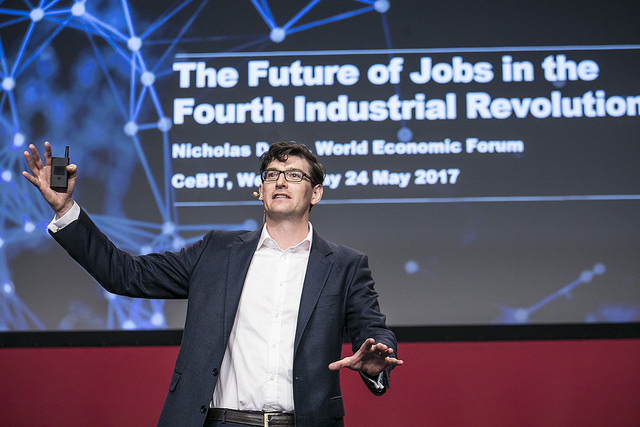
    Nicholas Davis, the World Economic Forum’s Head of Society and Innovation, was discussing at the recent Sydney CeBIT conference how we can take control of the digital economy and where workers fit into an increasingly automated world.

    Technology and online platforms aren’t neutral system, Davis observes. “It’s not just about how we use them, but the values that are designed into the systems, technology is not just a neutral thing. During a conversation like this if I put my iPhone between us, it’s proven that reduces our memory of that discussion and our sense of connection.”

    Politics and addiction

    “The purpose of the technology, the design of it, affects us in different ways.” Davis says, “if we design technologies for addiction, if we design business models that involve us being sucked into systems at the expense of other things in our lives, then that is a value choice that companies make and that we as users are trading off in our lives.”

    “In understanding that technology is not neutral then the question is how we, as revolutionaries have that political discussion? I don’t mean political like ‘Left’ and ‘Right’ but these are value decisions that we need to engage with.”

    “The difficulties about having discussions about technology is not getting sucked into a left-right divide and letting one group of people own innovation, but to say what do we want, How do we get there and how do we avoid the mistakes of previous industrial revolutions where the environment suffered, kids suffered and vulnerable populations suffered.”

    A change in thinking

    “One of the biggest problems is we don’t have regulatory or even democratic institutions where we can make collective decisions about technologies,” says Davis.

    “The average AI researcher, at the top of their game anywhere in the world, would only understand a small percentage of the AI space. So how do you expect a politician or a voter, to come to grips with it.”

    One of the key discussions missing in the public sphere is around automation and concepts like the Universal Basic Income, Davis believes. “We should have a serious chat about giving everyone the space to build up their skills.”

    In the development policy, Davis sees growing inequality and applying last century’s thinking to today’s challenges as among the biggest risks facing governments and communities.

    Rippling beyond business

    For business, the imperative is to recognise the effects of decisions on the wider community.

    “The big thing for business is understanding the technology decisions you make have a ripple effect beyond your company, you need to look forward to new ways of value adding.”

    Davis warns we are seeing a backlash against innovation and technology with concerns about privacy and security growing.

    “So much of the world is build on their use of data. Most companies and organisations don’t have good data hygiene or ontology to classify their information. People say data is their greatest assets – some say it’s the new oil – but it’s also their greatest liability. So understanding information security at the board level is critical.”

    The power of individuals

    For individuals, Davis believes the power lies with us in the choices we make as consumers.

    “Don’t underestimate your own power, but also don’t underestimate that more and more products around us are designed to influence our behaviour in ways we need to be aware of.”

    “In most cases, if the product is free then you and your data are the product, understand that and on what terms is important.”

    Conscious choices

    “Understand the externalities of these services as well. Appreciate the effects it has on your family, your mental health, on the ability to connect is important. Being able to make conscious choices about these things.”

    “Supporting open data standards and competition – not just accepting Android or Apple for instance – rather than allowing politicians and big business to fight over these things.”

    So in Davis’ view being an ‘industrial revolutionary’ in the digital era is a matter of being an informed, and empowered, consumer. Will that be enough?


    Similar posts:

  • Roger Ailes’ legacy

    Roger Ailes’ legacy

    The passing of Roger Ailes, former NIxon advisor and founder of Fox News, is an opportunity to reflect on how the media has evolved over the past forty years.

    Ailes’ work shows how click bait, fake news and filter bubbles are not products of the world wide web but pre-date it by at least twenty years with the rise of tabloid television and the modern version of yellow journalism designed to scare people.

    While the web and social media proved wonderful ways to spread such messages, it was the arrival of programs  like A Current Affair twenty years earlier in the United States and reporters like Steve Dunleavy who changed popular journalism and taught us to fear our neighbours.

    The results of that have been profound in everything from kids not walking to school any more to the magnificently wasteful prison systems all of the English speaking countries have built in response to hysteria over crime rates.

    Ailes and his colleagues found a successful media model that attracted viewers and advertisers which set the pattern for today’s febrile environment of fake news and filter bubbles that have ushered in the most unstable and reactionary political climate since the early 1930s.

    Where we go next remains to be seen, it’s a shame Ailes won’t be around to pay the price of his works.

    Similar posts:

    • No Related Posts
  • Labor’s pitch to repair Australia’s broken technology dreams

    Labor’s pitch to repair Australia’s broken technology dreams

    “It’s like we lived through five minutes of innovation sunshine,” says Federal shadow treasurer Chris Bowen about the Australian government’s innovation policy.

    Bowen was appearing at the Future of Innovation panel at Sydney’s Stone and Chalk fintech hub with his colleague Ed Husic where laid out the Labor Party’s platform for the tech industry and the changing workforce.

    Both Husic and Bowen represent Western Sydney electorates which, along with outer suburban Melbourne, are key election battlegrounds and the districts dealing with most of Australia’s surging population growth.

    Uneven spoils

    As Bowen indicated in his speech, those regions haven’t shared in the country’s economic growth over the past ten years.

    Some parts of the Australian economy are doing well.  Other parts are doing it tough.

    Half of all the jobs created in Australia in the last decade have been created right where we are: in a two kilometre radius of the Sydney and Melbourne CBDs.

    The economy feels good from this vantage point.


    Not understanding the mismatch between different parts of the economy was one of the failures of the government’s 2015 Innovation Statement. The multi million dollar advertising campaign was full of fine buzzwords but none of the rhetoric resonated with the broader electorate, something not helped by the Prime Minister retreating from his policies at the first opportunity.

    Spreading the gains

    Bowen and Husic made a good case for their policies being focused on the wider population as a changing workforce is going to affect all parts of the economy.

    So I spend a lot of time travelling to and talking to people in regional economies.  It doesn’t feel as good there.

    Regional central and North Queensland. Tasmania. South Australia.

    Here, unemployment and youth unemployment are high and show no signs of budging.

    So Bowen’s commitment for his party to work on innovation, education and industry policies that help suburban and regional Australia – not just the leafy bits of upper middle class Sydney and Melbourne – is welcome and essential for the nation.

    Refreshingly Bowen also acknowledged many of the jobs that currently exist in suburban and regional Australia are very likely to be automated and that education, reskilling and investment are all critical factors in dealing with employment shifts.

    A familiar tale

    However we have heard this before, the Rudd Labor government came in with high hopes when it was elected in 2007 which it quickly dispelled and then compounded its errors with cancelling the COMET commercialisation program and making a mess of employee option schemes.

    Given this history of poorly conceived thought bubbles posing as policy, this writer asked (or rather begged) Bowen to consult with industry and the community before announcing major policy changes – something both parties have become notorious for.

    In answer to the comment about consulting with the electorate before substantive policy changes, Bowen suggested a Shorten ALP government will be requiring senior public servants to be more engaged with industry.

    Suggesting that senior public servants should engage with the community and industry is a good idea. That the idea is seen as revolutionary illustrates the problem found by former Digital Transformation Office boss Paul Shetler when he arrived in Australia with the country’s top bureaucrats being isolated and aloof from the citizens they deign to rule. This isolation is in itself a challenge facing Australian governments.

    Memories of earlier oppositions


    The Sydney tech community’s lauding Husic and Bowen bought back some memories. Fifteen years ago Australian technologists  were doing the same thing with another Labor shadow spokesperson, Kate Lundy. We ended up with factional warriors Stephen Conroy and Kim Carr when Labor finally won. While both were no doubt wonderful at delivering the numbers to party faction warlords their understanding of the changing economy was marginal at best.

    While the Rudd government at least paid lip service to the Twenty-First Century, unlike the Howard government which was firmly focused on taking Australia back to the 1950s – with some degree of success it should be said, the Labor Party did little apart from getting the National Broadband Network underway.

    In opposition, the Liberal Party too made similar noises however communications spokesperson Paul Fletcher, like Lundy, has been marginalised since winning power and Paul Keating’s description of Malcolm Turnbull as ‘Fizza’ has never seemed more apt since Malcolm became Prime Minister.

    For Australians hoping some of the Lucky Country’s luck would be applied to the nation’s tech sector, government policies from both parties have been a succession of broken dreams.

    Husic and Bowen are promising this time it will be different. Many of us hope it will be, it may be the last chance for Australia to have a fair economy fit for the 21st Century.

    Similar posts:

  • When governments misuse data

    When governments misuse data

    Last year the Australian Federal government had a smart idea. To fix its chronic budget deficit, it would use data matching to claw back an estimated three billion dollars in social security overspending.

    Unfortunately for tens of thousands of Australians the reality has turned out to very different with the system mistakenly flagging thousands of former claimants as being debtors.

    How the Australian government messed up its welfare debt recovery is a cautionary tale of misusing data.

    Data mis-match

    At its core, the problem is due to the bureaucrats mismatching information.

    Australia’s social security system requires unemployment or sickness benefit claimants file a fortnightly income statement with Centrelink, the agency that administers the system, and their payments are adjusted accordingly.

    Most of those on benefits only spend a short time on them. According to the Department of Social Services, two thirds of recipients are off welfare within twelve months of starting.

    Flawed numbers

    Despite knowing this, the bureaucrats decided to take annual tax returns, average the individual’s income across the year and match the result against the fortnightly payment.

    That obviously flawed and dishonest method has meant hundreds of former welfare recipients have been falsely accused of receiving overpayments.

    Compounding the problem, the system frequently mis-identifies income because it fails to recognise employers may use different legal names, leading to people having their wages double counted and being accused of not reporting work.

    Shock and awe

    Under pressure from their political masters, the aggressive tactics of Centrelink and its debt collectors have left many of those accused shocked and distressed.

    I can barely breathe when I think about this. My time period to pay is up tomorrow. I asked them for proof before I pay and I have heard horror stories of debt collection agencies, people being asked to pay so much, people being told there will be a black mark on their credit. I am so terrified. It’s so stupid for me to be terrified but I can’t help it. I am a student, I can’t afford anything!

    Reading the minister’s response to criticisms, it’s hard not to come to the conclusion that intimidation was a key objective.

    The numbers of people involved are staggering. The department of Social Services reported 732,100 Australians received the Newstart unemployment allowance in 2015-16. Should 66% of those have moved off the benefit during the tax year then up to 488,000 people will receive ‘please explain’ notices.

    Nearly half a million people being falsely accused of welfare fraud is bad enough, but that is only last year’s figures – due to a  law change by the previous Labor government, there is no limit to how far back Centrelink can go to recover alleged debts.

    The System is working

    Claiming the Centrelink debacle is a failure of Big Data and IT systems is wrong – the system is working as designed. The false positives are the result of a deliberate decision by agency bosses and their ministers to feed flawed data into the system.

    How this will work out for the Australian government as tens of thousands more people receive unreasonable demands remains to be seen. Recent comments from the minister indicate they are hoping their ‘tough on welfare cheats’ line will resonate with the electorate.

    Regardless of how well  it turns out for the Australian government, the misuse of data by its agencies is a worrying example of how governments can use the information they collect to harass citizens for short term political advantage.

    Beyond welfare

    While many Australians can dismiss the travails of Centrelink ‘clients’ as not concerning them, the same data matching techniques have long been used by other agencies – not least the Australian Taxation Office.

    With the Federal Treasurer threatening a campaign against corporate tax dodging and the failure of the welfare crackdown to deliver the promised funds, it’s not hard to see small and medium businesses being caught in a similar campaign using inappropriate data.

    More importantly, the Australian Public Service’s senior management’s incompetence, lack of ethics and proven inability to manage data systems is something that should deeply concern the nation’s taxpayers.

    In a connected age, where masses of information is being collected on all of us, this is something every citizen should be objecting to.

    Similar posts:

  • Connecting 400 points of voter data

    Connecting 400 points of voter data

    As the 2016 US Presidential race enters its final stages, it’s interesting to see how data is being used by American political candidates and what this means for business.

    During last week’s Oracle Open World in San Francisco a panel hosted by the company’s Political Action Committee featured Stephanie Cutter, who worked on Obama’s 2008 and 2012 campaigns, and Mike Murphy, a Republican operative whose most recently worked on Jeb Bush’s primary effort against Donald Trump.

    While the discussion mainly focused on the politics – “Crazy times seem to require crazy candidates” says Murphy – it was the technology aspect of modern elections that was notable.

    Setting the data standard

    The Obama campaign of 2008 set the standard for how modern political campaigns used social media and information, “we revolutionized how data analytics helps predict how people will vote and how they will persuade voters to turn out.” Cutter said.

    “We put a big investment into it and Republicans have caught up,” she continued. “The key though was we relied on our own data and nothing that was out in the public domain. We didn’t rely on one piece of data, we had multiple sources. We had an analytics program where we were making 9,000 calls a night where we were predicting the votes.”

    Murphy agreed with the political campaigns using data, “the kind of polling you see in the media has kind of vanished in campaigns where they have money to spend on research.” He said, “we don’t do telephone polling any more because we have so much data we can collect.”

    Capturing everything

    “We capture everything. We have about four hundred data points on the American voter and we’ll have five hundred in the next two years. We’ll be able to build massive data models without phone polling,” Murphy pointed out. “We’re waiting for the tech folk to get ahead on AI so we can predict what voters are going to do in two weeks.”

    Despite the amount data collected by US political parties, the real key to success is the candidate’s organisation and management. Cutter made a strong point about the strength of Obama’s campaign team in both the 2008 and 2012 campaigns.

    How the US political parties use data points to how businesses will be managing data in the future. Increasingly using information well is going to be the measure of successful organisations in both politics and industry.

    Similar posts:

    • No Related Posts