Tag: politics

  • Australia’s grapes of wrath

    Australia’s grapes of wrath

    In a great post, The Wine Rules looks at what ails the Australian wine industry after the news of Cassella Wine’s problems.

    Three things jump out of Dudley Brown’s article – how industry bodies are generally ineffectual, the failure of 1980s conglomerate thinking and how fragile your position is when you sell on price.

    Selling on price

    It’s tough being the cheapest supplier, you constantly have to be on guard against lower cost suppliers coming onto the market and you can’t do your best work.

    Customers come to you not because you’re good, but because you’re cheap and will switch the moment someone beats you on price.

    Worse still, you’re exposed to external shocks like supply interruptions, technological change or currency movement.

    The latter is exactly what’s smashed Australia’s commodity wine sector.

    A similar thing happened to the Australian movie industry – at fifty US cents to the Aussie dollar filming The Matrix in Sydney was a bargain, at eighty producers competitiveness falls away and at parity filming down under makes no sense at all.

    Yet the movie industry persists in the model and still tries to compete in the zero-sum game of producer incentives which is possibly the most egregious example of corporate welfare on the planet.

    When you’re a high cost country then you have to sell high value products, something that’s lost on those who see Australia’s future as lying in digging stuff up or chopping it down to sell cheaply in bulk.

    Industry associations

    “It’s like a Labor party candidate pre-selection convention” says Brown in describing the lack of talent among the leadership of the Australian wine industry. To be fair, it’s little better in Liberal Party.

    There’s no surprise there’s an overlap between politics and industry associations, with no shortage of superannuated mediocre MPs supplementing their tragically inadequate lifetime pensions with a well paid job representing some hapless group of business people.

    Not that the professional business lobbyists are any better as they pop up on various industry boards and government panels doing little. The only positive thing is these roles keep such folk away from positions where they could destroy shareholder or taxpayer wealth.

    Basically, few Australian industry groups are worth spending time on and the wine industry is no exception.

    Australia conglomerate theory

    One of the conceits of 1980s Australia was the idea that local businesses had to dominate the domestic market in order to compete internationally.

    A succession of business leaders took gullible useful idiots like Paul Keating and Graheme Richardson, or the Liberal Party equivalents to lunch at Machiavelli’s or The Flower Drum, stroked their not insubstantial egos over a few bottles of top French wine and came away with a plan to merge entire industries, or unions, into one or two mega-operations.

    It ended in tears.

    The best example is the brewing industry, where the state based brewers were hoovered up in two massive conglomerates in 1980s. Thirty years later Australia’s brewing industry is almost foreign owned and has failed in every export venture it has attempted.

    Fosters Brewing Group was, ironically, one of the companies that managed to screw the Australian wine industry through poorly planned and executed conglomeration. Again every attempt at expanding overseas failed dismally.

    In many ways, the Australian wine industry represents the missed opportunities of the country’s lost generation as what should have been one of the nation’s leading sectors – that had a genuine shot at being world leader – became mired in managerialism, corporatism and cronyism.

    All isn’t lost for the nation’s vintners or any other Aussie industry, Dudley Brown describes how some individuals are committed to delivering great products to the world. There’s people like them in every sector.

    Hopefully we’ll be able to harness those talents and enthusiasm to build the industries, not just in wine, that will drive Australia in the Twenty-First Century.

    Picture courtesy of Krappweis on SXC.HU

    Similar posts:

  • Revolution and disconnected leaders

    Revolution and disconnected leaders

    China expert Patrick Chovanec has a provocative blog post on What Causes Revolutions, building upon the Financial Times’ description of how the Chinese Communist Party is struggling with corruption.

    In his article Chovanec quotes Richard Pipes’ Three “Whys” of the Russian Revolution which looked at how the fall of the Tsarist government was largely unexpected.

    This is true with the fall of all great regimes, in the late 1980s the idea that the Soviet Union would cease to exist within a decade was unthinkable.

    Chavonec quotes a key part of Pipes’ book;

    In 1982 [Pipes writes], when I worked in the National Security Council, I was asked to contribute ideas to a major speech that President Reagan was scheduled to deliver in London.  My contribution consisted of a reference to Marx’s dictum that, when there develops a significant disparity between the political form and the socio-economic context, the prospect is revolution.

    “A significant disparity between the political form and social-economic context” could be just as applicable to Western democracies.

    The Economist article makes a point about the French revolution “the widely accepted theory now is that the French Revolution was one of rising expectations that eventually could not be met.”

    As Stratfor’s George Freedman pointed out last week, a generation of Americans have expectations that are not going to be met. The same is true in Europe.

    While there’s no doubt the China’s political structures – like those in all totalitarian nations – are more brittle than those in established democracies, it might not be a good idea for those of us in the West to be smug and complacent about our own systems.

    Zapata image is courtesy of Ferferfer through SXC.

    Similar posts:

  • Life in the mob

    Life in the mob

    The reaction to last week’s tragic passing of a nurse over a hoax phone call shows how hysteria and cynicism in new and old media fuel each other.

    Having created villains, in this case the two hapless Sydney radio hosts, the mainstream media creates a moral outrage to stir up the mob which in turn generates more headlines.

    As with the Hillsborough tragedy, this allows those in positions of responsibility the opportunity to avoid scrutiny and accountability.

    In this case we see the hospital management demanding action being taken against the Sydney duo while conveniently ducking questions about why poorly paid nurses are expected to act as switchboard operators on top of their already considerable responsibilities.

    Now we’re seeing calls to make practical jokes illegal – no doubt there’ll be a wave of teenage boys being prosecuted for making prank phone calls when panicked politicians pass poorly drafted laws to deal with the ‘problem’.

    Our taxes at work.

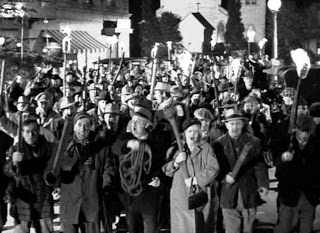
    Your mission in life is to use your brain and not to be one of the torch bearing mob.

    If it’s you the mob are looking for, then it’s best to lie low until another headline or something shiny distracts them.

    Similar posts:

  • Stumbing into recession

    Stumbing into recession

    The Committee for Economic Development Australia (CEDA) today released its 2012 Big Issues survey looking at the responses of 7000 business people on the issues confronting Australian industry in 2012.

    One of the notable results is that business people don’t care about government surpluses. A third are neutral on the question “do you believe maintaining a government surplus is important” while 35% disagree that it is a high priority.

    Q10

    Yet despite the electorate and business saying the deficit is not a priority, the politicians still obsess about maintaining their surplus.

    Now Australia’s mining boom has come to an end – along with the blue sky economic assumptions that underlie both sides of politics’ spending plans – governments are desperately trying to fudge the books and continue the pretense that their budgets are in the black.

    Driving this obsession with avoiding deficits is the religious belief among Australia’s political classes that Triple – A credit ratings from the discredited Wall Street ratings agencies is more important than educating the nation’s children, caring for the country’s sick or building the infrastructure to compete in the 21st Century.

    The real danger with this deficit obsession is that there is a very high possibility that state and Federal governments are going to tip Australia into a recession driven by European style austerity. Already we see this developing as various states start slipping backwards according to the ABS’ latest accounts.

    graph courtesy of Macrobusiness

    Another interesting result from the CEDA report is how business’ view the Australia in the Asian Century report with nearly 80% of respondents saying the issue is important or critical.

    It is questionable whether Australian business is prepared to face the realities of an Asian Century as David Llewellyn-Smith writes at the Macro Business Blog, Australia’s businesses are looking more at getting help from the government to cut domestic costs rather than sell into Asia. That inward focus of Australian business since the mid-1990s is the topic for another blog post.

    The sad thing is that the government aspects of Asian Century report is stillborn as surplus obsessed politicians carve into skills training and innovation programs in a vain attempt to balance the books while failing to reform the tax system or address the middle class welfare that’s squandered most of the returns from the last decade of prosperity.

    Australia’s politicians are very soon going to have to decide who they govern on behalf of, the corrupt and incomptent ratings agencies or the people who vote for them and pay the taxes which support them and their political parties. For some, this might be a tough choice.

    Similar posts:

  • Australia in the Asian Century – Chapter Five: A productive and resilient Australian economy

    Australia in the Asian Century – Chapter Five: A productive and resilient Australian economy

    This post is one of the series of articles on the Australia in the Asian Century report.

    Chapter five of Australia in the Asian Century looks at the domestic settings the nation needs to achieve the “2025 apirations” described in Chapter Four.

    To do this lays out a number of national objectives to achieve Australia’s 2025 Aspirations which are at least ambitious. These include education, innovation, infrastructure, communications and tax.

    Education

    National objective 1: All Australians will have the opportunity to acquire the skills and education they need to participate fully in a strong economy and a fairer society.

    Probably the most worthy of the report’s objectives is to improve the nation’s already good level of education. Unfortunately the detail in the report is lacking beyond rehashing existing programs.

    These programs do cover important initiatives such as improving literacy rates amongst the disadvantaged which is essential if Australia is going to address its poor participation rates which are going to be one of the major domestic challenges for the country in the 21st Century.

    At the other end of education though there is little more than empty words as the discussion of workforce training is rendered hollow by the decision to further cut back apprenticeship training and universities find their funding continually reduced making it less likely they can get into the world’s top rankings.

    Most importantly, there is little space given to addressing Australia’s poor performance in the STEM – Science, Technology, Engineering and Mathematics – subjects.

    Innovation

    National objective 2: Australia will have an innovation system, in the top 10 globally, that supports excellence and dynamism in business with a creative problem-solving culture that enhances our evolving areas of strength and attracts top researchers, companies and global partnerships.

    More fine words but this commitment to ‘innovation’ is again hollow when the Federal government cuts commercialisation incentives and export program.

    Any talk of encouraging innovation is pointless anyway without reforming the nation’s tax system which currently favours asset speculation over building productive businesses and products – we’ll come to the tax impasse later.

    Infrastructure

    National objective 3. Australia will implement a systematic national framework for developing, financing and maintaining nationally significant infrastructure that will assist governments and the private sector to plan and prioritise infrastructure needs at least 20 years ahead.

    This section is a sour sick joke which illustrates all that is wrong with Australian governments at all levels. Infrastructure planning for the next 20 years should largely be in place now and the fact it seen as being a national objective by the authors of this report

    At best this section of the report reads like an ode to the corporatist ideologies of the 1980s and in fact illustrates exactly where Australia lost its way in the 1990s as the country’s business leaders realised that Asia was too hard when there were easy pickings in convincing gullible Liberal and Labor governments into selling assets cheaply and exploiting the resultant monopolies.

    Communications infrastructure

    National objective 4. Australia’s communications infrastructure and markets will be world leading and support the rapid exchange and spread of ideas and commerce in the Asian region.

    This is a fine objective and may be achievable if the National Broadband Network is rolled out on time and isn’t affected by poor management decisions or gutted in an act of political bastardry by a future Liberal government.

    Hopefully this is one are where actions will meet the the report’s words.

    Taxation

    National objective 5. Australia’s tax and transfer system will be efficient and fair, encouraging continued investment in the capital base and greater participation in the workforce, while delivering sustainable revenues to support economic growth by meeting public and social needs.

    In 2007 the then Labor Prime Minister Kevin Rudd appointed Ken Henry to review the Australian tax system. That report was comprehensively ignored and the effects of the political bumbling around that lead to Rudd’s axing as Prime Minister and Gillard’s incompetent half-baked Mining Tax.

    To have an efficient and fair tax system which encourages investors and workers should be a given. That it has to be spelt out, and then ignored, probably illustrates the greatest failure of Australia’s political and business leaders.

    Australia’s current tax system is probably the economy’s greatest weakness as much of the resilience boasted of in the report is based around stimulating the housing market, the wealth effect in turn is reflected in the country’s affluence measures.

    Reforming the Australian tax system to favour workers and investors over property speculators is going to require great strength by the politicians who attempt to do it and they’ll need the reform of business leaders and the financial media. None of these three groups have the courage or integrity to be trusted to carry this out in the next 15 years.

    Reforming regulation

    National objective 6. Australia will be among the most efficiently regulated places in the world, in the top five globally, reducing business costs by billions of dollars a year.

    Possibly the greatest hubris in today’s Australia is about the efficiency of the nation’s regulators. In reality Australia is a country that’s quick to legislate but slow to regulate.

    We’re very good at passing laws and regulations, not to mention building bureaucracies of thousands of memo writers to oversee these rules, but we aren’t very good at actually enforcing them.

    Real reform in regulation is essential to a resilient Australian economy, but like taxation reform this is a complex and thankless task for any politician who attempts it.

    Sustainability

    National objective 7. The Australian economy and our environmental assets will be managed sustainably to ensure the wellbeing of future generations of Australians.

    A worthy objective – unfortunately the ideological war that saving the Murray-Darling has become, the bitter argument over the carbon tax and Australia’s rejection of clean tech entrepreneurs makes one wonder exactly where the country can have a competitive advantage in this area.

    One rare note of warning with this report identifies sustainability issues as affecting Australia’s ability to supply food to the growing Asian economies. This is a fair warning but its unlikely opportunistic politicians at all levels care too much to distract them from politicising discussion on the sustainability of various Australian communities and industries.

    Sound economic policies

    National objective 8. Australia’s macroeconomic and financial frameworks will remain among the world’s best through this period of change.

    Approaching this section fills one with dread at the prospect with being served up with more hubris wrapped around Australian exceptionalism.

    While the section doesn’t disappoint in this aspect, the writers have identified serious weaknesses in the funding structures and regulation in the capital markets. This probably reflects Ken Henry’s background in the Treasury.

    The not unexpected emphasis on AAA credit ratings and the size of the Australian superannuation industry make one wonder why we bother with restrictive economic policies when we clearly have the capacity to fund productive national investment.

    All the criticisms of the earlier parts of this chapter flow from this bizarre form of Australian Austerity that has crippled investment in education and infrastructure over the last thirty years and ditching that mentality could be the greatest reform of all.

    Every objective objective in the chapter is worthy and true, but state and Federal government actions are acting directly in the opposite direction to the stated intentions of the chapter. The introduction says;

    We have made substantial reforms and investments across the five pillars of productivity—skills and education, innovation, infrastructure, tax reform and regulatory reform—and these efforts will continue.

    This is not true – in almost every single one of these areas, Australia has been at best treading water. Just in the weeks before this report was released the Federal government’s mini-budget further cut innovation incentives.

    The New South Wales government announced in the week the report was released that it would de-skill the state’s workforce even further by following the TAFE “reforms” introduced by Victoria and Queensland which have seen industry training reduced to churing out pointless barista and nail grooming certificates.

    At the same time, the regulation “reforms” introduced by successive Liberal and Labor governments at state and Federal levels have followed the 1980s ideologies of gifting assets to ticket clipping managerial and banking classes. Nowhere is this more apparent in the debacle of Australia’s soaring power bills which are becoming a real competitive disadvantage to the nation.

    Infrastructure is probably the biggest failure of successive governments, the same corporatist ideologies of the Liberal and Labor Parties of the last 30 years have prevented the construction of infrastructure beyond toll roads which favour the same ticket clipping bankers.

    Much of Australia’s core transport infrastructure such as power companies, railways and ports have been sold off to the ticket clippers who have in turn “sweated” these assets by charging monopoly prices while spending the bare minimum to keep them running.

    At present Australia has a resilient and productive economy, as did Ireland and Spain before the economic winds turned against them. It’s hard not to think that if a similar report had been written in Madrid or Dublin five years ago the same chapter would have read much the same as Australia’s today.

    The big challenge will come for Australia when China, India, South Korea or Japan hit a tough spot.

    Even with the rose glass projections of the previous three chapters of Australia in the Asian Century, it’s at least reassuring there are a few notes of warning in this section of the report.

    Similar posts: