Tag: politics

  • We came, we saw, we were ripped off.

    We came, we saw, we were ripped off.

    One bad schnitzel on Queensland’s Gold Coast illustrates the biggest economic problem facing Australia.

    As we approach the 2013 Australian election, it’s notable how the debate – if it can be described as that – hasn’t touched on the biggest issue facing the country, the hollowing out of the nation’s economy.

    In the 1980s the Gold Coast was going to be the centre of a Japanese led tourism boom.

    That boom petered through a combination of greed and incompetence on the part of Australian tourism and hotel operators, a process being repeated with Chinese tourists twenty years later.

    Like the rest of the Australian economy, in the 1990s the Gold Coast looked inwards with a focus on property speculation and construction that kept the workforce employed pouring concrete and fitting out kitchens.

    In the meantime, the Gold Coast’s tourist assets were left to rot through under investment. Jupiter’s Casino is a good example of this, a building stranded in the 1980s and in desperate need of a capital injection.

    The Gold Coast was not alone in this, a review of Perth’s Rendezvous Grand Hotel — built by Alan Bond in the 1980s — illustrates exactly the same problem at the other end of the country.

    A lack of investment plagues all of Australia’s hospitality industry, a dinner at the Bavarian Bier Cafe on the Gold Coast’s Broadbeach* was a disaster as poorly trained staff were overwhelmed by a half full establishment and let down by poor business systems.

    That shocking meal — which saw the staff struggle to get out a salad and two beers in over two hours with the greasy, overcooked mains arriving nearly three hours after the diners arrived — is not untypical in Australia.

    Soviet style service is fine when beer and a poorly cooked, mostly breadcrumbs, schnitzel costs fifty kopecks, however at modern Australian prices the service, food and cooking should be world’s best.

    That high prices rarely translate to superior standards in Australian establishments shows how poorly the nation has adapted to being a high cost nation.

    While it’s fashionable to blame the mining industry for the down under manifestation of the Dutch disease, the answer to what has driven Australia’s under investment in tourism, agriculture and manufacturing lies in the cities and suburbs.

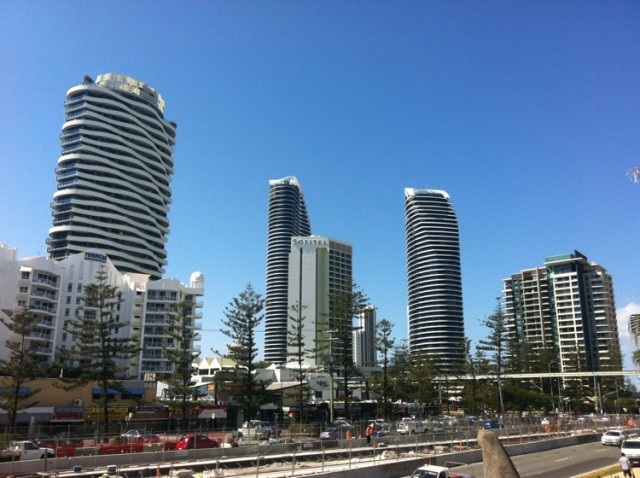
    On the same day as the disastrous Bier Cafe meal, the Gold Coast media was reporting that relaxed zoning restrictions would allow unrestricted high rise building heights.

    While the real estate industry welcomed this, the reality for local property speculators hasn’t been pretty with buyers in the twin tower Gold Coast Hilton development being hit with forty percent losses.

    Part of the reason for the poor performance in property speculation is that Gold Coast industry has been hollowed out with local office vacancy rates varying between 27 and 14% percent.

    While much of the rest of Australia’s property markets have been spared similar declines to date, the emphasis on real estate speculation over investment in industry has been similar across the nation.

    That lack of investment in productive industries, whether in tourism or manufacturing is already hurting Australia,  more critically it’s preventing Australian businesses’ from dealing with the transition to being a high cost economy more akin to Switzerland, Japan or Germany than the United States.

    One bad schnitzel on the Gold Coast might not tell us much in itself, but the under investment in systems, training and staff is a bad omen for Australia’s economy.

    Regardless of who wins Australia’s federal election on Saturday, it’s unlikely the group of pampered apparatchiks occupying the Treasury benches will have any idea of helping business or society transition to the realities of the Twenty-first Century.

    *Paul travelled to the Gold Coast and ‘dined’ at the Broadbeach Bavarian Bier Cafe as a guest of Microsoft Australia
    Similar posts:

  • Enniskillen and the G8’s Potemkin Village

    Enniskillen and the G8’s Potemkin Village

    In the middle of this month the G8 group of world leaders will meet in Northern Ireland when the UK takes their turn to host the annual conference.

    With the leaders of eight of the world’s biggest economies – which includes Canada but not China – coming to visit the Northern Irish government is anxious to present a prosperous face to the world, including allocating £233,000 to give Enniskillen’s town centre a ‘facelift’.

    It seems a good chunk of the facelift money has been spent on creating fake shops in the distressed town’s centre.

    In a little over two weeks they and other leaders will gather for a G8 summit at a golf resort in Enniskillen. And as the date approaches the cleanup is moving into high gear. It includes new coats of paint on houses, tidying up lawns, and putting up fake storefronts on shuttered businesses.

    For the visiting dignitaries, their advisors and the media caravans that follow them, Enniskillen’s shops will be looking prosperous when the reality is very different.

    “The County of Fermanagh has suffered terribly as a result of the credit crisis and the resulting recession,” says Dan Keenan of the Irish Times.

    Fermanagh County’s efforts to present a brave, if false, face to the world is symptomatic of the Western world’s refusal to accept the consumer based economy that drove the Corporatist model of government over the past fifty years is over.

    Just as the fall of the Berlin Wall in 1989 signalled the end of the Soviet experiment, the global financial crisis of 2008 marked the end for the big spending, big debt era which had driven the Western economies through the last half of the Twentieth Century.

    Unlike the Soviets, we refused to accept the game is up and have kept a failing economic philosophy alive with massive borrowing and money printing. In this respect, we’re dumber the Russian communist leaders who accepted the reality of the world they found themselves confronting in 1989.

    All of which will probably amuse Russian President Vladimir Putin as his motorcade speeds past the repainted shopfronts of Enniskillen and no doubt he’ll be thinking of the face Russia will present next year when they host the G8 Summit.

    Perhaps its time for the G8 leaders to invite the People’s Republic of China to join their privileged club – at present Japan is the only non-‘white’ nation.

    If the G8 decide to let the Chinese join, there’s the South China Mall that would be a perfect counterpoint to the Potemkin Village of Enniskillen and the world’s great leaders can continue to believe that the business rules of the 1980s still hold true today.

    Yesterday’s men are still pursuing yesterday’s dreams, dressing up Enniskillen may cater to their fantasies but it won’t help today’s economy.

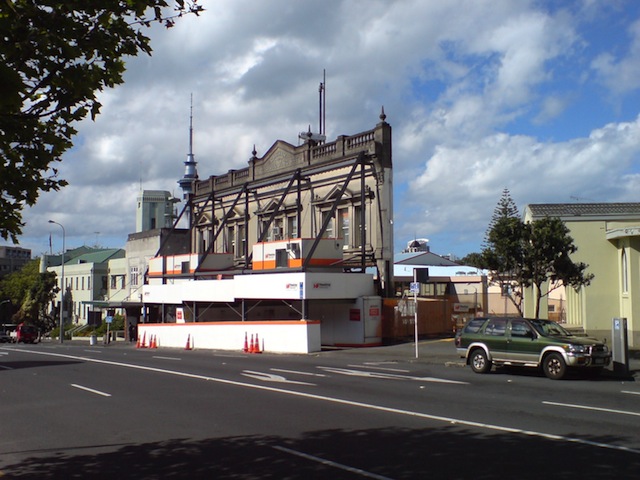
    Picture of a propped up facade courtesy of Ingolfson through Wikipedia Commons.

    Similar posts:

  • Doing social media right

    Doing social media right

    After last week’s Associated Press hack and the stock exchange fallout, regulators are struggling with implications of social media and informed markets.

    In a speech delivered last week the Australian Securities and Investments Commission’s Deputy Chair Belinda Gibson and Commissioner John Price gave some refreshing commonsense views on how businesses should handle public information.

    The continuous disclosure advice given by Price and Gibson is aimed at meeting the requirements of Australian corporate law, but it’s actually good social media advice.

    • Having delegations in place for who has authority to speak on behalf of the company – whether in response to an ASX ‘price query’ or ‘aware’ letter, or when they become aware of information that needs to be released to the market, perhaps in response to speculation.
    • Ensuring that there is a designated contact person to liaise with the ASX, who has the requisite organisational knowledge and is contactable by ASX.
    • Have a clear rapid response plan and ensure all board members and senior executives are fully appraised of it. Give it a practice run every so often – a stress test of sorts.
    • Have a plan for when you will consider a trading halt appropriate.
    • Have a ‘Request for trading halt’ letter template ready for use.
    • Have guidelines for determining what is ‘material’ information for disclosure, tailored to your company.
    • Prepare a draft announcement where you are doing a deal that will
    • likely require an announcement at some time, and a stop-gap one in case of a leak

    Having a nominated contact person with requisite organisational knowledge is possibly the most important point for any organisation.

    Even if you think social media is just people posting what they had for lunch or sharing cute cat pictures, it isn’t going away and those Twitter feeds and Facebook pages are now considered official communications channels.

    The intern running your social media is now your company’s official spokesperson. Are you comfortable with this?

    A good example of where this can go wrong is the Australian Prime Minister’s Press Office where an immature staff member has been put in charge of posting messages. The results aren’t pretty.

    prime-ministers-office-twitter-feed

    The funny thing is the Prime Minister’s office would never dream of some dill getting up and saying this sort of thing on her behalf, yet allows an inexperienced, loose cannon put this sort of material in writing on the public internet.

    Here’s Twenty Rules for Politicians using the Internet.

    On a more mature level, the ASIC executives also have some good advice on writing for social media.

    Don’t assume that the reader is sophisticated or leave readers to read between the lines. Companies need to highlight key information and tell it plainly.
    While the ASIC speech is aimed at the specific problems of complying with company law and listing requirements, it’s a worthwhile guide for any organisation needing to manage its online presence.
    Don’t be like the Prime Minister’s office, understand that an organisation’s social media presence is an official channel and treat it with the respect it deserves.

    Similar posts:

  • A question of relevance – why the PM welcomes bloggers

    A question of relevance – why the PM welcomes bloggers

    The Prime Minister’s courting of bloggers in the run up to the Australian Federal election later this year shows how credibility and relevance are most important assets for any media outlet.

    Late last year the Prime Minister invited bloggers to Kirribilli House for lunch then to dinner during her Rooty Hill adventure a few weeks ago.

    The press gallery grumbled and wrote patronising articles about North Shore mummy bloggers but failed to recognise the real threat to the established media outlets – these writers are more relevant to people’s lives than the machinations of ‘anonymous political sources’, sports stars or Hollywood celebrities.

    Now the Prime Minister is giving one on one exclusive interviews to some of those bloggers, something that will irritate the nation’s political journalists even further.

    Old media’s loss of relevance

    The press galleries’ problem though is relevance, which lies at the heart of any successful media outlet.

    In 1831 when The Sydney Herald’s first edition was published, the front page was made up of advertisements and shipping notices as it was with all newspapers of the time.

    That was relevant to the readers, they paid 7d – not an insubstantial amount in 1831 – to find out the latest in shipping movements, real estate sales and livestock prices which were essential to life and business in the colony.

    It wasn’t until 1944 that the now Sydney Morning Herald moved news to the front page, the London Times held out until 1966. What was now relevant to readers were photos and wire stories from around the world.

    Papers continued to do well despite the introduction of radio in the 1930s and TV in the 1950s because they were continued to be relevant to their readers. If you were looking a job, a house or where to take your mum for her 60th birthday then the local newspaper was the place to look.

    The shift to sensationalism

    In the 1980s all the media – newspapers, TV and radio stations – started a shift to sensationalism and infotainment and steadily all became less relevant to the populations they served.

    At the time media outlets got away with it as there was no-where else for people to get news. If you didn’t like stories about Princess Di’s wedding dress then you had to curl up in the corner with a good book.

    Then the web came along.

    All of a sudden engaged readers could get relevant information from all over the world.

    With social media and blogs, reporting Kim Kardishian’s latest wardrobe malfunction raised a ‘so what’ from an audience that learned about it two days ago on TMZ, the Huffington Post or Facebook.

    Making matters much, much worse were the advertising rivers of gold moved to specialist websites and Google.

    Newspaper executives found their revenues were evaporating and they worked their way deeper into the quicksand by cutting costs in the areas where their editorial strengths lay, making them even less relevant to the readerships they want to serve.

    Relevant lifestyles

    Today the mummy bloggers – along with the food bloggers, travel bloggers and political bloggers – are attracting  audiences with relevant, useful content that the audience can engage with.

    Last week’s embarrassing circus in Canberra was an example of how irrelevant the media, and much of politics, has become to the average Australian.

    Indeed it’s interesting to contrast the self important Canberra press gallery pushing non-stories while fawning over their discredited ‘anonymous party sources’ with the genuinely questioning tone of the some of the bloggers.

    So the mainstream, established media can kiss the mummy bloggers’ backsides; if they can’t find relevance in today’s society then they may as well shut up shop.

    For politicians relevance is important too – political parties that pitch themselves to 19th Century class struggles or 1980s corporatist ideologies are as irrelevant to today’s society as the Soviet Communist Party.

    It would serve the Prime Minister and her staff well to listen closely to what the mummy bloggers and their readers are saying.

    Similar posts:

  • Now may not be a good time to buy Melbourne property

    Now may not be a good time to buy Melbourne property

    There’s plenty of indicators that can be used to predict the health of an economy

    While my favourite is the mini-skirt index, the most reliable is when rich folk start building huge skyscrapers.

    Whenever developers propose a hundred storey building it marks the top of the property cycle. Should they get to actually build the thing, you can be guaranteed a nasty economic downturn is about to hit.

    The Skyscraper Index’s historical record

    This track record was set with the very first megatower – the Empire State building was started just before the 1929 stock market crash and completed as the great depression tightened its hold on the United States.

    Forty years later New York’s ill-fated World Trade Center opened just in time to welcome the 1973 oil shock and subsequent recession.

    A more recent example is Dubai’s Burj Khalifa, the world’s tallest building which was topped out in time for the city’s property crash and economic rescue by neighbouring Abu Dhabi.

    In Australia, the most notable downfall was 1980s entrepreneur Alan Bond who planned to build a 140 storey tower on the World Square site opposite Sydney’s Town Hall.

    The site was excavated but Bond went broke before work started and the hole remained for over a decade until a more modest 40 storey tower was built on the site.

    Australia 108

    So the news that property developers want to build a 108 storey tower on Melbourne’s Southbank should worry the Victorian government and unsettle the state’s property owners.

    What’s always notable about these super skyscrapers is the garishness of the project. While Australia 108 won’t match the Burj for sheer Las Vegas gaudiness, it will feature the ‘Star burst’, a star-shaped Sky Lobby and hotel at the top of the tower.

    Why the Skyscraper index works

    The reason why 100 storey buildings are such a reliable economic indicator is because they illustrate there’s too much dumb money in the economy. It rarely makes sense to build such tall buildings.

    Designing and building high rise buildings is complex and expensive – the higher you go, the more construction challenges there are as this Popular Mechanics article describes.

    Skyscrapers are subject to the law of diminishing returns as the taller the building is, the more space that’s needed for services like elevators, air conditioning, water supplies and fire protection which reduces the landlord’s rentable floorspace on the lower levels.

    When a building reaches a hundred storeys, there’s little space available on the lower floors for paying tenants. So the economics don’t add up.

    Builders, property developers and financiers know this so when they start proposing projects that don’t make commercial sense it’s a fair indication the locals are gripped with irrational exuberance and Adam Smith’s invisible hand is going to deliver a short, sharp slap to the back of the economy’s head.

    Does it matter to Australia?

    And so it is in Melbourne, which is going to be interesting to watch as South East Queensland is the only Australian metropolitan area to suffer a prolonged property downturn in the last twenty years.

    Hopefully Melbourne’s woes won’t affect the rest of the Australian economy but given how much the nation has invested in property and the stratospheric debt levels to service that speculation, it may well be that the rest of the country will follow Victoria.

    Winning the next election might not be a good thing for Tony Abbot and his followers who genuinely believe a Liberal government will deliver a magic pudding to the home of every dinky-di Working Australian.

    Similar posts: