Tag: risk

  • Coping with ignorance in a dysfunctional market

    Coping with ignorance in a dysfunctional market

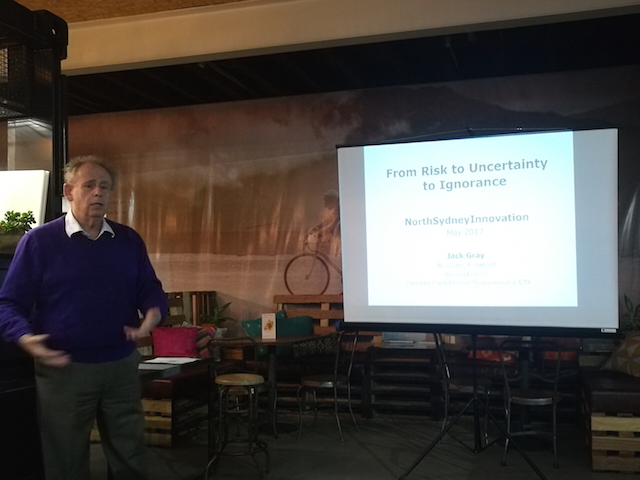
    “We discount uncertainty and ignorance too much,” says funds manager Jack Cray.

    Cray was giving his From Risk to Uncertainty to Ignorance presentation at Sydney’s North Shore Innovation Network where he went through some of the lessons from a career of managing funds in North America and Australia.

    Groupthink is one the great risks Cray sees in the investment community with funds managers tending to recruit from a monoculture drawn from economics and finance degrees. “Diversity amplifies signals,” says Cray.

    Compounding the groupthink is the focus on risk, believes Cray. Risk can be managed while the other factors in investment – uncertainty and ignorance – can’t.

    Traditional investors, particularly those in the public equity markets, understand risk well. However those established models also mean create process driven risk averse institutions.

    In the Uncertainty field, typified by the private equity markets, fixed models don’t work so well as a consequence investors have to be more risk tolerant and patient as they deal with a world where things can’t be assumed.

    And then there is the world of ignorance where no-one can quite be certain of what’s going on, which is typical of the tech startup field. In this space, investors have a high risk tolerance and are often muddling through while being buffeted by unexpected factors.

    “To succeed in a world of ignorance you have to be honery and less concerned about certainty,” Cray observes with a wry smile.

    This explanation makes a lot of sense when looking at why institutional investors struggle with the startup world and why private equity investors – largely a group of financial pirates – are so profitable.

    In answer to my question that saying startup investors are operating in a world of ignorance implies that sector really is an insider game, Cray was ambivalent – it can be, but the endorsement of a major VC or highly regarded investor will by its nature be seen as information in a field where everyone is short of data.

    Cray also had an interesting perspective on how markets and pundits see change differently, “investors overlook while futurists overcook.”

    Speaking to Cray after the event, he had some thoughts about the internet itself, while it’s a great source of information it also creates too much noise. Cutting out that noise is essential for a good investor.

    When it comes to investment all of us are dealing with different degrees of ignorance, Jack Cray’s views were an interesting insight into how managing a stock portfolio or picking ventures is more than just understanding risk.


    Similar posts:

    • No Related Posts
  • Forget eliminating risk

    Forget eliminating risk

    “How are you going to manage, not stop, risk?” Asked John Suffolk, the Global Cyber Security & Privacy Officer of Huawei Technologies at the company’s ICT roadshow in Sydney today.

    Suffolk’s message is one that should be heeded by all business owners, managers and executives in areas more than just IT security.

    One of the conceits of the late Twentieth Century management philosophies is that risk could be managed out of business, partly through technology but mainly through legalisms that attempted to push liabilities onto suppliers, contractors, resellers and customers.

    That philosophy still holds true in many organisations today, particularly government agencies, and it costs them dearly.

    In truth, business is risky and trying to eliminate risk is a fool’s errand. How it’s managed is the real test for leaders.

    Similar posts:

    • No Related Posts
  • The high cost of failing fast

    The high cost of failing fast

    It’s fashionable to talk about innovation and failing fast but exploring new technologies has always carried a great deal of risk as a BBC feature on failed aircraft design shows.

    Aviation, like automobiles, was a wonderful opportunity for early Twentieth Century tinkerers. With the added impetuous of two world wars, the development of aircraft saw some strange experiments.

    One of the things that drove aviation innovation was the evolution of materials science and manufacturing methods, sometimes with tragic results as we saw with the Comet jet liner’s fuselage failures and the DC-10s defective cargo door latches.

    In many ways, the early days of airliners was not dissimilar to today’s experiments with smart materials and 3D printing.

    Tragedies like the Comet and DC-10  should remind us that in some field the cost of failure is high.When a widget breaks, people can get hurt.

    As we experiment with new materials and manufacturing processes, we will make mistakes just as the aviation pioneers did. It’s an ethical aspect of innovation we need to keep in mind, there can be real costs to failing fast.

    Image of De Havilland Comet by Clinton Groves through Wikipedia


    Similar posts:

    • No Related Posts
  • Trusting technology and eliminating risk

    Trusting technology and eliminating risk

    As the search for missing Malaysian Airlines flight MH370 heads into its third week, a great deal of nonsense continues to be written about the flight and how its disappearance could have been prevented.

    One good example of the tosh that’s being written is this piece in The Conversation where UK Open University lecturer Yijun Yu declares that cloud based technologies would have helped us solve the mystery.

    While this may be true, Yijun’s article shows a deep trust in technology to solve all of our problems; in this case, insanely complex verification systems to ensure no-one is doing anything untoward.

    Yijun is correct that better inflight technology could have told us much about MH370s location, however he also illustrates how we’ve become a society that doesn’t understand risk as we look to our gadgets to save us when a problem happens.

    A cloud connected Boeing 777 probably wouldn’t have saved the souls on MH370 and ultimately it may prove that the technology wouldn’t have helped the searchers either.

    We simply don’t know until the plane is found and, hopefully, the flight data information analyzed.

    Despite the loss of MH370 air travel is safer than any other form of mass transportation and much of that is due to technology being cleverly applied.

    There’s no doubt there’s much to be learned from the current search, we can expect rules on inflight communications to be tightened substantially as a consequence, but we’ll never eliminate risk.

    In the meantime, we should join the families in praying for those lost aboard the aircraft and quit the silly theories.

    Image of Malaysian Airlines Boeing 777 by Aldo Bidini via Wikimedia

    Similar posts:

    • No Related Posts
  • Solving intractable problems

    Solving intractable problems

    Developing counter terrorism strategies is an unlikely path to founding a business that deals in organisational change, the latest Decoding The New Economy video covers exactly this in an interview with David Snowden.

    Snowden is the Chief Scientific Officer and founder of UK based consulting network Cognitive Edge that assists organisations with change and solving ‘intractable problems’.

    A failing Snowden sees with the way most businesses approach organisational change and problem solving is “the case based approach that dominates most of society.”

    “The idea is you find what other companies have done and you imitate it.” Snowden explains; “apart from the fact you can’t imitate the context, no company has succeeded other by imitating other people – they succeed by doing things differently.

    “We take what we know about how the human brain works and we help people work those problems out.”

    Safe to fail experiments

    In approaching ‘intractable problems’, Snowden believes there are two ways to approach them; one is to set up ‘safe to fail’ experiments where smaller experiments are run in parallel within the organisation to see what innovative solutions arise.

    The other approach involves using Snowden’s software based approach where staff or customers’ views are captured in real time to create a crowdsourced view of problems and their possible solutions.

    “You can’t afford, for example, in market research to spend three months commissioning something, two months gathering the data and one month interpreting it.”

    “If we create a sensor network of your customer we can give you data in real time.”

    Consumers and terrorists

    Dealing with real time data in public security are the origins of Cognitive Edge; “we started in counter terrorism where you have to deal with weak signal detection, you need fast real time feedback loops and you need to intervene very quickly.”

    “There’s no difference between a terrorist, a customer, a citizen and an employee,” says Snowden. “They all represent the same problem which is how the hell does a large authority make sense of fragmented data.”

    Developing human sensor networks

    Snowden sees ‘human sensor networks’ where groups contribute their stories to create a narrative around a topic, as being one of the strongest intelligence and communications channels.

    “Big data can tell us where you travelled, a narrative approach can tell why you travelled. If something goes wrong, I can also use that network to communicate.”

    One project Snowden is looking at brings these concepts together to create new communication channels at airports, an idea that came to him after being stuck for two days at Toronto airport in a snowstorm, “frequent fliers have smartphones, they can be activated by the airlines and used as a communication mechanism.”

    The interview with David Snowden is one of the most information and concept dense videos that I’ve done to date. It’s worthwhile listening this a few times to understand some of the fascinating fields he and Cognitive Edge are working in.

    Similar posts:

    • No Related Posts