Tag: smartcities

  • Bringing the IoT to Australia’s far north

    Bringing the IoT to Australia’s far north

    In the tropical north of Australia, one university is looking at using the Internet of Things to expand the reach of its research and open new opportunities for the local economy.

    On Monday James Cook University opened Australia’s first university IoT lab in Australia.

    Based at the Cairns campus in Far North Queensland, the lab is part of the university’s new Internet of Things engineering degree and is supported by Chinese telco vendor Huawei.

    The university, which also has campuses in Townsville and Singapore, boasts expertise in areas such as marine sciences, tropical ecology and tropical medicine, all of which are relevant to the IoT and made more relevant by Cairns being the main service centre for much of Australia’s remote Top End and the Torres Strait.

    Part of a central mission

    “The Internet of Things is based on something that is central to our mission in the Tropics: building greater connectivity between people, place and technology,” said the university’s Vice Chancellor Professor Sandra Harding.

    JCU’s IoT degree, the first of its kind in Australia, combines the study of electronic engineering with internet technologies, wireless communications, sensor device, industrial design and cloud computing.

    Currently the IoT faculty has 57 first year students, which the university hopes to grow to over 200. The head of the IoT faculty, Professor Wei Xiang, explained why the university decided to offer this course.

    Economic drivers

    “Primarily it’s driven by the economy, Australia is transitioning from a mining boom to a knowledge and innovation driven economy. So in the middle of 2015, JCU decided to offer an engineering degree in Cairns.”

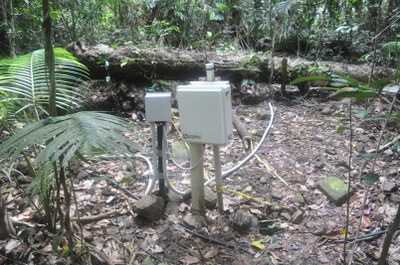
    “The IoT places nicely into traditional strengths at JCU in fields like marine science, marine biology and remote medicine, for example we can use the IoT for reef condition monitoring and our Daintree Rainforest project.”

    An electronics Engineer himself, Professor Xiang sees the IoT as the future of industry and leapt at the chance to lead a course when the opportunity arose.

    “In the middle of 2015 I thought, ‘this is what I want to do as this is where the future is.’”

    Smartcity opportunities

    Along with the remote health, marine science and agricultural aspects the City of Cairns itself offers smartcity opportunities. As a moderate sized town of 142,000 relatively isolated from the rest of Australia, Cairns has large tourist traffic coupled with weather extremes – the city gets nearly two meters (80 inches) of rain every summer. Making it a good test bed for new city technologies.

    “Cairns Regional Council is very interested in smartcities, I’ve been working very closely with the city council and its innovation team,” says Professor Xiang. “We are also rolling out our smart campus.”

    Part of the smart campus initiative is the university installing a NarrowBand-IoT base station provided by its program supporter, Chinese telecoms giant Huawei.

    Huawei’s NB-IoT base station

    Along with supporting the IoT lab, Huawei also plans to offer JCU IoT students the opportunity to travel to Huawei’s global headquarters in China and its Australian headquarters in Sydney as part of its Seeds for the Future program.

    “It gives our students and staff an experimental platform that conforms to the latest IoT international standard,” Professor Xiang said. “It means that as we design devices and sensor networks we can test and configure them using that standard.”

    The university’s Vice Chancellor, Sandra Harding shares Professor Xiang’s enthusiasm. “From designing smarter cities, to growing precision agricultural systems, monitoring natural environments in real-time, and creating clever health solutions that work in remote communities,” she says. “We don’t want to be just a part of that future, we want to lead it.”

    Paul travelled to James Cook University’s Cairns campus as a guest of Huawei.
    Similar posts:

    • No Related Posts
  • Google’s plans for the smartcity

    Google’s plans for the smartcity

    Last June Google launched its Sidewalk Labs project to explore smart city technologies. At a conference this week the scheme’s director, Dan Doctoroff, hinted they may be looking at building an entire digitially connected town from scratch.

    Planned cities don’t have a good track record, as Disney discovered in Florida with their community named Celebration, so the odds are against Google from the start in this.

    Google adds to the challenge with some distrust towards the company following the shutting down of the Revolv device — even the slightest risk of a service or device being shutdown or discontinued is enough to dissuade even the most eager smartcity enthusiasts.

    Making Google’s task of successfully rolling out smartcity products, let alone build a smartcity from scratch, is the company’s notorious attention deficit disorder where management struggle to maintain focus on products or projects.

    For anyone thinking of living in a smartcity, the commitment of developers, vendors and authorities towards the technologies is an essential consideration. It’s also why open source software and standards are essential when building a community around technology.

    Similar posts:

    • No Related Posts
  • Trade offs in the smart city

    Trade offs in the smart city

    What are the trade offs in the connected city? Last week we had an opportunity to talk with Esmeralda Swartz, Ericsson’s Vice President of Marketing Enterprise and Cloud last week about what policy makers and citizens need to consider.

    One of the important issues is security in both the data being collected, “what are the benefits and what is not acceptable?” Esmeralda asks.

    In all the conversations this site has had with smart city advocates the topic of open data has been essential, but this raises the issue of security. Something lacking in the Internet of Things.

    “Security has to be built into every level,” says Esmeralda who flags that the IoT adds a whole range of new risks.

    Along with security, a critical part of a successful connected city is having open data, Esmeralda believes.

    “if you start looking at the all the layers that need to be connected then they have to be open,” she says.

    Open data is a critical point for smart cities and connected communities, if information isn’t open then it’s hard for an ecosystem to develop or for residents to have confidence their data is being used for their benefit.

    For companies like Ericsson, who are trying to establish themselves outside of the traditional telco model, gaining the confidence of communities and their leaders is essential to their smart city strategies.

    Much of the smart city movement is based upon solutions looking for problems – a common trait of the IT industry – for vendors like Ericsson to succeed in selling their products it’s essential to prove value to their customers and gain the confidence of communities as they trade off utility for privacy.

    Similar posts:

    • No Related Posts
  • Putting the smart vision into smart cities

    Putting the smart vision into smart cities

    “Smart cities need smart visions,” states Terry Bennett, Autodesk’s lead strategist for the infrastructure industry.

    Bennett was speaking to Decoding The New Economy about how cities will evolve with smart technologies however he believes that data is not the answer.

    “Smart doesn’t mean putting sensors on everything and collecting terabytes of data,” he says. “Just putting sensors in the road doesn’t make it a smart city. To have a smart city you need smart people with a smart vision.”

    S.M.A.R.T

    “We see smart as more as an acronym. The ‘S’ is for setting science based targets for the data being collected,” he explains. Those targets could be financial, environmental or quality of life, “you have to set targets to see that your plan is being carried out.

    The M is for measuring against those targets while the A is for absorbing or analysing that information and using it effectively.

    R is for retrofitting, with Bennett seeing that valuable existing assets that still have long lives ahead of them being best refitted with smart technologies to get better information out of them.

    Shifting demographics and tastes

    One of the challenges ahead for planners and designers are the changing demographics and usage patterns of cities as the next generation of workers promise to be far more mobile and not as fixed to central business districts.

    An advantage for smarter cities is they have much more data available to make informed decisions and as patterns change, those municipalities can see the differences occurring sooner.

    Coupled with newer construction methods that allow infrastructure to be built faster, cities are going to be able to quickly respond to changing usage and demands on services.

    Contracting out innovation

    Those fast construction methods create another need for change in contracting methods. “We have to start thinking more as manufacturing rather than construction,” he says. “We get bogged down a lot in the ‘contract’ part of contracting. We have contracts written in the 1950s that are today’s standard contracts.”

    “You can’t build fast enough given the changes in demographics and technology using those older contracts. You basically contracting out innovation.”

    For government this can be an opportunity, Bennett believes. If clients allow builders freedom in techniques and methods then costs can be reduced with more resilient results.

    Ultimately it’s that resilience that matters with infrastructure being designed for decades, “if you’re designing for traffic patterns for today then you’re wrong.”

    Paul travelled to Autodesk University in Los Vegas as a guest of Autodesk

    Similar posts:

  • Diversifying South East Queensland

    Diversifying South East Queensland

    Australia is one of the world’s most urbanised countries with the bulk of the nation’s population clustering in half a dozen centres mainly strung along the east coast of the continent.

    The northernmost of Australia’s population centres is South East Queensland, a sprawling collection of suburbs extending from the upper class enclave of Noosa Heads down to the Gold Coast and the New South Wales state border.

    Cisco believe this sprawling region of three million people can become a ‘Smart Region’ with the use of technologies such as intelligent lighting and parking, citizen applications, and smart power metering could add up to 30,000 jobs and $10 billion of value to the community over coming years.

    “The residents of South East Queensland told us they want to experience greater convenience and integration of public transport, greater digital engagement and intimacy in their cities, more reliable local government services, and new digital ways to further reduce the cost of red tape,” said Cisco Australia & New Zealand Vice President Ken Boal in releasing the South East Queensland: A Smart Region report.

    Local civic leaders in the cities making up the South East Queensland conurbation see this as an opportunity to grow their economies.  “The future of cities and regions and their ability to create enduring employment opportunities are entirely linked to their digital capabilities,” says Sunshine Coast Mayor Cr Mark Jamieson while Ipswich Mayor Paul Pisasale said Ipswich was already preparing for a strong future as a digital city.

    “We have recognized that building and taking advantage of digital highways now will set Ipswich on a secure and successful path to capitalise on the ballooning digital economy,” said Cr Pisasale.

    For South East Queensland, the challenge in creating new industries and jobs is becoming acute. The Australian miracle economy has left the region – like most of the nation – hopelessly uncompetitive and the bulk of employment is in domestically facing service industries underpinned by property prices.

    In fact, the residential construction industry has been the mainstay of the SE Queensland economy and the region remains probably the most economically volatile of the Australian conurbations given its high dependence upon the building sector.

    The digital economy does hold out hope for diversifying South East Queensland’s economy from building and domestic tourism, but the work is just beginning. Cisco’s smart region initiative is a first step, but there’s much more work to be done by business and civic leaders.

    Brisbane image, “Brisbane CBDandSB” by Stuart Edwards. – Own work. Licensed under CC BY-SA 3.0 via Wikimedia Commons – https://commons.wikimedia.org/wiki/File:Brisbane_CBDandSB.jpg#/media/File:Brisbane_CBDandSB.jpg

    Similar posts: