Tag: smartphones

  • Maintaining the BlackBerry ecosystem: A review of the Passport smartphone

    Maintaining the BlackBerry ecosystem: A review of the Passport smartphone

    “Man, it’s a BlackBerry!” Exclaimed the assistant at the T-Mobile store on San Francisco’s Financial District, “I haven’t seen one of those in years.”

    Generally that was the reaction in taking a BlackBerry around; a lot of bemused comments along with the the odd wistful reminiscence, usually from a forty something lawyer or banker, about how they used to love their BlackBerry back in the day.

    So is the Passport is enough to rekindle Blackberry’s fortunes, or at least keep the company going until CEO John Chen can execute his Internet of Things strategy around QNX?

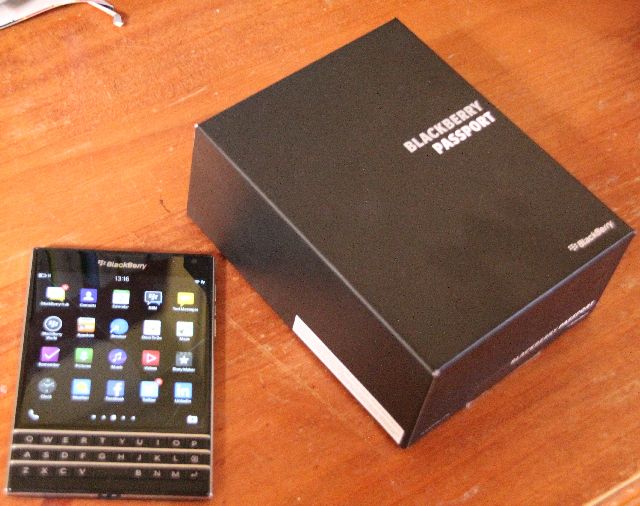
    The BlackBerry Passport is an unusual device; with a square screen it’s a very different mobile phone that takes a little getting used to.

    An irony for this reviewer is the tactile keyboard, with soft keyboards now the norm for smartphones, going back to a ‘real’ keyboard takes some getting used to and the Passport suffers from the real estate taken up by the keys.

    A return to two thumb typing

    The layout of the keyboard also takes some getting used to with the three row tactile QWERTY layout requiring two thumbs to use, compared to the one fingered swipe or typing options available on Android or Apple phones.

    Only having three rows also presents a problem for inexperienced users — where are all the punctuation keys? The answer is they appear on the screen above while typing. While a bit clunky, the predictive software which determines which punctuation you’ll need works well.

    Adding to the predictive typing features is a suggested word box that appears as you type, as one becomes more experienced in using the device this becomes a very efficient way to get messages out quickly. Overall BlackBerry has done a good job on designing the phone’s typing functions to get the most out of the form factor.

    Blackberry-passport-handset

    Another learning curve for users are the swipe functions, where an up gesture brings up the home screen and swipes to the the left and right let you navigate between screens and apps.

    The main app on the phone is the BlackBerry Hub, a centralised repository for all information. The aim of the hub is bring together email, social media and text messages into one fixed location.

    Bringing together information like this is always problematic as many of us are receiving dozens, if not hundreds, of emails, texts and social media messages a day. Overall though the Hub handles them well and integrates nicely with the major social media services including Twtitter, Facebook and LinkedIn.

    The Appstore weakness

    Where the software falls down is when venturing outside the pre-packaged apps — while things are better than they were, BlackBerry’s devices still suffer from a sparse app store.

    The lack of a suitable WordPress app prevented this reviewer from testing out the device’s blogging potential which is a shame as the 1:1 aspect screen may well have proved to be better than the Apple and Samsung equivalents.

    In the case of social media Instagram is a good example with the only free app, iGram, only offering Facebook and Twitter integration; a limitation that betrays the device’s excellent 13 Megapixel camera.

    On the other important hardware matters, the phone’s battery gives well over a days life on heavy use, the company claims 24 hours talk time, and recharges through a standard Micro USB connector.

    The decent battery life is reflected in the weight of the device with it tipping the scales at 196g, compared  to the Samsung Galaxy 5’s 145g and the Apple iPhone 6 plus’ 172g. It’s not heavy by any means which shows some of the engineering BlackBerry has applied to the phone.

    Inside the device is 32Mb of storage with the capacity to add up to 128Mb Micro SD memory, alongside the memory slot is the Nano SIM holder which worked well on both the US T-Mobile and Australian Optus 4G networks.

    Maintaining the ecosystem

    Unfortunately we were unable to review how well the device and its software integrated with the Black Enterprise Service as this is going to be the main selling point for the Passport.

    Overall the BlackBerry Passport is a good corporate phone that’s going to appeal to organisations that wants to give their staff secure communications with smartphone capabilities.

    However the handset itself is unlikely to appeal to the broader smartphone market. At best the BlackBerry Passport is an attempt to keep the company’s core market locked into the ecosystem while John Chen executes his pivot into new markets. It may not be enough.

    In San Francisco’s Financial District, the guys at the T-Mobile shop are probably not going to see many more BlackBerry phones.
    Similar posts:

    • No Related Posts
  • Chinese businesses take on the world

    Chinese businesses take on the world

    We’ve looked previously at how Chinese manufacturers are moving up the value chain, proof of how PRC based companies are beginning to make their mark on markets are the latest smartphone IDC rankings.

    Two Chinese companies, Lenovo and Xiaomi, entered the rankings with the latter recording a threefold increase on the previous year’s sales.

    Remarkably, Xiaomi only had a few hours as number three in IDC’s global ranking as Lenovo closed its Motorola acquisition shortly after the release which pushed the combined company into third position.

    Top Five Smartphone Vendors, Shipments, Market Share and Year-Over-Year Growth, Q3 2014 Preliminary Data (Units in Millions)

    Vendor

    2014Q3 Shipment Volumes

    2014Q3 Market Share

    2013Q3 Shipment Volumes

    2013Q3 Market Share

    3Q14/3Q13 Change

    1. Samsung

    78.1

    23.8%

    85.0

    32.5%

    -8.2%

    2. Apple

    39.3

    12.0%

    33.8

    12.9%

    16.1%

    3. Xiaomi

    17.3

    5.3%

    5.6

    2.1%

    211.3%

    4. Lenovo*

    16.9

    5.2%

    12.3

    4.7%

    38.0%

    4. LG*

    16.8

    5.1%

    12.0

    4.6%

    39.8%

    Others

    159.2

    48.6%

    113.0

    43.2%

    40.8%

    Total

    327.6

    100.0%

    261.7

    100.0%

    25.2%

    Source: IDC Worldwide Quarterly Mobile Phone Tracker, October 29, 2014

    The two companies illustrate the different strategies Chinese companies are making in taking on the world; while Lenovo is growing through acquiring ‘cast off’ operations like Motorola Mobility from Google and the various hardware arms of IBM, Xiaomi is growing through selling lower budget devices into East Asian markets.

    Both approaches have their strengths and benefits and illustrate as much the diversity of the markets the two companies are chasing as much as the differing management philosophies of the business.

    The other message from the respective successes  of Lenovo and Xiaomi is that Chinese companies, particularly manufacturers, are increasingly confident in competing in the global marketplace.

    Just as Japanese manufacturers found their feet in the 1970s with many becoming global brands and market leaders, we are seeing the same thing happening with the Chinese businesses today.

    Similar posts:

    • No Related Posts
  • Where next for the telco industry?

    Where next for the telco industry?

    The last thirty years have been good for the telecommunications industry; a wave of privatisations, regulatory reforms and technological change drove the sector and company profits.

    As populations around the world adopted mobile phones users started enthusiastically calling and texting, Telco profits exploded.

    Twenty years later the massive growth to the industry has peaked as customers have moved to using their cellphones for  less lucrative data services.

    So where do the telecommunications companies go next for growth and profit? Today and tomorrow I’m attending the Ovum 2020 Telecoms Summit where they’re looking at the future for the industry.

    Salvation from the internet of things

    The great white hope for the telco industry is the internet of things and the machine to machine (M2M) technologies; the hope being that putting SIM cards into every car, kettle and shipping container that this will be another lucrative revenue stream.

    Martin Creighan, Managing Director for Australia and New Zealand at AT&T, points out that by the end of the decade there will be seven times as many connected devices as live mobile phones. This is where the opportunity lies.

    The problem with the M2M vision is annual revenues per user (ARPU) for connected devices are a fraction of those from voice and messaging over the last twenty years and telcos will need more than that to maintain their revenues, let alone grow.

    Moving into the cloud

    One of the other revenue streams is adding cloud services, again this is a low margin business and involves competing with global giants like Amazon and Google along with the myriad of specialist companies.

    Another possibility is in providing professional services as Jennifer Douglas, Director of Fixed voice and platinum for Telstra, described in the company’s home support product.

    The problem with both the cloud and professional services model this requires a change in culture for the telcos, the traditional contempt telecommunications executives have for the end user doesn’t cut it in the professional services and cloud computing industries.

    For the telcos, this major change is something that’s been experienced by many other industries. That a comparatively protected industry like telecommunications companies are subject to these disruptions illustrates just how no sector is safe from being uprnded.

    Similar posts:

    • No Related Posts
  • Connecting people to spaces

    Connecting people to spaces

    Beacon technologies are one of the hottest items in the Internet of Things with retailers, sports stadiums and hotels looking at how they  can use these devices to improve their operations and customer experiences.

    At Dreamforce 2014 Proximity Insight’s Steve Orell spoke on the event’s wearable panel about how their service plugs into beacon technology and customer service.

    Proximity Insight was born out of the 2013 Dreamforce Hackathon where Orell and his team were finalists. From that, the company set up operations in New York with a focus on customer relationship management in the retail industry.

    Retail isn’t the only the field that Orell sees for Proximity Insight with the hotel and casino industries as being other targets.

    “With the hotel, why check-in? Why not walk in and let your smartphone do it for you?” Orell asks.

    “It’s all about making live so much more seamless and slick,” Orell adds. “There’s opportunities in every sector.”

    For businesses looking at rolling out beacon technologies the key is to be adding value to enhance the customer experience, Orell believes.

    “You have to be delivering something to the customer beyond tracking them, it’s about making the whole retail or hospitality experience better. It has to benefit the customer.”

    With beacon technologies now becoming common and the supporting hardware being built into all smartphones, we can expect to see more applications coming onto the market. It’s worth considering how your business can use them to enhance the customer experience.

    Paul travelled to Dreamforce 2014 as a guest of Salesforce

    Similar posts:

    • No Related Posts
  • Apple and the long game

    Apple and the long game

    As expected, Apple announced their new range of iPhones and a smart watch today with many digital trees being felled as the tech media falls over to describe all the shiny features of the new devices.

    Buried in Apple’s announcements though are the company’s real long game in payments and the Internet of Things.

    For the IoT, the various ‘kits’ Apple have announced in the last year — HomeKit, HealthKit and now CloudKit — are the serious plays in this space as they bundle together programs, devices and data streams across health and smarthome applications.

    CloudKit moves Apple onto another level as it makes it easier for developers to build back end applications that tie into smart devices; even if someone isn’t using Apple equipment they still may find themselves firmly in the walled garden of Cuptertino.

    The long awaiting release of Apple Pay leverages iTunes’ strength as a payment platform, bundling a secure chip into the new iPhone adds to the company’s pitch of being a trusted partner to merchants and payments processors.

    What today’s announcements of new hardware, software and APIs indicate is Apple’s shoring up the perimeters of its walled garden.

    For it’s competitors, this raises the ante; Google Wallet has nothing like the market penetration or customer acceptance that iTunes has and earlier this week Amazon effectively admitted the Fire smartphone has been a failure by slashing prices. Facebook has made promising noises about payments but still remains locked in an advertising driven business model.

    While there’s no doubt the new iPhone will be a success, although the jury is out on the smart watch, Apple’s real game is in controlling a large part of the payments industry and the internet of things. Today’s announcements are a key step in that strategy.

    Similar posts:

    • No Related Posts