Tag: telstra

  • A kid in a telco candy store

    A kid in a telco candy store

    “It’s a kid in a candy store opportunity,” says Telstra CTO Vish Nandlall on being asked what excites him about the telecommunications industry.

    Nandlall was talking to Decoding the New Economy about the challenges facing telcos in an industry facing massive change as the once immensely profitable voice and text services are being displaced by less lucrative data products.

    Previously we’ve spoken to Nandlall about the future of Australia’s incumbent telco in a competitive market and this interview was an opportunity to explore some of the broader opportunities in a radically changing market.

    A data business

    “While our business sounds complicated, we actually only do three things.” Nandlall observes about telecommunications companies, “we move data, we store data and we compete on data.”

    “In the course of my lifetime in telecoms any two of those coming together meant a major shift. Today all three are converging.”

    That convergence creates a range of challenges and opportunities, Nandlall believes. “When I look at what we see on the consumer side, I see the Internet of Things which really does promise a golden age of convenience.”

    “Underpinning it all is going to be a massive transformation around data, the data insights suddenly become the thing that we’re going to need to differentiate our businesses from competitors in the industry.”

    Differentiation through data

    The differentiation of telecoms companies is going to lie in the software and data services being offered, Nandlall believes. “I don’t think telcos need to replicate Over The Top services,” he says in reference to services like Facebook or WhatsApp or Skype.

    Nandlall sees the value for telcos in providing the next level of services in areas such as API management, content delivery and security. “We need to have new digital delivery systems,” he says, flagging software defined systems as being key to delivering to the new generation of telco services, “we can’t be restricted to fixed lines.”

    Facing the skills shortage

    The challenge facing telcos and all businesses is finding skilled workers, Nandlall observes. “Because change has been so rapid there has been a pipeline of students or workers being readily available.”

    Nandlall sees initiatives like Cloud Foundry and Hadoop offering a means to address the skills shortage by standardising processes, reducing complexity and automating many of the tasks occupying today’s developers and technology workers.

    This change also promises to speed up business as well and, combined with cloud services, changing the operating models of entire industries.

    A new competitive advantage

    For businesses without the scale of Telstra Nandlall has an important message, “I think we’ve hit a point in industry is where the competitive advantage is not just through some sustained differentiation,” he observes. “Today it’s about your ability to rapidly adopt new things.”

    That rapid adoption is only going to accelerate, Nandlall believes, as the Internet of Things and wearable devices bring a whole new range of ways to collect and display information. For a kid fascinated with data, that’s a big candy store.
    Similar posts:

    • No Related Posts
  • Telstra adds Singapore to its Muru-D startup network

    Telstra adds Singapore to its Muru-D startup network

    Today Aussie incumbent telco Muru-D opening in Singapore.

    Muru-D is loosely based on Telefonica’s Wayra incubators that the Spanish telco has set up across Europe and Latin America.

    Wayra’s fortunes have been mixed recently with the incubators coming off badly in the company’s restructure last year and it’s interesting that Telstra are copying the model of opening in strategic neighbouring markets.

    Complicating matters is Telstra’s Singapore based rival Singtel has its own chain of incubators Singtel Innov8. Singtel’s model is different in that they sponsor incubators, Sydney’s Fishburners for example, rather than set up their own Wayra or Muru-D style operations.

    So Telstra’s moving into Singapore could be seen as another move by the Aussie incumbent to take on Singtel on it’s own home ground, something that will be assisted by the recent acquisition of PacNet.

    Also notable is the Singaporean government’s support for Telstra’s with Kiren Kumar, Director of Infocomms & Media at the Singapore Economic Development Board, welcoming the launch as enhancing the city’s repuation as “the innovation capital of Asia”.

    Telstra’s move is another showing how telcos are trying to move out of being utilities along with Telstra’s need to grow out of the domestic Australian market it now dominates.

    For Telstra both moves are well outside the company’s historical expertise, it will be interesting to see how successful they are.

    Similar posts:

    • No Related Posts
  • Opening Telstra in a life and death market

    Opening Telstra in a life and death market

    “Communications are a life and death issue”, says Vish Nandlall the chief technology officer of Telstra. “You realise that when that pipe gets shut off people can die in the field.”

    Nandlall’s experience in weapons technology led him to a life in the telecoms industry which bought him to Australia as he believes Telstra is one of the most innovative companies in the industry. How much this is due to Telstra dominating its domestic market is a discussion for another post.

    Nandlall was speaking last week at a lunch for journalists and bloggers hosted by Telstra in Sydney. It was an opportunity for the company to introduce their CTO to the media following his joining the company last August and to publicise their push into health care services.

    One of the areas Nandlall was particularly keen to push was how Telstra was looking at opening their platforms to third party developers as he sees the nine to ten million strong community as offering opportunities that even the best resourced telecoms company can’t access.

    “How can I get telecom services into places where developers can access the information?” Nandlall asks.

    His answer is to open the services through the Telstra Developer Site which at present is fairly Spartan although one expects it will become more impressive ahead of the I love APIs conference the company is sponsoring in Sydney this June.

    Down the track Nandall sees the open systems assisting the company moving into the key growth areas for all telcos such as the Internet of Things, smart cities and the productivity growth applications in industry verticals.

    The big opportunity the company sees is in health care where a fragmented industry struggles to corral disparate sources of information that touch almost every person. It though just one of the growth telcos are looking at in a dramatically changing marketplace.

    For Nandlall the challenge is to grow Telstra beyond the domestic Australian telco market that it increasingly dominates as its competitors lose interest in the market and the nation’s ambitious but failed national broadband network slowly fades into irrelevance.

    While Telstra is by no means facing any life or death issues, many of its customers could be. Nandlall and his fellow executives are hoping they can help them.

    Similar posts:

  • Software ate the demonstration centre

    Software ate the demonstration centre

    Yesterday Australian incumbent telco Telstra took the media on a tour of its showpiece  Customer Insights Centre in downtown Sydney.

    The company is justifiably proud of the facility that includes  a 300 person auditorium, broadcast quality TV studio, a restaurant, workshop and collaboration spaces.

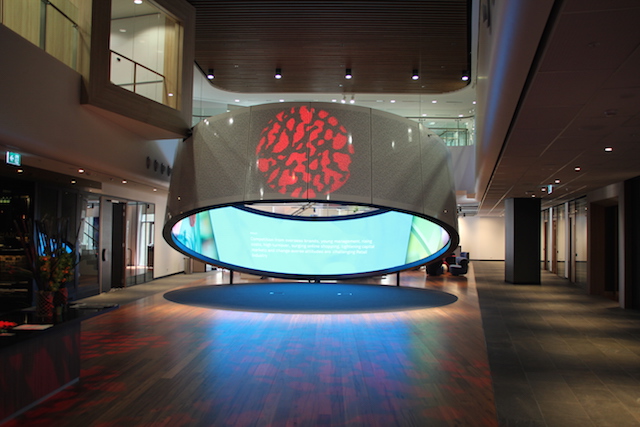
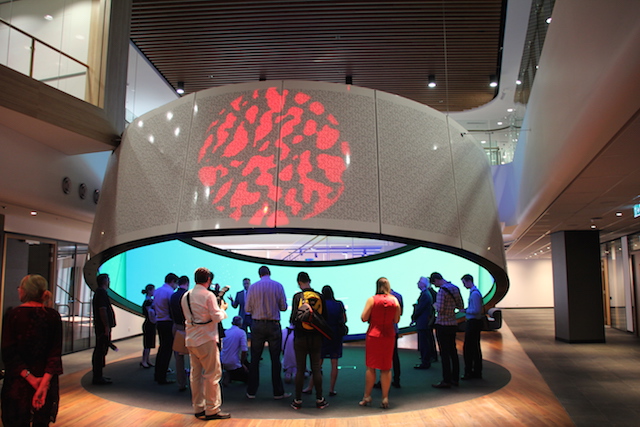
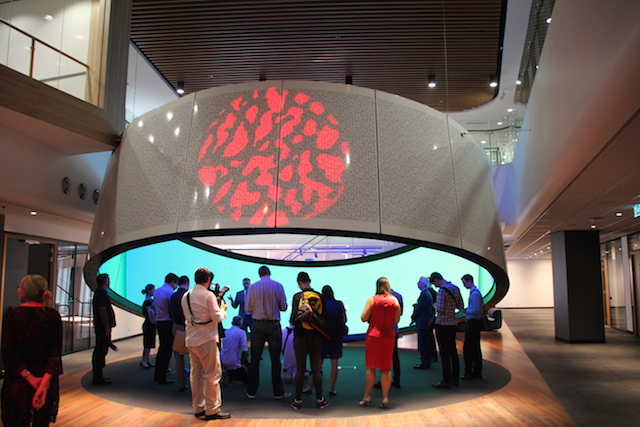
    Welcoming visitors is the centre’s Insight Ring, a nine metre circle-shaped platform that surrounds guests with digital insights mined from Telstra’s information services. Leading off the reception area are a range of displays showcasing the company’s products and capabilities including wearable technologies, 3D printing and Ged The Robot.

    Marking the centre as a modern facility the display spaces where Telstra and its partners can show off technologies to industry bodies and prospective clients.

    Ged, the Telstra robot
    Ged, the Telstra robot

    The previous space two floors higher in the building was beginning to show its age after seven years and the fixed displays of technology in the older facility dated the centre, something that’s a disadvantage in an industry changing as quickly as telecommunications.

    In the new centre, the demonstration facility is largely screen based so displays can quickly be adapted to show off the technologies aimed at whichever industry they are pitching.

    The fast moving technology world
    The software driven demonstration centre


    Andy Bateman, Director of Segment Marketing at Telstra, who lead the tour was proud to show off the current display that had been set up to showcase the company’s banking products.

    telstra_client_demonstration_consumer_insights_centre

    Bateman described how the facility can be quickly altered to suit the needs of specific demonstrations, this was a degree of flexibility missing in the PayPal innovation center in San Jose, which is more comprehensive in its displays but requires a major fit out to change anything.

    Venture capital investor Marc Andreessen stated that software will eat the world, Telstra’s Customer Insights Centre illustrates this starkly.

    However software doesn’t always have the upper hand, just opposite the Telstra centre is the Sydney City Apple Store. In some ways, the two facilities opposite each other illustrate one of the big technological and market battles of this decade.

    View of the Apple Store from the Telstra Centre
    View of the Apple Store from the Telstra Centre

    For most businesses, software will define the future way of working but for the smart hardware vendors will still be making good money.

    Similar posts:

  • A tale of two telcos

    A tale of two telcos

    Last Thursday saw China Mobile and Australia’s Telstra release their annual results.

    Both have impressive numbers that illustrate how the telco industry is changing along with some stark differences between the two nation’s business culture.

    For both companies their results show how voice and SMS are declining as the ‘rivers of gold’ for telecoms operators around the world; China Mobile’s voice revenues are down 6% while  Telstra’s fixed line voice fell by a similar amount.

    In Australia, the incumbent telco (which sometimes advertises on this blog) continued its dominant position in its market with net profit rising nearly 15% on the back of 6.1% increase in income.

    teslstra-revenue-2014

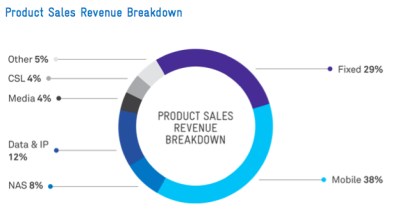
    Telstra’s results also showed how the Aussie telecommunications market is now primarily a mobile sector; while the advantages of being the incumbent are substantial the real growth and profits in the business are in it’s non traditional sectors. It’s little wonder the company is happy to give away its legacy copper systems to the government’s troubled National Broadband Network.

    In the PRC, the news wasn’t so good with China Mobile’s net profit for the first half of the year falling  8.5 per cent as its traditional voice and messaging businesses faced continued pressure from social media firms, despite revenue being up nearly five percent.

    China Telecom is under pressure from competitors while in Australia the incumbents are doing very well. This is true across much of the Aussie economy.

    While China Mobile is staking its future on its 4G rollout, Telstra is seeing the Internet of Things and Machine to Machine (M2M) markets as being the key markets, despite Gartner flagging the IoT as being at peak of the Hype Cycle.

    It may well turn out to be the other way round — Chinese businesses and governments are far quicker to embrace the IoT than their Australian equivalents while Telstra’s biggest competitive advantage against SingTel Optus and Vodafone is it’s far superior 4G network.

    China Mobile’s and Telstra’s competing fortunes tell us much about each country’s telecommunications markets along with the direction of both nation’s economies.

    Similar posts:

    • No Related Posts