Tag: us

  • Does closed government hurt business and the economy?

    Does closed government hurt business and the economy?

    Earlier this week I interviewed Vivek Kundra, the former US Chief Information Officer and now Salesforce executive, on innovation, technology and government with some of the Australian business perspectives run as a story in Business Spectator.

    Something that stood out for me from the interview were Vivek’s views on the effects of governments making both innovations and information freely available.

    “Two policy decisions that transformed the future of civilisation – GPS opening and human genome project through the Bermuda Principles.”

    While it’s probably too early to draw conclusions on how the opening of the human genome data will change business, it’s certainly true the Global Positioning System has allowed whole new industries to evolve and it’s an important lesson on making technology available to the masses.

    The Global Positioning System was, like the internet, a US military technology developed during the Cold War with the Soviet Union.

    After Korean Airlines flight 007 was shot down by Soviet fighters in 1983, President Reagan approved civilian use of the GPS – then named Navstar – to prevent similar tragedies.

    Such a decision was controversial, this was military technology being given over to the general population which could be used by enemy forces as well as airlines and truck drivers.

    No doubt if the GPS technology was developed in the UK or Australia, there would have been demands to monetize the service. It almost certainly would have been sold off to a merchant bank that would have charged for the service and stunted its adoption.

    By making GPS freely available, the US gained a competitive advantage which maintains the nation’s technological and economic lead over the rest of the world.

    This openness isn’t just an advantage for technology companies. While US governments are no means perfect, the relatively open nature of local, state and Federal administrations is an advantage for the United States economy and society. As Vivek says,

    Making data available provides three concrete functions; it allows citizens to fight corruption, it allows you to build the next billion dollar companies and it transforms government functions by breaking down silos.

    When the default position of government is to classify everything as secret or ‘commercial-in-confidence’, there’s little chance of an entrepreneurial culture growing in that society – instead you have a business culture that favours connected insiders who can trade off their privileged contacts within government.

    A culture of closed government reflects the business culture of a society and the reluctance of both the private and public sectors to openly share knowledge is why countries like Britain and Australia will struggle to emulate the United States.
    Similar posts:

  • Taxing the internet

    Taxing the internet

    One of the competitive advantages for online shopping has been the difficulty in levying taxes on internet transactions.

    This has been particularly true in the United States where individual states, counties and cities have different sales taxes, meaning a consumer in Birmingham, Alabama might pay 10% more than their friends in Billings, Montana.

    Amazon in particular has been aggressive in exploiting these price differentials, right down to threatening states where ‘Amazon taxes’ has been proposed.

    Now the US Congress looks set to pass a law which would make online sellers responsible for buyers’ state sales tax obligations.

    The next stage will be treaties between countries on the collection of sales or value added taxes.

    For many retailers though this won’t be particularly good news as price differentials are more than just the 10% GST or VAT and online shopping sites compete as much on product range and customers service.

    What the US Congress’ bill really shows is how online retailing is maturing – rather than thinking of companies like Amazon, eBay or niche operators like Shoes Of Prey as being disrupters they are the new normal.

    Similar posts:

  • is G’day China a good idea?

    is G’day China a good idea?

    Yesterday’s announcement by the Prime Minister’s  of an Australia Week in China may prove far more successful than the G’day USA events the idea is based upon.

    G’day USA has been run for a decade and showcases Australia’s attractions, skills and businesses at events in Los Angeles and New York.

    It’s been moderately successful but an emphasis on movie stars appearing at black tie Hollywood events illustrates Australian governments’ disproportionate focus in throwing money at US movie producers.

    If China Week follows the US example we can expect private, exclusive dinners where Twiggy Forrest, Clive Palmer and the BHP board entertain Chinese plutocrats over bowls of shark fin soup and braised tigers’ testicles.

    Should China Week follow that model then it will probably share G’day USA’s middling successes.

    The opportunity to do it differently though is great as the Chinese-Australian relationship is far younger and hasn’t been locked into Crocodile Dundee type stereotypes on both sides.

    As the Chinese economy matures and evolves, there’s an opportunity for Australian businesses and industries which haven’t been available for exporters to the US.

    Done properly, G’day China could help the profile of Australian businesses in many sectors, particularly in those affected by the great Chinese rebalancing.

    Let’s hope they do it properly.

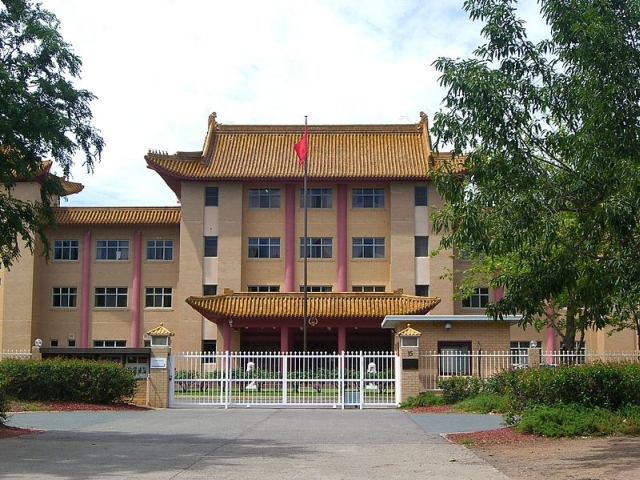
    Image of the Chinese embassy in Canberra, Australia from Alpha on Wikimedia

    Similar posts:

  • Australia and the Chinese Mexican stand off

    Australia and the Chinese Mexican stand off

    Twenty years ago visitors to Sanya on the south coast of China’s Hainan Island could find themselves staying at the town’s infectious diseases clinic, converted into a backpackers hostel by a group of enterprising doctors.

    The Prime Ministers and Presidents attending of Boao Asia Forum this week won’t get the privilege of staying at the infectious diseases hospital as Sanya’s hotel industry has boomed, bust and boomed again following the island being declared a tourism zone in 1999.

    Instead, their focus is on the pecking order of nations and for the Australians the news is not good. As the Australian Financial Review reports, the Aussies have been seated well below the salt by their Chinese hosts.

    On the Boao list, Australia is outranked by Brunei, Kazakhstan, Myanmar, Zambia, Mexico, and Cambodia – even New Zealand Prime Minister John Key gets higher billing.

    Central and South East Asian countries make sense as countries like Myanmar and Kazakhstan are China’s  neighbours with strong trade ties.

    That the Kiwis have been given priority over the Aussies by the Chinese government is not surprising in light of this.

    An unspoken aspect for the Australian attendees to the Baoa conference is how long Canberra’s political classes can continue their forelock tugging fealty to the US without offending the nation’s most important trading partner.

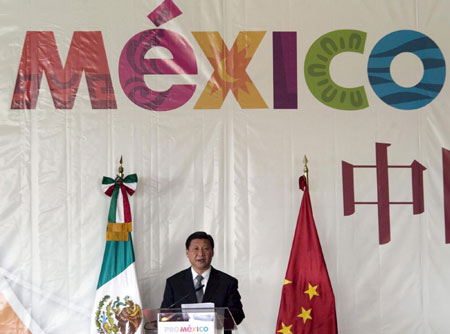
    Mexico’s entry on that list could be one of the most important with consequences for Australia and the world.

    During the 1992 US Presidential campaign candidate Ross Perot coined the phrase “the great sucking sound” in his opposition to the North American Free Trade Agreement and the risk of losing jobs to lower cost Mexico.

    As it turned out, the giant sucking sound was China – it turned out China’s admission into the World Trade Organisation had far greater consequences for the United States and Mexico than NAFTA.

    Mexican manufacturing was one of the greatest victims of China’s rise as US companies found it easier to subcontract work to Chinese factories rather than setup their own plants in Mexico.

    Now China is finding its own costs creeping up and labor shortages developing and Mexico is attractive once again. The Chinese and Mexican governments have been working on their relationships for some time.

    As manufacturing moves out of China, the shifts in world trade we’ve seen in the last two decades are going to be repeated, this time with Chinese moving up the value chain the lower level work moving to Mexico and other nations.

    The leaders at the Baoa conference have their work cut out for them in dealing with another decade of global change.

    Similar posts:

  • Graphs, damn lies and the middle class

    Graphs, damn lies and the middle class

    Graphs are great for illustrating a story, and also excellent at misleading people.

    A good example of where a graph can give an incorrect impression is the Sydney Morning Herald’s story Whatever Happened to the Middle Class.

    The story is a very good explanation of the predicament Australia’s political classes have put themselves into – exacerbated by their 1950s view of dividing the workforce into poorly paid ‘blue collar’ workers and affluent ‘white collar’ office staff – but it suffers from the selective use of headline graphs.

    Viewing the big picture

    The first graph shows how Australians are identifying themselves as middle class and the trend looks staggering,

    Graph of How Australians see themselves as middle class

    Now if we add those who identify themselves as working class, the picture looks even more dramatic with some pretty volatile swings,

    A graph showing How Australians see themselves as middle or working class

    However if we now add in those who identify themselves as rich, or upper class, we get a better perspective as the entire range is now shown,

    Graph showing How Australians see themselves as upper middle or working class

    Selective choosing the Y, or vertical, axis will always give an exaggerated view of a trend or proportion. Once we take the full range in we see the real extent of things. It also has the benefit of showing the trends aren’t as volatile as first appear.

    Middle class perceptions

    When we look at the graph showing the full picture there’s a number of interesting trends and characteristics about Australian society that come out of it which are worthy of some future blog posts.

    Most notably is the identification of Australians being middle class as their property values increased.

    On this point, it’s worthwhile contrasting the Australian experience with the US, here’s a Gallup poll from last year on how Americans see themselves,

    A graph showing how Americans see themselves as upper middle or working class

    While the definitions are different – that Americans differentiate ‘working class’ and ‘lower class’ is interesting in itself – it’s clear that the same trend happened in the US with more people identifying themselves as being members of middle class when their property values were increasing.

    In 2008 and 9 there’s suddenly a sharp increase in Americans identifying themselves as working class as the property downturn bites. The steady increase in those claiming to be ‘lower class’ from 2006 onwards is worth closer examination.

    What this means for Australia

    The implications of the US trends is that any Australian politician intending to dismantle John Howard’s middle class welfare state will have to wait until the property market falls before trying to win any popular support.

    For this year’s Australian election though, what’s clear is that any attempt to stoke the fires of class warfare is going to fail dismally in the outer suburban marginal seats so coveted by both parties.

    We’re going to see a lot more selective graphs during the course of this year, it’s worthwhile taking time to look at them closely. The stories may be different, and a lot more nuanced, than the headlines tell us.

    Similar posts: