New Media in the Boardroom workshop

How do directors and executives deal with the new online tools?

The Internet is changing our businesses and markets. The New Media in the Boardroom workshops are an executive briefing on how your organisation can meet the challenges of the new economy.

Online tools like social media and cloud computing offer opportunities along with a range of reputational, legal and compliance risks to corporations and large organisations.

New Media in the boardroom explains the various technologies, their usage and how they fit into business and professional objectives with hands-on instruction on setting up and using these tools.

This workshop is designed for all business people concerned about managing staff who are using social media tools inside and outside the workplace.

During the workshop participants will learn about the different new media tools in use at present, how workplaces are affected by them, developing Internet trends and discover whether these programs are useful to their professional activities.

Customised for your business

The new media in the boardroom workshop is customised for the attendees. All case studies and tools are selected to be specifically relevant to the client’s industry and business objectives.

Participants cover;

  • The new media tools
  • Why do people use them
  • Opportunities in the new economy
  • Enhancing your online repuation
  • Managing risks
  • Executive use strategies
  • Legal tricks and traps
  • Social media policies
  • Employment issues
  • Case studies

Who should attend?
New Media in the Boardroom is designed for business owners, executives and senior management wanting to understand how the web and social media is affecting their business.

Workshop duration
This workshop can be run as a group or an individual executive training session. For individuals, we recommend the program be structured as three 90 minute sessions. Group courses can be run up between two hours and three days depending upon requirements.

More details
Contact us for more details on this workshop and how we can help your business, organisation or community group identify and deal with challenges of our exciting era.

5 ways to guarantee postive online reviews

how do we ensure people say nice things about us on the web?

The last week has been an interesting time in the online travel review world with some serious questions about the reliability and honesty of customer reviews being raised.

First an English hotelier threatened to sue the hotel review site Tripadvisor over a negative review and then the same site sanctioned an Irish hotel for obvious fake positive reviews. Today, the travel site Orbitz has announced they’ll allow user reviews from people who’ve never actually used the service.

There’s no doubt these sites are important to businesses. In hospitality, customers check the online reviews of cafes, restaurants and hotels before planning meals or holidays. Smartcompany has previously listed a range of sites where customers review businesses in other sectors.

So given the value of positive reviews on these sites, how do we ensure our businesses get positive coverage?

Sue the critics
You can always lawyer up and threaten the bad guys. If you can identify the malicious reviewers, a “nastygram” from a your solicitor may shut them down. This is expensive though and high risk if the bad reviewers goes public with your threats.

Also, experience shows that restaurants who succeed in the courts usually don’t do well in the marketplace. Most litigious proprietors find their establishments out of business long before the judge or jury vindicates them.

Bribe your customers
Quite a few businesses do this by offering freebies and discounts to customers who write nice reviews. This can work well but be careful you don’t put these offers in writing as the sites themselves frown on this behaviour.

Write your own reviews
As politicians and spin doctors know, the best way of controlling the message is to create your own narrative. You’ll need to be anonymous and you have to establish credibility by having more than just a single gushing review of your own establishment. So it’s worthwhile visiting your competitors and writing mildly complimentary reviews about them before submitting the sparkling review of your premises.

Listen to your customers
Even the best establishments have the odd crook day and if even yours doesn’t there will be some customers who are never happy. Use the ‘social’ part of “social media” and engage with them. If you are honest and upfront you’ll find a polite reply will actually win customers from a bad review.

Online review sites can also be thought of as a free customer feedback service. Consistent poor reviews on a specific area such as food or stroppy staff are sending you a message that something needs to be fixed. The Clare Hotel, the Irish establishment referred to above, clearly has a problem which all the rigged reviews in the world aren’t going to fix.

Deliver a great service
Ultimately these review sites are about lifting the game for all businesses. It means we have to all have to make sure we’re delivering our best product because people are talking about us and sharing their experiences. If we do a great job, that will be reflected in the majority of our reviews.

Review sites are important and they are changing the way our customers find us. But in many ways there’s nothing new about these services, they’re a modern variation on word of mouth marketing which is the most basic and fundamental way of attracting clients.

We need to keep in mind that ultimately the flashiness of our websites, the slickness of our marketing or the bling of our fitouts really don’t matter – it’s the quality of our product that matters.

The illusion of transparency

Disclosure doesn’t excuse poor behaviour

Transparency is one of the great excuses of our era; the belief that something is correct as long as it is disclosed has been used to justify unethical or downright deceptive behaviour by groups ranging from financial advisors to gadget bloggers.

But is does transparency really excuse how we behave? Is a mugger who lets you know they are stealing your money more ethically correct than a pickpocket or shoplifter who steals it by stealth?

This idea of disclosure excusing everything was introduced by the financial industry in the 1990s, the idea being that an informed market can make rational decisions and if your advisor disclosed they were receiving kickbacks from a funds manager you could make an investment choice in the knowledge of this.

Of course this failed dismally, partly because these disclosures resulted in an avalanche of densely written, small font paperwork that became another level of opaqueness to baffle investors and consumers. The very concept of transparency was used to baffle people.

We saw this idea spread across the consumer economy where all manner of unfair contracts by telcos, finance companies and other service providers were justified by a nest of gotchas in their “transparent” contracts and terms.

On the Internet, the idea of transparency becomes even more complex. In theory we can Google anything and find the background of any individual or business but in reality we find the weight of information makes it harder to find the background of a comment or post.

Most people quite rightly can’t be bothered researching every post to see if the poster’s been taking freebies or convicted of spamming. It’s simply too time consuming an issue.

In a perverse way, search engines can make the web even more opaque as paid or sponsored web pages or blog posts crowd out objective views on an issue or business.

The danger is for most of us that the illusion of transparency lulls us into a false sense of security. As consumers, we think that all is well because there’s no obvious disclosure of conflicts of interest. If we have these conflicts of interest, we think they are okay because we’ve disclosed them in the fine print.

Either attitude can bring us unstuck when the conflicts become apparent and all the alleged transparency won’t save us from the damage to our wallets, reputations of trust.

Transparency’s important, but acting honestly and ethically is far more essential in a trust based society.

Managing connected workers workshop

How do managers deal with twittering staff and employees on facebook?

Today’s staff consider the Internet to be a basic right and expect to use social media tools like Facebook and Twitter while they work.

Managing Connected Workers examines the motives for these workers and shows how managers and business owners can harness the power of these workers’ networks while minimizing risks to the organisation.

This workshop is designed for all managers concerned about staff use of social media tools inside and outside the workplace.

During the workshop participants will gain an understanding of why employees are using social media, ways of controlling it in the workplace as well as the risks and opportunities the Internet presents to the modern workplace.

Participants cover;

•    Why your staff are online
•    What is social media
•    The risks to a business
•    How a business can harness social networks
•    Your staff as your brand
•    Social media as a recruitment tool
•    Engaging with online stakeholders
•    Blocking technologies
•    Monitoring strategies
•    Developing a social media policy
•    Communicating with staff
•    HR and legal issues

Who should attend?
Managing Connected Workers is designed for managers and business owners concerned about the business effects of their staff’s Internet usage.

Workshop duration
We recommend this workshop be held as a four hour program at a minimum. The length can be up to two full days. We can tailor the workshop to your organisation’s needs and budget.

More details

Contact us for more details on this workshop and how we can help your business, organisation or community group identify and deal with challenges of our exciting era.
Online business essentials workshop

Get your business online in less than a day

The web is the new shopfront — your customers, employees and suppliers are all checking your website along with online channels like Facebook and LinkedIn before doing business with you. Your business has to present a professional, modern image to the world.

“Online Business Essentials” is a workshop designed for business owners and managers looking at getting a fully functional, professional looking website running quickly and inexpensively.

During the workshop participants will learn how to quickly develop a cost effective online presence allowing organisations to rapidly respond to opportunities and threats.

At the end of the workshop, participants will have registered a business Internet domain, established a working website and created a basic online marketing strategy.

Participants cover;

  • identifying current internet based competitors
  • the various Internet domains
  • registration of domain names
  • hosting Internet domains
  • the different publishing platforms
  • choosing a website design from templates
  • integrating social media
  • leveraging existing marketing collateral
  • online publishing processes
  • being a credible online authority.

Who should attend?

Online Business Essentials is suitable for business owners and managers wanting to maximise the use of online media and avoid unnecessary mistakes in the virtual marketplace.

Duration

This workshop is a six hour workshop. At the end of it, you will have a fully functioning small business website and a basic online strategy.

We’re currently taking obligation free expressions of interest for early 2011 workshops, please contact us to let us know if you’d like to be part of the Online Business Essentials workshop.

Can we trust online reviews?

Customer review sites are important. But can we trust the comments?

Travel review site Tripadvisor was in the news last week when a british hotelier threatened to sue the service over a subscriber’s poor report that alleged, among other things, a dead mouse was found in their suite.

Online review sites are changing the way we do business, particularly in the hospitality industries where sites like Tripadvisor, Urbanspoon and Eatibility are becoming the first places people check when planning a meal or holiday.

The value in these sites are the user reviews, people trust others opinions and experiences far more than they trust marketing material or even the world of professional reviewers.

For customers and the industry this is a good thing, however there is a downside as anonymous reviewers can’t always be trusted to tell the truth.

So how do we separate the false reviewers, be they positive ones placed by the establishments or negative ones places by competitors or people with an axe to grind?

Reviewer profiles
All review sites show the reviewers’ history. If a reviewer has only one review then the credibility is suspect, particularly if that one review is overly critical or complimentary. Trust reviewers with multiple, fair minded posts.

The nature of the reviews
Real reviewers rarely score ten or nine out of ten on all aspects. So treat gushing reviews with suspicion.

Mixed reviews
Even the best establishment has a bad day and even if they are perfect there is always a customer who is never happy. Real reviews vary across a range where a venue with top service might see the review scores ranging from 7 to 10 out of 10.

Review length
Long rambling reviews praising or criticising everything from the online booking facilities through to the dining room’s cutlery are either the work of plants or a nutters. Most genuine reviews are a paragraph or two.

Age of reviews
Establishments change over time, some get better and some go downhill. Newer reviews deserve more weighting although some managements decide it’s easier to fix a problem by making their own reviews so be cautious of a recent wave of positive reviews.

Regardless of whether managers and business owners like them or not, review sites are here to stay and they are spreading out of hospitality into almost every industry.

So for business owners, it’s important to take reviews seriously and use the legitimate ones as a reality check to make sure you and your staff are delivering the best possible product.

For customers, these sites can be a really useful service but they rely on real people giving genuine reviews. If you do use one of these sites to research your travel and dining, give a little back to the community by adding your own honest reviews.

Review sites are part of the information economy that’s developed around the Internet and we expect trustworthy data to be at our fingertips. Time will tell just how much we can trust these sites

ABC 702 Weekend Computers: Can you trust online reviews?

When should we trust comments on the Internet?

Tune into ABC 702 Sydney to hear Paul Wallbank and Simon Marnie discuss the tech issues that affect your home and business from 10am or listen online through the ABC Sydney webpage.

For October’s program, we’re looking at review sites asking how reliable they are and ways you can determine if an online review is real or fair.

We love to hear from listeners so feel free call in with your questions or comments on 1300 222 702 or text on 19922702. If you’re on Twitter you can tweet Paul at @paulwallbank and 702 Sydney on @702sydney.

Australia’s one trick economy

Businesses need fall back plans, particular when the nation doesn’t have one.

Earlier this week, Reserve Bank of Australia Governor Glen Stevens gave a speech to the Australian Industry Group on the world’s changing economic currents.

That presentation has a number of pointers for Australian businesses on how we use technology, our investments and, most importantly, where the Canberra sees our economy going.

Much of the Governor’s speech discussed how those of us who at the beginning of the century believed Australia’s economy had to diversify into new industry sectors — such as the IT sector — were proved wrong by the Dot Com Bust and the subsequent boom in the resources sector.

“Australia would probably do best, in its production structure, to stick to its comparative advantages in minerals or agriculture or various services.” Mr Stevens quoted from ten years ago, “but it was hard going trying to make sensible points against the barrage of market and media commentary.”

Perfect hindsight

It’s impressive the Governor had this perfect hindsight which can overlook the role of ramping the housing markets by the Rudd and Howard governments to avoid the 2001 and 2008 US recessions along with the sheer good luck of having a resources boom through the last half of the decade.

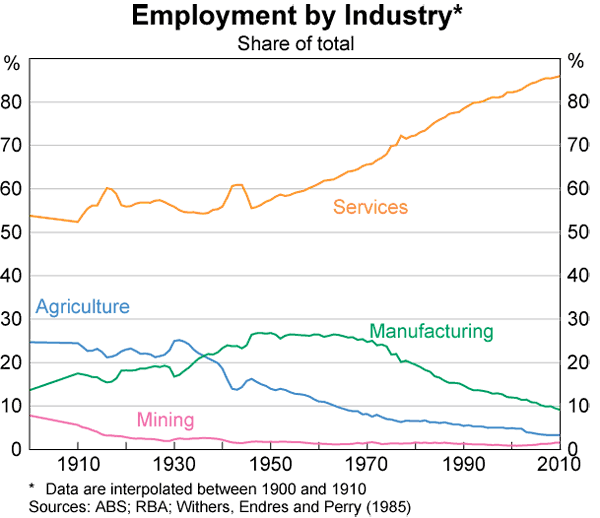
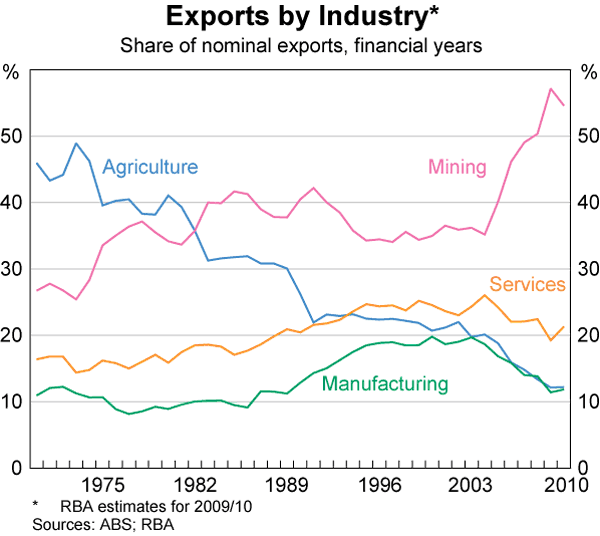
During his speech the governor referred to an RBA research paper, Structural Change in the Australian Economy which casts an interesting light on the comparative advantages in those “various services”.

That paper shows that service sector employment has risen to nearly 85% while its share of GDP has stayed around the same for the last twenty years, which to this non-economist’s mind implies the portion of national wealth is declining for service based workers and businesses.

Sleepwalking into the dutch disease

Of course those of us in the service sector could make it up by exporting but here again, service sector exports haven’t done much over the last decade which won’t be helped by the current high Aussie dollar — another aspect of the Dutch Disease we seem to have sleep walked into over the Howard and Rudd years.

Those same statistics show mining employment has declined over that period as well and if you’re considering sending your kids down the pit, or even packing in your own city job to drive a mining truck, you might want to read the interesting work being done by the University of Sydney’s school of robotics.

Generously, Governor Stevens didn’t completely write off the role of technology observing that, “in the old versus new economy stakes, it was probably in the use of information technology, rather than in the production of IT goods, that the gains would be greatest.”

Invest in, but don’t develop, technology

The Governor’s messages are clear to business people; our businesses have to invest in technology to be more efficient and we need to understand that government policy will be geared around the mining sector.

Most importantly, we need to understand that on a national level there is no Plan B.

In the last election it was clear both sides of politics based their policies, such as they were, on the assumption the China boom will last for the foreseeable future. Yesterday’s speech shows Glenn Stevens and the Reserve Bank share that outlook and no other alternative is being planned for.

That’s fine for Glenn, Julia, Tony and their colleagues as they have safe, indexed pensions when they deign to cease giving us the benefit of their visionary leadership.

In the business community we don’t have that luxury; a plan B is required just in case things don’t quite work out the way we hope. As the Governor says:

Succeeding in the future won’t ultimately be a result of forecasting. It will be a result of adapting to the way the world is changing and giving constant attention to the fundamentals of improving productivity. That adaptability is as important as ever, in the uncertain times that we face.

That’s excellent advice. How adaptable is your business in these uncertain times?

The next business era

No business is invulnerable in a time of change

Ray Ozzie, Microsoft’s outgoing Chief Software Architect, has some interesting reflections on the future of the PC as he steps down after five years.

His views on the mobile, pervasive always connected world and how the Personal Computer fits into it come at a time when there are real questions on how the Microsoft will fare in coming years.

Scoble’s article, based on an interview with Starbucks Chief Information Officer, Stephen Gillet, describes how laptop usage is falling as customers are moving to slate computers such as the iPad and smartphones. He also touches on how standards like HTML 5 are beginning to replace proprietary products like Adobe Flash and Microsoft Silverlight.

Is this necessary bad news for Microsoft? Perhaps not, but it what it means is they will have to reinvent the business away from the old, PC based, model of selling operating system licences.

That’s not to say it can’t be done, Bill Gates successful turned the entire company around to an Internet Explorer view of the computer industry shortly after the launch of Windows 95 as it became apparent the bet on the Microsoft Network was wrong and the open Internet was where the market was going.

One salient point that we should remember is the biggest businesses are not forever. In his post, Ray referred to the 1939 New York State Fair where one of the key exhibits was the S1 locomotive which was built by the Pennsylvania Railroad

At one stage the Pennsylvania Railroad was the world’s biggest listed company, it went a hundred years without missing a dividend payment and at one stage employed more people than the US government.

It ceased to exist in 1976.

No business is forever and even the most powerful is at risk during times of great change. We need to remember that when looking at today’s seemingly untouchable business giants.

The 360º brand

Our brand is bigger than just advertising

“How do I advertise on LinkedIn? Asked a business owner at a recent workshop.

While I answered that LinkedIn advertising probably isn’t the right path for many small businesses, one of my fellow presenters, Lara Solomon, disagreed and made the point LinkedIn is an important marketing tool.

There’s no doubt about that as a marketing, rather than an advertising tool, all online channels — including LinkedIn pages — are important to businesses as customers, suppliers and potential staff check the web before doing business with an organisation.

A good illustration of this was over the weekend when digital marketer, Raz Chorev, called out chicken chain Oporto’s for not training their staff on honouring Foursquare deals. Raz also made a point about censoring web comments which might be the topic of a future post, but really isn’t the issue here.

Raz’s comments appeared on Twitter, Facebook and on web searches. To their credit, Oporto responded quickly by isolating the damage, explaining their position and learning a lesson on letting their staff know about all the offers they post.

It isn’t just cranky customers posting on their own sites or any one of the thousands of review services such as Eatablity or Tripadvisor, we’re being judged on the comments of ex-employees, suppliers and even the quality and content of our own online utterings.

our brand is out there, on line, all the time.

A surly call centre, missed deliveries or billing mistakes all add up and damage our brands. Eventually, the massed weight of negative comments can overwhelm even the best, most expensive advertising campaign.

Our brands, both as individuals and our businesses are bigger than just marketing, we have to make sure we are consistently doing the right thing by our customers, suppliers and staff.

We’re in an era of accountablity which forces us to deliver on our promises. This is not a bad thing.

A time for fresh ideas

To stand out from the crowd we need to be original and creative

Stale old thinking doesn’t cut it anymore. In an age when plagiarism and rip offs can be uncovered with a few minutes searching on the web, simply copying someone else’s work has ceased to be an option.

The same can be said for just recycling past ideas; the days of money for old rope are over.

It’s time for new, innovative ideas and work. The opportunities for getting fresh thinking into society and business have never been greater.

We can all do better than just leeching of other people’s work.

Eight online tips for franchising

Is your franchise network part of the online economy, or becoming a relic of the past?

The world wide reach of the web has always been a problem for territory based franchises. As a consequence, many franchise networks have a token web presence which they use mainly as a recruitment tool for new franchisees.

An aversion to the web presents a difficulty for these franchisees as most customers are now online. By not actively using the net, those locally based franchise chains are finding themselves at a disadvantage to their non-franchised competitors.

The franchising industry’s problem was illustrated last week by Ben who called into to my ABC radio spot last week on Internet business trends to ask about how a territory based lawn mowing franchisee can use the web.

Ben’s question raised some important points that franchise holders — and anyone considering entering a franchise — should check to make sure that business is competing in today’s marketplace.

Does the franchise have an individual page for each territory?

Each franchise area should it’s own page within the chain’s site. While the contact details can redirect back to the central phone or form, the territory page should include some local testimonials and few other localised features.

Is the home page regularly updated?

A static index page that rarely changes isn’t attractive to search engines or customers. A vibrant business should be updating their page regularly. This is particularly true if there is a substantial network of franchisees.

How does the site rank?

When searching for the product or service the franchise sells, how high does the franchise’s page come up. If it doesn’t appear in the first page, then the franchise isn’t working.

Does local search work?

Type in a search for the franchise’s product and an established territory such as “lawn mowing Footscray”. If the Footscray franchise doesn’t appear in the local listings then the franchisor hasn’t listed their sites in the local search listings.

What does the site sell?

In researching this article, I found the biggest franchised lawn mowing chain appears in paid ads for “buy a lawn mowing franchise” but not for a actual lawn mowing. A site or digital strategy designed to sell franchises is good for the franchisor but doesn’t do much for the franchisee looking for customers.

Is the franchise engaging with social media?

Whether you trust social media or not, the market is talking about you on forums, blogs, Facebook, Twitter and other channels. A great example of this was Oporto last weekend. A franchise needs to be engaging with customers, critics and fans.

Where are the franchisees?

Are the franchisees listing themselves? This is always a worrying sign that a franchise isn’t controlling its marketing properly. On the other hand, if their personal profiles aren’t appearing on sites like LinkedIn, it can indicate too tight a control on franchises.

What is their media strategy?

The whole point of buying a franchise is to have a ready made brand and marketing strategy. If a franchise is locked into a print mindset with only at best a token online presence then they aren’t going where the customers are. Have a look at the online versus print effort before signing up.

Many franchisors are playing by 1990s rules. Which was great for the last twenty years, but the old models are evolved as customers and potential franchisees have changed the way they shop and do business.

The web and social media are more than just a passing fad or a blunt advertising and marketing tool. They are a key part of your business identity and are being used by suppliers, recruiters, job seekers and commercial partners to figure out whether you are worth doing business with.

A franchise that doesn’t use today’s media tools is stuck in yesterday’s market.