Author: Paul Wallbank

  • Connecting 400 points of voter data

    Connecting 400 points of voter data

    As the 2016 US Presidential race enters its final stages, it’s interesting to see how data is being used by American political candidates and what this means for business.

    During last week’s Oracle Open World in San Francisco a panel hosted by the company’s Political Action Committee featured Stephanie Cutter, who worked on Obama’s 2008 and 2012 campaigns, and Mike Murphy, a Republican operative whose most recently worked on Jeb Bush’s primary effort against Donald Trump.

    While the discussion mainly focused on the politics – “Crazy times seem to require crazy candidates” says Murphy – it was the technology aspect of modern elections that was notable.

    Setting the data standard

    The Obama campaign of 2008 set the standard for how modern political campaigns used social media and information, “we revolutionized how data analytics helps predict how people will vote and how they will persuade voters to turn out.” Cutter said.

    “We put a big investment into it and Republicans have caught up,” she continued. “The key though was we relied on our own data and nothing that was out in the public domain. We didn’t rely on one piece of data, we had multiple sources. We had an analytics program where we were making 9,000 calls a night where we were predicting the votes.”

    Murphy agreed with the political campaigns using data, “the kind of polling you see in the media has kind of vanished in campaigns where they have money to spend on research.” He said, “we don’t do telephone polling any more because we have so much data we can collect.”

    Capturing everything

    “We capture everything. We have about four hundred data points on the American voter and we’ll have five hundred in the next two years. We’ll be able to build massive data models without phone polling,” Murphy pointed out. “We’re waiting for the tech folk to get ahead on AI so we can predict what voters are going to do in two weeks.”

    Despite the amount data collected by US political parties, the real key to success is the candidate’s organisation and management. Cutter made a strong point about the strength of Obama’s campaign team in both the 2008 and 2012 campaigns.

    How the US political parties use data points to how businesses will be managing data in the future. Increasingly using information well is going to be the measure of successful organisations in both politics and industry.


    Similar posts:

    • No Related Posts
  • Facebook proves a false saviour for advertisers and publishers

    Facebook proves a false saviour for advertisers and publishers

    The advertising industry is in trouble, as consumers’ eyeballs move from broadcast mediums to online services, the wildly successful Twentieth Century business model that drove the radio and television industries is dying.

    One of the biggest hopes for advertisers, and publishers, was social media would be the salvation of their mass market model. Facebook continues to prove it isn’t the messiah with the Wall Street Journal reporting video viewing figures have been inflated for the past two years.

    Coupled with the recently announced shift away from publishers Facebook is increasingly showing any hopes of replicating the broadcast media model on social platforms is doomed.

    So it isn’t surprising advertisers are angry at Facebook for mis-stating its figures although a cynic would suggest those inflated statistics helped drive its video service over competitors like YouTube at a critical time.

    Whether Facebook’s actions were deliberate or otherwise, the service’s misleading behaviour only underscores how publishers and advertisers are struggling to find ways to translate their business model to an online world.

    Similar posts:

    • No Related Posts
  • Data and the modern movie producer

    Data and the modern movie producer

    Dealing with the massive wave of data flowing into businesses will be one of the defining management issues of the next decade. One company that is already dealing with this is New Zealand’s Weta Digital.

    Wellington based Weta that’s best known for its work on Lord of the Rings and is part owned by director Peter Jackson employs 1400 staff for its movie special effects work and has won five visual effects Academy Awards over its 23 years of operations.

    Kathy Gruzas, WETA Digital’s CIO, spoke to Decoding the new Economy at the Oracle OpenWorld forum in San Francisco this week about some of the challenges in dealing with the massive amount of data generated by the movie effects industry.

    “We have some very heavy loads.” Kathy states. “We push our systems to the limit.”

    Applying powerful systems

    One challenge is the sheer computing power required, ‘the render frame processes one frame per server until you have four seconds of footage. Sometimes that takes over night or even longer and for that we use a lot of storage,” Kathy says. “The render farm being six thousand servers will write 60 to 100 terabytes of data a day and read a quarter to half a petabyte each day.”

    “We need systems that will be very large to handle the volume of data we generate but also be very quick to handle those read and writes.”

    “One render could use a thousand computers, sometimes more, and all of those will be reading and writing against the same block of storage so we have our own software layer that directs those loads but we try to minimise the load on our storage but we have the worst work load you can imagine with lots of servers, lots of small reads and writes and many of them random and concurrent with pockets of hot files.”

    Despite the automation, the business is still extremely capital intensive. “In visual effects you probably need at least three hundred artists to work on one film, it’s a very labour intensive process to do the artistry and much like a production line.”

    Going mobile

    The nature of modern movie production means the effects teams are now part of the shoot which adds another level of complexity for Weta. “Although we are visual effects which is largely post-production we do go out with crews when they’re shooting the movie so we can do reference photography,” says Kathy.

    “We do 3D scans so if we need to do something digitally and we do motion and facial capture as well,” she says. “There are 240 muscles that we tweak individually to get the expression. That’s a huge amount of data to capture.”

    To do this, Weta created their own ‘road case’ that contains everything they need to grab the shots and store the data they need, “you can’t ask the director retake the shot because we missed something.”

    Into the forest

    “We have to take the case into the forest and into the rain and everywhere. It’s good having that roadcase that has storage, networking and servers in it.” The case, which was self assembled by Weta’s team is “probably the most travelled Oracle system on the planet,” laughs Kathy with “lots of data capture and sub-rendering.”

    Weta’s story illustrates just how managing data is becoming a critical issue for companies. While movie special effects is very much a specialised field that’s far ahead of the curve in its technology use than most businesses, they do show the importance of managing and securing their data.

    For other businesses, lessons from Weta is understanding your company’s – including staff and customers’ – needs then investing in the right tools to deliver is essential.

    One important difference between technology intensive businesses like Weta and most other organisations is the New Zealand company is doing most of its processing and storage in house. Those without the same needs will almost certainly be shifting these tasks onto the cloud.

    Similar posts:

    • No Related Posts
  • What’s next for small business – trends in the modern workplace

    What’s next for small business – trends in the modern workplace

    This week’s The Future is now – Trends in the Modern Workplace webinar was an opportunity to look at the trends affecting small and micro businesses.

    What’s notable is almost all the topics affecting small business are being felt by their corporate cousins. It shouldn’t be surprising the technology and social trends affecting society are equally being felt

    Now the webinar is over, I’ve posted the presentation to Slideshare with the commentary below, we cover established trends like the shift to mobile then ponder the future of business with artificial intelligence and virtual reality.

    The presentation ties up with the post I published a few days ago that provides the commentary to the slides.

    Similar posts:

  • Seeking salvation in the cloud

    Seeking salvation in the cloud

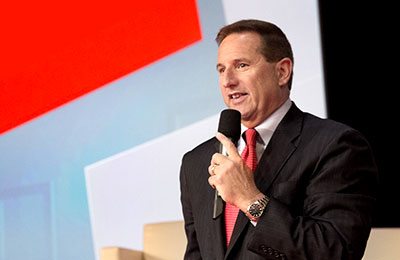
    Oracle CEO Mark Hurd’s keynote at the company’s Open World conference in San Francisco yesterday illustrated a problem facing businesses around the world and its effects on enterprise software vendors like the one he heads.

    “Standard and Poor’s top five hundred companies’ revenue growth is at one percent, their earnings growth is five percent.” “It means what? Expenses are going down.”

    “This is the problem that the CEO has,” he says. “Why is it hard to grow revenue. All your investors want you to grow earnings and deliver growth. They have little patience for any long story about why it’s so hard.”

    “They don’t care about any issues you may have. Grow earnings, grow cash flow, grow stock price. That’s it.”

    Growing in a slow market

    As a result of that the easiest way to grow earnings is to grow revenues but when global GDP and markets are flat, the only way to grow is to gain market share, Hurd says. “We have to know the customer better, we have to do a better job of marketing and we have to do a better job of aligning our goods and services to what our customers want. We have to improve our products and processes.”

    That imperative for companies to cut their operating costs has had a brutal effect on enterprise IT budgets, “over the past five years, the growth in enterprise IT has been flat.” Hurd says, “the growth in spending has been basically zero.”

    Customers drive the market

    Like many things in the tech industry, the sector’s growth focus has shifted to consumers, “consumer spending on IT has almost quadrupled in the past decade. So while companies are sort of flat, consumers have been spending like crazy.” Hurd observes, “consumers are more sophisticated, more capable, more knowledgeable and expect better services than ever before.”

    “Your customer experience is not being defined by your competitors but by technology fuelled consumers. For instance, AirBnB may be defining customer experience for the hospitality industry.”

    “People are using a lot of social technologies in their personal lives,” “we expect ease of use, simplicity, clean interfaces are now things we expect in the enterprise side.”

    Crimping innovation

    In the enterprise IT sector, Hurd believes the flat market means many companies catering to the corporate market are skimping on Research and Development which in turn is crimping innovation, a factor compounded by cloud providers taking an increasingly larger share of the market.

    This is underscored by cloud leader Amazon Web Services spending over ten billion dollars a year on R&D. Hurd’s boast that Oracle is spending half of that shows how the legacy players are struggling.

    What stands out in Hurd’s keynote is how legacy providers see cloud computing as their salvation. However Amazon’s dominance in that space is a major obstacle for them.

    For consumers, big and small, the shift to the cloud has been a good thing in shaking up the existing industry and making new technologies more accessible to smaller customers. For existing businesses like Oracle, there’s a challenge in adapting to a lower margin, commoditized and quickly changing market.

    A bigger question though facing all large corporations, not just software companies, is this new normal of low economic growth. Succeeding in that environment is going require a completely different management and investor mind set to that of the last seventy years.

    Similar posts:

    • No Related Posts