Author: Paul Wallbank

  • Necessity, innovation and the birth of the web

    Necessity, innovation and the birth of the web

    The man who invented the world wide web, Tim Berners-Lee spoke at the launch of the CSIRO’s Digital Productivity and Services Flagship in Sydney yesterday.

    In telling about how the idea the idea of web, or Hyper Text Markup Language (HTML), came about Berners-Lee touched on some fundamental truths about innovation in big organisations.

    In the 1990s the European Laboratory for Particle Physics (CERN) in Geneva had thousands of researchers bringing their own computers, it was an early version of what we now call the Bring Your Own Device (BYOD) policy.

    “When they used their computers, they used their favourite computer running their favourite operating system. If they didn’t like what was available they wrote the software themselves,” said Tim. “Of course, none of these talked to each other.”

    As a result sharing data was a nightmare as each scientist created documents using their own programs which often didn’t work on their colleagues’ computers.

    Tim had the idea of standard language that would allow researchers to share information easily, although getting projects like this running in large bureaucratic organisations like CERN isn’t easy.

    For getting HTML and the web running in CERN Tim gives credit to his boss, Mike Sendall, who supported him and his idea.

    “If you’re wondering why innovation happens, one of the things is great bosses who let you do things on the side, Mike found an excuse to get a NeXT computer,” remembers Tim. “‘Why don’t you test it with your hypertext program?’ Mike said with a wink.”

    There’s much talk about innovation in organisations, but without management support those ideas go nowhere, the story of the web is possibly the best example of what can happen when executives don’t just expect their workers to clock in, shut up and watch the clock.

    One key point Tim made in his presentation was that it was twenty years after the Internet was invented before the web came along and another five years until the online world really took off.

    We’re at that stage of development with the web now and with the development of the new HTML5 standard we’re going to see far more communication between machines.

    Berners-Lee says “instead of having 1011 web pages communicating, we start to have 1011 computers talking to each other.”

    These connections mean online innovation is only just beginning, we haven’t seen anything yet.

    If you want your staff to stay quiet and watch the clock, that’s fine. But your clock might be figuring out how to do your job better than you can.

    Tim Berners-Lee image courtesy of Tanaka on Flickr

    Similar posts:

  • Explaining the NBN on 702 Sydney ABC Radio

    Explaining the NBN on 702 Sydney ABC Radio

    I’ve covered what the NBN is previously on the ABC for Tony Delroy’s Nightlife and on Technology Spectator last year looked at the challenges ahead for the project in 2013.

    The National Broadband Network was always going to be one of the key issues in the 2013 Federal election, The Liberal Party’s policy launch on Sunday and Malcolm Turnbull’s comments on ABC Radio station 702 Sydney on Friday illustrated how critical it will be.

    His assertion that wireless should be affordable is laudable, but the indications are that it is increasingly going to become less affordable.

    It also puts the coalition in a bad position, losing the three to four billion dollars expected from the spectrum auction wouldn’t help their budget position.

    One comment from Malcolm that particularly sticks out is on subsidies;

    If I could just make one other point Linda, possibly the most important. The government as we know is spending a stupendous amount of money on building a national fibre to the premises broadband network. And the subsidies there run into the tens of billions of dollars –

    The member for Wentworth is facturally wrong; there are no subsidies for the NBN, the government is providing the capital for the project which they hope will be paid back by 2018.

    the value of the network once completed will be a fraction of what the government is spending on it.

    On what basis? Certainly fibre has a 25 to 40 year expected life cycle, but that’s true of a roadway or an office building; does Malcolm suggest we don’t spend on that as well.

    you could make a very powerful argument that the form, the channel of broadband communication which adds the most to productivity is in fact wireless broadband.

    Possibly, but let’s see that argument. Currently data downloads to fixed lines still dwarfs mobile, both are growing exponentially.

    Malcolm actually touches on the problem we’re facing with wireless — the shortage of bandwidth.

    The government has been very slow at getting it out. As of the last report there was only about eight and a half thousand premises connected to the fibre optic network that they’re building throughout all of Australia

    This is true, the rollout so far of the NBN has been disappointing. This is what observers are watching closely on this.

    The Fibre to the Node setup also creates another problem – that of ownership. If Telstra retain ownership of the copper cable from the node to the premises, it means providers have to deal with two wholesalers one of whom is their competitor.

    In fact it creates a whole rabbit’s nest of problems for retailers and could very quickly find us in a situation where telco access requires dealing with two monopolies — Telstra and NBNCo.

    One the disappointing things about the National Broadband Network has been the poor debate around the topic, indeed the whole debate at times has been wrong headed. Any hope it’s going to improve during the election campaign isn’t likely

    Similar posts:

  • Managing unemployment perceptions

    Managing unemployment perceptions

    Stephen Koukoulas has a look at the changing composition of the Australian economy in Business Spectator today where he looks at how things have evolved over the last 50 years.

    One of the notable things is unemployment and how our perception of what an acceptable level is;

    Australia’s unemployment rate is 5.4 per cent at present, it was 0.9 per cent in August 1970 while in August 1951 it was a staggering 0.3 per cent.

    In the 1961 Federal election the Menzies government hung on by one seat, having been punished for allowing the unemployment rate to reach the dizzying heights of 3.5 per cent.

    Through the Twentieth Century, Australia’s unemployment rate averaged around 5% as shown in this Treasury graph.

    Australia's unemployment through the twentieth century

    What’s notable in that graph is how high unemployment became the norm in the last quarter of the century. When it became obvious politicians and economists couldn’t move the needle below 5%, the process of convincing us that five percent was ‘good’ began.

    One wonders what the acceptable level of unemployment will be for the next generation. Will they consider us the failures that our grandparents would?

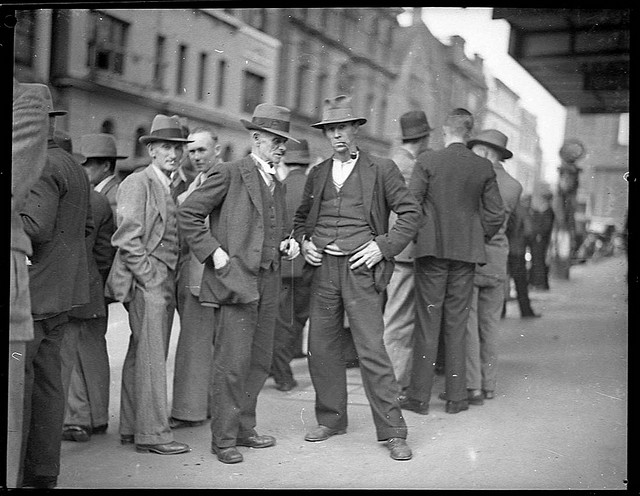
    Image of unemployed carpenters in 1935 courtesy of the NSW State Library via Flickr

    Similar posts:

  • Throwing your problems over the fence

    Throwing your problems over the fence

    I first heard the term “throwing the problem over the fence” from a telco project manager a few years ago, it describes how modern organisations shift risk to others.

    Throwing the problem over the fence usually involves contracting out a task, the philosophy is once the contract is signed delivery is no longer management’s problem, it’s now the responsibility of the contractor. Once the job is over the fence it’s out of sight and out of mind.

    Governments, financial institutions and most corporations have become very good at throwing their problems over the fence.

    Contracting away your worries

    A core tenet of 1980s management thinking is contracting out; freeing executives from the tedious task of actually doing their jobs lets them focus on the important things in life, like securing performance bonuses.

    Of course you can’t contract out risk – risk is like toothpaste, squeeze it in one place and it oozes out somewhere else.

    Unlike toothpaste, risks have a habit of growing if they are ignored. Which becomes a problem for whoever is unwittingly on the other side of the fence.

    Railways and risk

    In “The Crash That Stopped Britain” author Ian Jack looked at the causes of the October 2000 Hatfield train accident which threw the nation’s railway network into chaos.

    Jack correctly predicted that no-one would be found responsible as the tangle of rail operators, maintenance companies, financiers, labour hire firms and regulators made it almost impossible to determine exactly where responsibility for a fatal failure lay.

    Diffusing responsibility is partly by design although originally the idea was to save costs, the theory being that tendering work previously done in house to the lowest cost provider would save money.

    Instead its caused an escalation in costs as contracting out meant an increase in middlemen as financiers, lawyers, project managers, contract administrators – of which I was once one – and many others are drafted in to manage the outsourced contracts.

    Throughout the Anglosphere – the US, UK, Canada, Australia and New Zealand – the results of embracing this mentality has meant skyrocketing costs and delays in public work projects, a good example being the Southern Sydney Freight Line which was three years late and 250% over budget.

    Naturally no-one is held responsible for the delays, cost over-runs or lousy initial planning and estimating on that project, which is a happy result for everyone except the taxpayer who foots the bill.

    The Global Financial Crisis

    While the cost of building railways, schools and motorways is a chronic problem, a far more bigger issue is the role of “throwing problems over the fence” in the financial industry.

    Securitisation was seen as a magic bullet for the banking industry in the 1990s, the Basel Accords allowed banks to bundle up their entire home loan portfolios and throw them over the fence to fund managers and their unwitting investors.

    When the inevitable happened with the Global Financial Crisis in 2008, it was difficult to attribute exactly who held the mortgages, let alone who was responsible for the losses among the mass of brokers, ratings agencies, fund managers and bankers who’d profited so well from the boom.

    The only thing we could be sure of was that it was the taxpayer – you, your children and grand-children – who ended up holding the problem when the GFC’s bills were hurled over the last fence.

    On the other side of the fence

    Risk isn’t something that can be thrown over a fence, eventually it comes back in a bigger and nastier way. The question is who ends up dealing with it.

    The genius of political and business leaders in the last 30 years has been in how they’ve thrown their responsibilities over the fence while retaining the perks and privilege of holding responsible positions.

    Generally it’s taxpayers and shareholders sitting on the other side of the fence who have to deal with the costs and they aren’t getting cheaper.

    Similar posts:

  • Can Yahoo! disrupt the disruptors?

    Can Yahoo! disrupt the disruptors?

    Yahoo! CEO Marissa Mayer packed out the room for her interview at the World Economic Forum this week where she spoke about some of the challenges her and the company face.

    One of the areas she sees for Yahoo! is in collaborating with other tech industry giants.

    Mayer also is making a point of collaborating with companies such as Apple Inc., Google and Facebook, instead of competing.

    “It ultimately means there’s really an opportunity for strong partnerships,” she said.

    The problem for Yahoo! is that it doesn’t have a lot to offer companies like Apple, Google or Facebook – they are steaming along on their own and have moved ahead of the areas which Yahoo! dominated a decade ago.

    Generally in the tech industry partnerships are more the result of the sector’s also-ran coming together in the hope that their combined might will overcome the leader’s advantages.

    It’s the same philosophy that thinks tying the third and fourth placed runners legs together will make them faster than the winner.

    A good example of this is Microsoft’s tie up with Nokia over the Windows Phone. If anything, the net effect has put Windows Phone and Nokia even further behind Apple and Google in the handset market.

    Even when two tech companies have united to exploit their individual strengths, the results usually end in tears. Probably the best example of this was the IBM and Microsoft joint venture to develop the OS/2 operating system which eventually sank under IBM’s bureaucrat incompetence and Microsoft’s disingenuous management.

    Those two examples show how partnerships only work when each party has something valuable to contribute and all sides are committed to the venture.

    Marissa Mayer’s task is to find Yahoo!’s strengths and build on them, then she’ll be in a position to enter partnerships on an equal basis.

    Whether its worth entering into partnerships with the big players though is another question. It may well be that Yahoo! has more to offer smaller businesses and disruptive startups.

    Entering into a desperate alliance with Apple or Facebook could possibly be the worst thing Yahoo! could do, the company is no longer a leader and now needs to be a challenger or a disruptor.

    Facebook’s locking competitors out of data feeds is an example of how complacent the big four internet giants are becoming, Yahoo! are in the position to upset that comfortable club.

    The value of partnerships is that we all have weaknesses and strengths, a properly thought out venture builds on the various parties’ strengths and covers their weak spots. Right now Yahoo! has more weaknesses than strengths.

    Similar posts: