Last weekend’s ABC Radio spot looked at setting up a blog. There’s a whole range of reasons why you’d one to build one; to start a business, to publicise a charity or to show off your hobby.
We were lucky to get food bloggers Thang Ngo from Noodlies and Rebecca Varidel from Inside Cuisine calling in to tell their experiences of setting up successful websites.
One common factor for both was they had started off using the free Google Blogger service and then moved up to the more robust and scalable WordPress platform as their sites took off.
Rebecca and Thang’s journeys, which is common for many businesses and entrepreneurs, illustrates how our plans have to be flexible and the tools we choose must be able to adapt to changed circumstances.
The nineteenth century German general, Helmuth von Moltke, said “no battle plan survives first contact with the enemy”. The same is true of business plans; none survive first contact with the realities of the marketplace.
As our businesses adapt to the ever changing economy and the needs of our customers, we can’t afford to get locked into static tools and responses. Our choices have to reflect that we will make mistakes, assumptions will be proved wrong or our customers, suppliers and staff will change.
Being flexible and open to new ideas is essential to survival in the 21st Century economy. The days of doing things because they have always been done this way are over.
One of the things that’s great with the Internet is we’re able to get our ideas out to the world very easily without spending much money. If you have a great idea, for a business, community group or just an interest there’s nothing stopping you letting the planet know about you and your dreams.
During the Sydney Writers Festival we saw debates between food bloggers and the print critics, particularly notable was Food blogger Rebecca Varidel and her Inside Cuisine website.
The biggest challenge is setting up a website so you can be found on the net, today’s tools make it very easy to set up a site. Here’s a few you can use.
This is the best basic starting tool which also has the attraction of being free.
Blogger’s simple layout which you can change by dragging and dropping the various parts of the website works well and you can add features such as subscription services, advertising, e-commerce and other features by turning on various “gadgets”.
52 Suburbs and Grab Your Fork are two good examples of Blogger based sites. In Louise’s case she registered the 52 Suburbs domain name – the bit behind the “www” or “@” in an email – which costs around $20 a year.
The big daddy of Internet publishing is the WordPress tool. This free software drives most websites and is becoming the software of choice. Rebecca at Inside Cuisine and this website are using WordPress along with thousandds of businesses.
One WordPress’ great attractions is it features thousands of ready to use “widgets” and templates that makes it extremely easy to add features and customise your website.
WordPress offers a free service that gives you the basics of the platform. To get the most from WordPress you need to host the site with a web hosting provider and this can get more expensive and complex.
Other tools
There are hundreds of other platforms you can use to get your ideas out to the world. Worpress, Blogger and Facebook are just three of the most popular and easy to use. It’s worth exploring with what you find works well for your idea or business.
Growing your site
As your site grows, you’ll need to manage content, track visitors and promote it through the various social media and traditional methods. We have some free resources from NSW Microbusiness Month that can help you manage and grow your online presence.
If you subscribe to our newsletter we also make available various free offers along with keeping readers up to date with smart new ideas.
There’s nothing to stop you getting your ideas online. If you want to do something interesting, or even change the world, the tools are now here for you to do it.
We all claim to want a simple life, but sometimes we make things too darned complex by slapping layers of technology on problems that should have straightforward solutions.
New York Times’ technology writer David Pogue last week wrote about his battles with technology at speaking events, often finding he can’t control his own presentation or the hapless venue doesn’t have the right dongle for his computer.
At one event he describes how he had a technician driving two computers, one showing the current slide and the other showing the next slide so David would know what was coming up next. The article is worth a read just to understand what hoops people will go through to get technology working for them.
Like all technologists, David has a touching belief in the reliability of technology and forgets Murphy’s Law – what can go wrong will go wrong. To a degree we’re all doing this as technology becomes pervasive, cheap and easy to use.
Because it’s so easy to use, we assume it’s always going to be there so we come to rely complex solutions to simple problems. The GPS takes the place of the street directory and, because the computer says ‘yes’, we suspend belief in our own eyes until we find ourselves stranded in the wilderness.
The business risks are even greater when the computer says ‘no’ and all work comes to a stop, as we’ve seen with recent bank and airline outages.
The chain of disasters that led to the Fukushima Dai ichi nuclear plant meltdown is probably the worst case example. Each potential problem had a complex solution involving standby power and emergency pumps, all of which were washed away by the tsunami leaving the operators helpless.
Fortunately most of us will never be responsible for a nuclear meltdown – except maybe in our own offices after a disastrous presentation – but the lesson is that the more simple we can keep our systems, the more robust our businesses.
David Pogue’s adventures are a good example of this, avoiding disaster when he was told his computer, and therefore his presenter view, would be off stage, David panicked and it was only when he realised he could have a, gasp, print out of his event was the day saved.
A simple hard copy print out beats the technology bugs every time which is what anybody who regular gives presentations knows.
With presentations, people have come to expect to see a slide show illustrating the speakers points which does add complexity to everybody’s lives. Just how complex it can be is shown in how I make sure we have there’s a working presentation at the venue;
Mail the presentation to the organisers a few days before
Upload a copy to Dropbox or Box.net
Save the presentation to a USB stick
Copy the presentation to a netbook computer
Take the netbook with me. The netbook is dumb and cheap but it has a VGA output which will work with most projectors
Have a print out the presentation with speaker’s notes
Arrive early
Finally, I practice. Winging it the way David Pogue does is a recipe for embarrassment
Practice is an important thing both in presentation and businesses. If staff are trained, prepared and confident then they can work around tech or other hiccups.
How can you strip some of the complexity out of your operations? You could save some money along with making your business more flexible and robust.
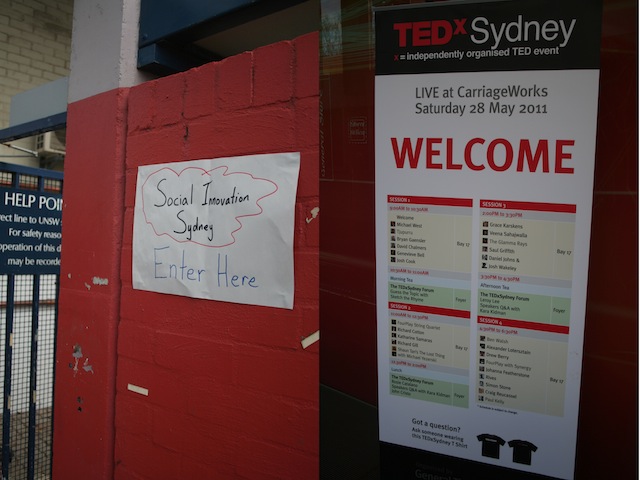
Two conferences about ideas took place in Sydney last Saturday, TEDx Sydney and Social Innovation BarCamp. While both involved exploring concepts and thoughts they could not have been more different.
One was about exclusivity and elitism while the other was about a genuine exchange of ideas. Both the events tell us much about the new and old models of communication and learning.
The entrance to SIBSyd. Exit through the gift shop?
At the Paddington College Of Fine Arts, Social Innovation Bar Camp – SIBSyd – was open to anyone with an idea or who just wanted to show up a throw some thoughts around. Across town at the Everleigh Carriageworks, the TEDx Sydney offshoot of the prestigious US TED event featured high profile speakers before an invitation only audience.
Welcome to TEDx Sydney. May I see your invitation, sir?
Most TED events are exclusive and restricted you have to be qualified to attend, let alone speak and this showed in the way the audience were ushered into the auditorium and then asked to turn off their mobile phones unless they wanted to sit in the back two rows.
The speakers at TED were slick, rehearsed and had their presentations timed exactly to the minute – as you’d expect at an event where the content is carefully chosen – while at SIBSyd any of the audience could choose to speak.
Even with a speaker everybody at a SIBSyd is able to participate, with all the audience of giving their views. In the reforming education session I sat in on a quiet lady at the back of the room told her experiences of working with villagers in Chiapas, Mexico.
It’s unlikely that lady would get an invite to TEDx, let alone have the opportunity to tell her story and that illustrates the fundamental difference between the two conferences.
One is the formal, traditional one-to-many lecture from an expert imparting wisdom on an audience awed by the speaker’s knowledge while the other sees the speaker – who may be an expert – drawing out the collective wisdom of the room.
TEDx stage ready for action
The “unconference” structure of meetings like SIBSyd probably does a better job of developing new ideas as the traditional conference TED is based upon that assumes the expert on the stage already has the answers.
Of the two types of conferences, it’s probably safe to say the collaborative “unconference” model works better in driving innovative solutions to problems. To work effectively though it needs the participants to be motivated by common issues.
The traditional TED style conferences do a better job of getting big ideas across to a broader audience and that’s probably one of the reasons why the event’s videos have been such an Internet success.
Both have their role and probably the most worrying thing at the two events was the lack of Australia’s corporate and political leadership, with the exception of Penny Sharpe, MLC who appeared to be the sole member of Parliament attending TEDx, there was little representation from either group.
In a time of massive climate, technology and economic change that is challenging the assumptions and business models of previous generations, it’s a shame our business and political leaders aren’t engaging and listening to those outside their narrow circles.
As part of the plan, the Federal government intends to setup “digital hubs” in the each of the 40 communities that will first benefit from the NBN, these will “assist local residents to better understand how they can benefit from the NBN and to improve their digital literacy skills”.
The whole concept of digital literacy is worrying; it assumes there is something unique about using technology and that the concepts to use web services and devices are arcane and difficult to grasp.
Such a belief might have been true in the days of the command line interface where obscure commands and strange keystroke combinations controlled how you used a computer, but in the age of the touchscreen and intuitive systems the majority of people, regardless of age, can pick up the basic concepts with a few minute’s instructions.
A bigger issue is genuine literacy and numerical skills. Without these, we’re not able to understand or properly evaluate the data that is being presented to us.
Even more important are critical skills, the volume of information on the net demands we have the ability to filter fact from opinion and truth from misinformation if we don’t possess these talents we’re condemned to being unable to filter the gems from the dross that masquerades as fact on the net.
Clifford Stoll said “data is not information, information is not knowledge, knowledge is not understanding, understanding is not wisdom”. Without basic literacy we’re unable to process the data we see on the net, without the critical skills we cannot understand that information.
That’s the real challenge the connected society presents, how do we develop and nurture the critical skills that lets us identify the scammer, the knave and the ill-informed – all of whom thrive in an environment that gives their views equal weight with the wise, honest and knowledgeable.
Probably the best thing we can do for our children, and ourselves, is to work on developing those skills.