Category: society

  • The quiet revolution

    The quiet revolution

    Earlier this weekPricewaterhouseCoopers released their Productivity Scorecard, which showed Australia’s business efficiency isn’t improving as fast at it once was and the country’s relative performance is steadily slipping down international tables.

    One of the notable things in the PwC report is the massive growth of productivity in the 1990s, a point emphasised by the accompanying paper on business productivity in a presentation by economist Saul Eslake last month to the Reserve Bank of Australia.

    Economists attribute most of this late 20th Century growth to deregulation and privatisation by governments in the 1980s and 90s but the driving force was really computerisation that allowed most businesses to do much more with less.

    Immediately noticeable for an Australian walking into a British, European or Japanese office during the early 1990s was the lack of desktop computers.

    Australian businesses adopted technology a lot quicker than their counterparts outside of North America and this alone was probably responsible for the country’s relatively good productivity growth in that decade.

    The arrival of computers – followed by desktop printers and Internet access – suddenly gave small businesses access the means to do jobs that even the biggest corporations had struggled to do previously and drove a rapid reorganisation of most offices.

    Everybody from secretaries to architects and graphic designers to lawyers – even economists – suddenly found they had the tools at their fingertips to do work they could have only dreamed of prior to 1990. This drove massive productivity gains in businesses of all sizes.

    From 2000 onwards, things became tougher as the easy gains had been made and the incremental improvements in technology, such as smartphones, cloud computing and web publishing didn’t have the same substantive effect the early PCs delivered with spreadsheets, word processing and desktop publishing.

    The real challenge we now face in business – and government – is to start harnessing cloud computing driven online services that promise to deliver similar productivity gains to what we saw twenty years ago.

    We have the tools; online office apps, Customer Relation Management services (CRM) and sharing platforms all deliver major improvements in the way we work within our businesses and with external partners like contractors, suppliers and event clients.

    One of the most powerful aspects of cloud computing services is reduced capital cost meaning reduced barriers to entry into markets we previously may have thought were safe.

    This easy access into established sectors is one of reasons the retail industry’s giants are now struggling as online competitors can setup cheaply and quickly while offering better prices and service.

    Retail is only one of the more obvious sectors being changed by these technologies and as the decade continues we’re going to close to every industry be radically changed by low cost computers accessing the Internet.

    As business owners and managers we need to look at our own processes and systems with an eye on how we can improve workflows and customer service within our organisations.

    Those of us who manage to get these new technologies are going to reap the benefit of the next productivity wave, those who don’t are going to go the way that many uncompetitive and slow to respond industries did in the 1980s.


    Similar posts:

  • The Privacy Processors: How social media is re-manufacturing our identities

    The Privacy Processors: How social media is re-manufacturing our identities

    Most of us accept that things we don’t pay for – such as broadcast TV and Internet sites – are supported by advertising or have some sort of catch in order to pay their bills.

    Social media sites have been a great example of this, millions of users on services like Facebook and LinkedIn have accepted targeted advertising and the associated privacy trade offs as the cost of getting a free online service.

    The price of “free” though is escalating, the social networks have moved on from just using our data for displaying advertisements to processing our private information and distributing it in ways we may have never expected.

    Professional networking site LinkedIn caused an uproar last week when their social advertising feature started adding what appeared to be users’ personal endorsements to adverts for products, businesses and websites based on behaviour monitored by the site’s tracking software.

    Facebook, the leading social networking site, also had a recent privacy scare when users discovered the services’ Phonebook feature gleefully displays all the mobile phone numbers of their online contacts and, given the right settings, merges them with those from a mobile phone.

    The recently launched Google Plus takes these risks even further as the search engine giant requires a personal profile before you can use the service which can then be integrated into your search and email histories.

    What we’ve ‘Liked’ or ‘Followed’ online – or even just looked at – is now being processed, regurgitated and delivered to our friends and the public as endorsements and recommendations just like a retired sportsman selling air conditioners or hair restoration products.

    At least the retired cricketer flogging hair products or long past it soap opera star promoting washing powder gets a paycheck, all a social media user gets from the transaction the privilege of sharing their private information along with personal and professional relationships with a multinational advertising platform.

    In some ways the social advertising functions are worse for the user than the celebrity endorsement; most people know the retired sportsman or actress is doing it for a paycheck, the social network advertising clearly implies your friends like that product or company.

    We should also remember it’s not just the sites themselves, one of the reasons for Facebook’s popularity has been the games and applications people can use. Every one of these features has some access to your data and most have a business model for using it to make a buck.

    It’s become common for online applications to send out messages on new users’ accounts, pretending to be a personal message from them. Just this week a new service invoked the ire of Facebook’s founder, Mark Zuckerberg, for doing exactly this.

    This processing of our own data and services is a logical step for social media services desperate to justify billion dollar valuations of their business but few people signed up to these sites to endorse random products or allow someone else to send advertising on their behalf.

    Privacy is no longer the issue with social media services, we’ve now moved into the corporate ownership of our identities. What a corporate algorithm decides are our likes is now being processed and publicly displayed as our endorsements, our tastes and dislikes.

    What interests us, what we enjoy and what we like forms the core of our identities, friendships and personalities. That social media sites seek to take this from us should be our greatest concern with these platforms.

    We need to be careful with what, and whom, we share, like and connect with online.

    Similar posts:

    • No Related Posts
  • The ideas revolution: How to set up a blog

    The ideas revolution: How to set up a blog

    It’s been a big month for ideas in Sydney with the Sydney Writers Festival, TEDx, Vivid Sydney, AMP Amplify and XMedia Lab along with many other events intended to stimulate thought and action.

    One of the things that’s great with the Internet is we’re able to get our ideas out to the world very easily without spending much money. If you have a great idea, for a business, community group or just an interest there’s nothing stopping you letting the planet know about you and your dreams.

    During the Sydney Writers Festival we saw debates between food bloggers and the print critics, particularly notable was Food blogger Rebecca Varidel and her Inside Cuisine website.

    Earlier in May, Louise Hewson launched her 52 Suburbs book and exhibition which was born out of her website chronicling her discoveries around the suburbs of Sydney.

    The biggest challenge is setting up a website so you can be found on the net, today’s tools make it very easy to set up a site. Here’s a few you can use.

    Facebook

    If you already have a Facebook account, it’s very easy to set up a page covering your topic or idea.

    While it’s simple to create a Facebook Page, be aware there are risks as the company has some quirky policies and not everybody has a Facebook account or is comfortable with it.

    Blogger

    This is the best basic starting tool which also has the attraction of being free.

    Blogger’s simple layout which you can change by dragging and dropping the various parts of the website works well and you can add features such as subscription services, advertising, e-commerce and other features by turning on various “gadgets”.

    52 Suburbs and Grab Your Fork are two good examples of Blogger based sites. In Louise’s case she registered the 52 Suburbs domain name – the bit behind the “www” or “@” in an email – which costs around $20 a year.

    WordPress

    The big daddy of Internet publishing is the WordPress tool. This free software drives most websites and is becoming the software of choice. Rebecca at Inside Cuisine and this website are using WordPress along with thousandds of businesses.

    One WordPress’ great attractions is it features thousands of ready to use “widgets” and templates that makes it extremely easy to add features and customise your website.

    WordPress offers a free service that gives you the basics of the platform. To get the most from WordPress you need to host the site with a web hosting provider and this can get more expensive and complex.

    Other tools

    There are hundreds of other platforms you can use to get your ideas out to the world. Worpress, Blogger and Facebook are just three of the most popular and easy to use. It’s worth exploring with what you find works well for your idea or business.

    Growing your site

    As your site grows, you’ll need to manage content, track visitors and promote it through the various social media and traditional methods. We have some free resources from NSW Microbusiness Month that can help you manage and grow your online presence.

    More information

    In July we’ll launching eBu$iness: 7 Steps to Get Your Small Business Online… and Making Money Now! Which will cover all the steps of getting your business online, promoting it and tracking your success. Pre-release orders are available now.

    We also have some free workshops for business wanting to get online sponsored by the NSW Government, contact us for more details.

    If you subscribe to our newsletter we also make available various free offers along with keeping readers up to date with smart new ideas.

    There’s nothing to stop you getting your ideas online. If you want to do something interesting, or even change the world, the tools are now here for you to do it.

    Similar posts:

    • No Related Posts
  • A tale of two conferences

    A tale of two conferences

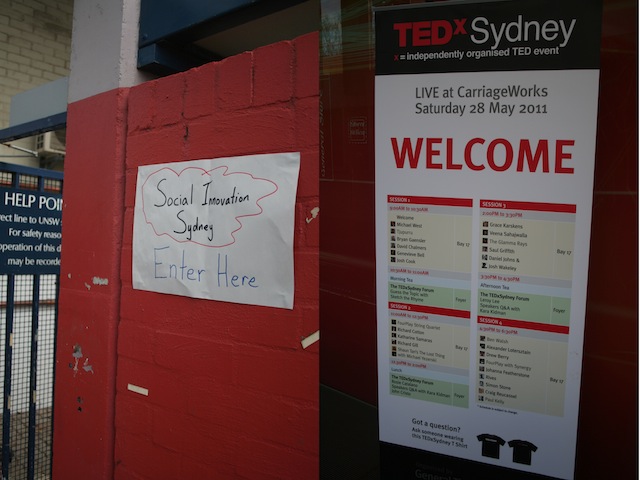
    Two conferences about ideas took place in Sydney last Saturday, TEDx Sydney and Social Innovation BarCamp. While both involved exploring concepts and thoughts they could not have been more different.

    One was about exclusivity and elitism while the other was about a genuine exchange of ideas. Both the events tell us much about the new and old models of communication and learning.

    Welcome sign to SIBSyd
    The entrance to SIBSyd. Exit through the gift shop?

    At the Paddington College Of Fine Arts, Social Innovation Bar Camp ­– SIBSyd – was open to anyone with an idea or who just wanted to show up a throw some thoughts around. Across town at the Everleigh Carriageworks, the TEDx Sydney offshoot of the prestigious US TED event featured high profile speakers before an invitation only audience.

    Welcome sign to TEDx Sydney
    Welcome to TEDx Sydney. May I see your invitation, sir?

    Most TED events are exclusive and restricted you have to be qualified to attend, let alone speak and this showed in the way the audience were ushered into the auditorium and then asked to turn off their mobile phones unless they wanted to sit in the back two rows.

    The speakers at TED were slick, rehearsed and had their presentations timed exactly to the minute – as you’d expect at an event where the content is carefully chosen – while at SIBSyd any of the audience could choose to speak.

    Even with a speaker everybody at a SIBSyd is able to participate, with all the audience of giving their views. In the reforming education session I sat in on a quiet lady at the back of the room told her experiences of working with villagers in Chiapas, Mexico.

    It’s unlikely that lady would get an invite to TEDx, let alone have the opportunity to tell her story and that illustrates the fundamental difference between the two conferences.

    One is the formal, traditional one-to-many lecture from an expert imparting wisdom on an audience awed by the speaker’s knowledge while the other sees the speaker – who may be an expert – drawing out the collective wisdom of the room.

    TEDx Sydney stage setup
    TEDx stage ready for action

    The “unconference” structure of meetings like SIBSyd probably does a better job of developing new ideas as the traditional conference TED is based upon that assumes the expert on the stage already has the answers.

    Of the two types of conferences, it’s probably safe to say the collaborative “unconference” model works better in driving innovative solutions to problems. To work effectively though it needs the participants to be motivated by common issues.

    The traditional TED style conferences do a better job of getting big ideas across to a broader audience and that’s probably one of the reasons why the event’s videos have been such an Internet success.

    Some of the differences reminded me of British writer Paul Carr’s comments about the South By South West Conference in 2009 when he said “I really hope that next year one or two of those early adopters will organise – and I mean that in the loosest sense – a user-generated unofficial fringe conference to sit alongside the main event.” In many ways SIBSyd was the fringe festival to TEDx’s “establishment” status.

    SIB Syd session in progress
    SIB Syd session underway

    Both have their role and probably the most worrying thing at the two events was the lack of Australia’s corporate and political leadership, with the exception of Penny Sharpe, MLC who appeared to be the sole member of Parliament attending TEDx, there was little representation from either group.

    In a time of massive climate, technology and economic change that is challenging the assumptions and business models of previous generations, it’s a shame our business and political leaders aren’t engaging and listening to those outside their narrow circles.

    But ideas are one thing and action is another. As journalist and enfant terrible Stilgherrian said during the day, “completely over events about ‘ideas’. We have plenty of ideas. What we need is a bit of effort put into execution.”

    Hopefully out of both events we’ll see some of the ideas discussed turned into action

    Similar posts:

    • No Related Posts
  • Is there a need for digital literacy?

    Is there a need for digital literacy?

    In preparing for tonight’s ABC Nightlife segment I was re-reading the Australian government’s National Digital Economy Strategy when I twigged what was bugging me in the first few pages; the talk of “digital literacy.

    As part of the plan, the Federal government intends to setup “digital hubs” in the each of the 40 communities that will first benefit from the NBN, these will “assist local residents to better understand how they can benefit from the NBN and to improve their digital literacy skills”.

    The whole concept of digital literacy is worrying; it assumes there is something unique about using technology and that the concepts to use web services and devices are arcane and difficult to grasp.

    Such a belief might have been true in the days of the command line interface where obscure commands and strange keystroke combinations controlled how you used a computer, but in the age of the touchscreen and intuitive systems the majority of people, regardless of age, can pick up the basic concepts with a few minute’s instructions.

    A bigger issue is genuine literacy and numerical skills. Without these, we’re not able to understand or properly evaluate the data that is being presented to us.

    Even more important are critical skills, the volume of information on the net demands we have the ability to filter fact from opinion and truth from misinformation if we don’t possess these talents we’re condemned to being unable to filter the gems from the dross that masquerades as fact on the net.

    Clifford Stoll said “data is not information, information is not knowledge, knowledge is not understanding, understanding is not wisdom”. Without basic literacy we’re unable to process the data we see on the net, without the critical skills we cannot understand that information.

    That’s the real challenge the connected society presents, how do we develop and nurture the critical skills that lets us identify the scammer, the knave and the ill-informed – all of whom thrive in an environment that gives their views equal weight with the wise, honest and knowledgeable.

    Probably the best thing we can do for our children, and ourselves, is to work on developing those skills.

    Similar posts:

    • No Related Posts