Tag: privacy

  • “He looks like a geek”

    “He looks like a geek”

    The unseemly media scrum around alleged Bitcoin inventor Dorian Nakamoto has not been the press’ finest hour.

    What’s more worrying though is a Business Insider interview with Sharon Sargent a ‘forensics analyst’ who was part of the Newsweek investigative team.

    A systems engineer by training with experience in computing security, military protocol analysis, and artificial intelligence, Sergeant said everything she found converged on an individual with a background apparently similar to hers — and who ended up sharing a name with Bitcoin’s creator.

    “I said, ‘I think I know this guy — he wears a pocket protector, he has a slide rule, he comes from that genre,’ which was very different from other characterizations,” she told BI by phone Friday.

    He wears a pocket protector and uses a slide rule? Hell yeah, not only did he create Bitcoin but he’s probably a witch as well.

    One hopes Newsweek have found the right man.

    Picture courtesy of forwardcom through sxc.hu

    Similar posts:

    • No Related Posts
  • On the internet, the Feds know what breed of dog you are

    On the internet, the Feds know what breed of dog you are

    The arrest of alleged Silk Road founder Ross Ulbricht – also known as the Dread Pirate Roberts – has attracted plenty of media attention.

    What’s particularly notable is the FBI is claiming Ulbricht made a basic mistake in posting to a website under his real name that gave his identity away.

    If true, Ulbricht’s trivial mistake illustrates how easy it is for any determined investigator to find someone’s identity online from the trillion points of data we all create in the connected world.

    Anyone who wants to be truly anonymous on the web has to work extremely hard to protect their identity. Most of us aren’t prepared to trade convenience for security, particularly given the massive effort required.

    Even if we could protect our online habits, the use of credit cards, loyalty plans and even driving our cars still it almost impossible to escape the watch of a determined investigator.

    In the early days of the web, it was said “on the internet, no-one knows you’re a dog.” Today the feds can figure out not only what breed of dog you are, but what your name is and your favourite brand of dog food.

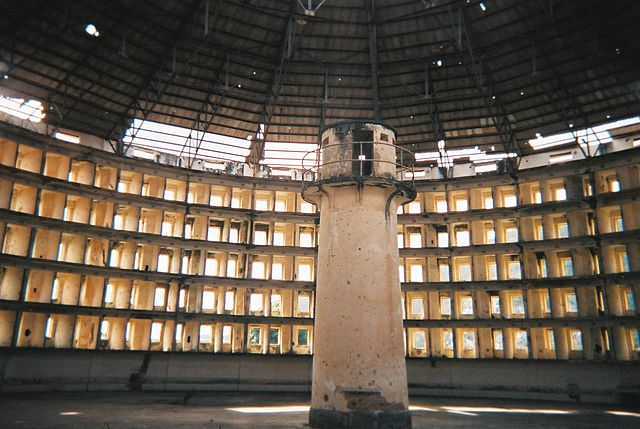
    The modern panopticon we live in is a very efficient machine and it’s difficult to hide from society’s gaze. It’s why we need to rethink privacy and information security.

    Image of Presidio Modelo by Friman through Wikimedia.

    Similar posts:

    • No Related Posts
  • Crumbling cookies

    Crumbling cookies

    On the last ABC radio spot we looked at how our data is being tracked, in the following 702 Sydney program with Linda Mottram we looked at the role of Internet cookies and online privacy.

    Cookies – tiny text files that store visitors’ details on websites – have long been the mainstay of online commerce as they track the behaviour of web surfers.

    For media companies, Cookies have become a key way of identifying and understanding their readers making these web tracking tools an essential part of an already revenue challenged online news model.

    Cookies also present security and privacy risks as, like all Big Data, the information held within them can be cross-referenced with other sources to create a picture of and often identify an internet users.

    These online data crumbs often follow us around the web as advertising platforms and other services, particularly social media sites, monitor our behaviour and the European Union’s Directive on Privacy and Electronic Communications is the first step by regulators to crack down on the use of cookies.

    Similar moves are afoot in the US as regulators start to formulate rules around the use of Cookies, in an Australian context, the National Privacy Principles apply however they are of limited protection as most cookies are not considered to be ‘identifiable data’, the same get out used by US government agencies to monitor citizens’ communications.

    Generally these rules promise to be so cumbersome for online services Google is looking at getting rid of cookies altogether .

    Ditching cookies gives Google a great deal of power with its existing ways of tracking users and ties into Eric Scmidt’s stated aim of making the company’s Google Plus service an identity service that verifies we are who we say we are online.

    Whether Google does succeed in becoming the web’s definitive identity service remains to be seen, we are though in a time where the questions of what is acceptable in tracking our online behaviour are being examined.

    For the media companies and advertising, putting the control of online analytics in the hands of one or two companies may also add another level of middle man in a market where margins are already thin if not non-existent.

    It may well be that we look back on the time when we were worried about  internet cookies tracking us as being a more innocent time.

    Similar posts:

    • No Related Posts
  • Microsoft’s China crisis

    Microsoft’s China crisis

    That the Chinese Public Security Bureau is blocking your messages – and may even be reading them – would make anyone pause before they used a service.

    Bloomberg Businessweek reports Microsoft Skype is doing exactly this with its Chinese customers. Anything deemed inappropriate is censored and referred to servers belonging to TOM Online, the company that runs the Skype service on behalf on Microsoft in China.

    The Bloomberg story goes onto detail how one Canadian researcher is reverse engineering the Chinese blacklists, giving us a wonderful insight into the petty and touchy minds of China’s censors and political leaders.

    What raises eyebrows about this story is how nonchalant Microsoft is about this issue, in a wonderful piece of corporate speak the software giant answered Bloomberg’s question with the following bland statement;

    “Skype’s mission is to break down barriers to communications and enable conversations worldwide,” the statement said. “Skype is committed to continued improvement of end user transparency wherever our software is used.”

    Microsoft’s statement also said that “in China, the Skype software is made available through a joint venture with TOM Online. As majority partner in the joint venture, TOM has established procedures to meet its obligations under local laws.”

    Microsoft have to fix this problem quickly, glibly saying the Chinese government eavesdropping on conversations is a matter for partners is not going to be accepted by most customers.

    It would be a shame should Microsoft’s Skype investment fail – Skype is a very good fit for Microsoft, particularly when the technology is coupled with the Linc corporate messaging platform, so squandering goodwill over protecting users’ conversation seems counterproductive.

    One of the great business issues of this decade is the battle to protect users’ privacy. Those who don’t do this, or don’t understand the imperatives of doing so, are going to lose the trust of the marketplace.

    Twenty years ago, Microsoft could have risked this. Today they can’t as they struggle with a poor response to their Windows 8 operating system and their mobile phone product.

    Losing the trust of their customers may be the final straw.

    Similar posts:

  • Exciting but vague

    Exciting but vague

    On Tuesday Tim Berners-Lee rounded off his Australian speaking tour with a City Talks presentation before 2,000 people at a packed Sydney Town Hall.

    After an interminable procession of sponsor speeches, Berners-Lee covered many of the same topics in his presentations at the Sydney CSIRO workshop the previous week and the Melbourne talk the night before.

    These included a call for everyone to learn some computer coding skills – or at least get to know someone who has some, wider technology education opportunities, more women in computing fields and a warning about the perils of government over-surveillance.

    On government monitoring Internet traffic, Berners-Lee has been strident at all his talks and correctly points out most of our web browsing histories allow any outrageous conclusion to be drawn, particularly by suspicious law enforcement agencies and the prurient tabloid media.

    Who owns the ‘off switch’ is also a concern after the Mubarak regime cut Egypt off the Internet during the Arab Spring uprising. The willingness of governments to cut connectivity in times of crisis is something we need to be vigilant against.

    The web’s effect on the media was discussed in depth as well with Sean Aylmer, editor-in-chief of the Sydney Morning Herald, saying in his introduction that Berners-Lee’s invention had been the defining feature of Aylmer’s career.

    While the web has been traumatic for a generation of newspapermen, Berners-Lee sees good news for journalists in the data explosion, “how do we separate the junk from the good stuff?” Asks Tim, “this is the role for journalists and editors”.

    One person’s junk is another’s treasure though and the web presents one of the greatest opportunities for people to “write on their blank sheet of paper.”

    When asked about what he regretted most about the web, Berners-Lee said “I’d drop the two slashes,” repeating the line from Melbourne the night before.

    At each of his Australian speeches Berners-Lee has paid homage to his mentor at CERN, Mike Sendall. After Sendall passed away, his family found the original proposal for the Hyper Text Markup Language (HTML) which formed the basis for the world wide web.

    “Exciting but vague” was the note Sendall made in the margins of Berners-Lee’s proposal.

    Vague and exciting experiments was what drove people like James Watt and Thomas Edison during earlier periods of the industrial revolution. Tomorrow’s industries are today’s vague and strange ideas.

    Similar posts: