Category: consumer

  • Firing your customers

    Firing your customers

    Running your own business can be tough, but one of the therapeutic advantages of dealing with the stresses of self-employment is the ability to fire stroppy customers.

    Steve Cody, the proprietor of marketing agency Peppercom, gives a list of five types of clients worth sacking in Inc Magazine.

    It’s a good list although it misses the general “pain in the ass” client who demands a solid gold level of service for a pittance. These are particularly common if you pitch to the lowest end of the market.

    Lists like Steve’s are good reminder of Pareto’s Law, or the 80/20 rule which is usually put in terms of 80% of business revenues come from 20% of customers.

    The converse is also true, 80% of business hassles come from just 20% of customers and they are almost certainly not the most profitable ones.

    Pandering too much to the bad customers can hurt your health as well – running your own business is stressful enough without dealing with troublesome clients.

    So sacking bad clients is good, not only is it therapeutic but it also helps the bank account. It’s worthwhile doing whenever a customer drives you too far.

    Go on, you know you want to.

    Similar posts:

  • On being evil

    On being evil

    “Don’t be evil” are the opening words of Google’s corporate code.

    When it was framed in the late 1990s there was one company in particular everyone in the tech industry thought of when the word ‘evil’ was being used.

    At the time Microsoft defined evil in the technology industry. The main reason was their crushing of real or potential competitors like Netscape, Java or the troubled IBM joint venture of OS/2.

    Topping everything though was Microsoft’s tactic of fake error messages designed to scare customers away from the competing DR-DOS system in the early 1990s.

    So it’s rather delicious that Microsoft seems to be getting a taste of its own medicine twenty years later as Google Maps returns an error message on Windows Phones.

    This is particularly galling for Microsoft as Windows Phone is essential for the company’s resurgence and, as Apple have learned, maps are a critical feature for smart phone users.

    It’s too early to accuse Google of having become evil as Microsoft did during their period of dominance as Tim Wu discusses in Why Does Everyone Think Google Beat The FTC but the search giant is flexing its muscles on many fronts.

    For Microsoft, they are learning what life’s like when you’re not the toughest, meanest kid on the block.

    Karma can be a real bitch.

    Similar posts:

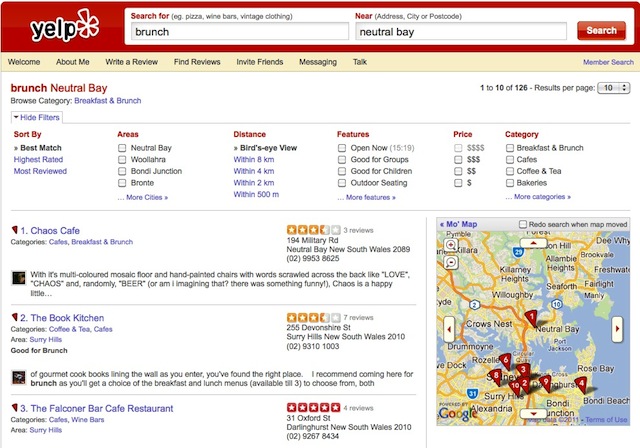
  • Yelp’s problem with activists

    Yelp’s problem with activists

    It’s been a bad couple of years for James Knight, a dentist in Fort Dodge, Iowa.

    First his wife found some text messages he’d exchanged with Melissa, his attractive assistant who’d been with his practice for ten years.

    Then James’ spouse demands Melissa is fired.

    James then has what was no doubt a difficult conversation with Melissa’s husband explaining why she’s been sacked.

    Then Melissa sues him for discrimination. He wins the case.

    Melissa appeals to the state’s Supreme Court and loses there as well however the case now has national attention.

    This attracts the ire of the Internet mob, who start posting bad reviews about James on Yelp despite most of them not even living in Fort Dodge, let alone using his service.

    For Yelp, the rabble descending on James Knight’s review page is as much their problem as it is his.

    Yelp is one of the leading customer review sites which are changing the way small business operates and getting “smashed on Yelp” isn’t good for one’s reputation.

    Recently a builder also attracted the ire of the online lynch mob when he threatened to sue a customer over a poor Yelp review.

    As consequence, his Yelp page was overwhelmed with negative reviews by people who’d never used his business. The service had to delete 65 of those reviews which clearly had nothing to do with the quality of service the builder provided.

    The problem for Yelp, an other online review sites like Tripadvisor, is that for their sites to be trusted the reviews have to be reasonably accurate – self righteous internet mob skewing results is going to damage the service’s credibility as much as the targeted businesses.

    What this means for Yelp is that the low cost online business model doesn’t work, for the site to be relevant and credible there has to be administrators checking reviews and dealing with these situations.

    There’s also a lesson for all of us using the web – mindlessly joining online lynch mobs creates more damage than it fixes.

    Picking on a mid-Western dentist because he appears to be a pussy whipped jerk isn’t really solving humanity’s problems – we can all find causes that are a better use of our time.

    Similar posts:

  • Fiddling the prices

    Fiddling the prices

    Discriminatory pricing is nothing new, a good salesperson or market stallholder can quickly sum up a punter’s ability or willingness to pay and offer the price which will get a sale.

    Anybody who’s travelled in countries like Thailand or China is used to Gwailos and Farang prices being substantially higher even for official charges like entrance fees to national parks and museums.

    The Internet takes the opportunity for discriminatory pricing even further arming online stores armed with a huge amount of customer information which allows them to set prices according to what the algorithm thinks will be the best deal for the seller.

    Recently researchers found that the Orbitz website would offer cheaper deals for people searching for fares on mobile phones and prices would vary depending of which brand of smartphone people would use.

    Writers for the Wall Street Journal did an experiment with buying staplers and found the same thing.

    Interestingly, one of the factors Staples’ seems to take into account is the distance customers live from a competitors’s store – the closer you live to the competition, the lower the price offered.

    There’s also other factors at play; sometimes you don’t want a customer, or you don’t want to sell a particular product and it’s easy to guess the formulas used by Staples and other big retailers do the same thing.

    One of the great promises of the internet was that customers’ access to information would usher in a new era of transparency. In this case it seems the opposite is happening.

    Similar posts:

  • Disruption and leadership

    Disruption and leadership

    As new communications tools appear, the challenge for managers is to deal with the disruptions these technologies bring to their businesses.

    Launching Deloitte Digital’s release of Taking Leadership in the Digital Economy last week the Executive Director of Telstra Digital Consumers, Gerd Schenkel, described how business is changing as consumers are being empowered by smartphones.

    A good example of this is the taxi industry where applications like GoCatch, InGoGo and Uber give passengers the opportunity to fight back against poor service from protected operators.

    Sydney is an attractive market for taxi industry disruptors as the current protected market fails both passengers and drivers. Travis Kalanick, the CEO of Uber, said at the Sydney launch of his service earlier last week that the city is one of the more ‘problematic” markets they’ve entered alongside San Francisco and Paris.

    That letting down drivers along with passengers is an also an important point – drivers get 80% of Uber’s charges while InGoGo and GoCatch free operators from poor booking systems that frustrate everybody involved in the industry while making the system as unaccountable as possible.

    Similar changes are happening in other industries as technology changes the way suppliers, customers and staff work.

    A good example of changing work practices is the adoption of Bring Your Own Device (BYOD) policies in the workplace. A few years ago in most businesses it was unthought of that staff could be allowed to bring their own computers to work. Today it’s common and soon the companies that don’t have a BYOD policy will be exception.

    BYOD has happened because of the arrival of cheap consumer devices like smartphones and tablets along with IT departments rolling out web based services.

    We’ve seen this before – probably the greatest influences on the shape of modern society had been electricity and the motor car. These, and many other technological changes have shaped today’s workplace.

    Many businesses though suffer for those changes as we’re seeing with the drying up of the newspapers’ “rivers of gold”.

    For Telstra this is seen in the demise of their phone directory business; Sensis was a true river of gold in the days of printed phone directories, but a number of management mis-steps over the last 15 years meant they totally missed the transition to digital.

    The tragedy for Telstra that Sensis’ strength in the local advertising market should have been a positive given Google’s failure to execute on their local search strategy.

    On reflecting about the struggle to deal with transitions to new technology, just how many business are like Sensis and Fairfax in having leaders that aren’t equipped to deal with these changes.

    The leaders of the 1980s whose business models were based on the assumption of economic growth underpinned by easy credit, cheap energy and demographic growth and now finding those factors are moving against them at the same time technology change is disrupting their industries.

    For the upcoming generation of leaders, both in business and government, having the ability to adapt to the changed power relationships between customers, suppliers and workers is going to be essential. For those steeped in last century’s certainties, it’s going to be a tough time.

    Similar posts: