Australia in the Asian Century – Chapter Six: Building capabilities

How can Australia build a productive workforce to take advantage of the Asian Century

This post is one of the series of articles on the Australia in the Asian Century report.

Of all the chapters in the Australia in Asian Century discussion paper, Chapter Six has probably attracted the most opprobrium because of the fine words which haven’t been matched by government policy and action.

Parts of this chapter have a strong “school marm” tone as it tries to mandate the composition of company boards or the locations of where students will study. Overall though, most of the objectives are either motherhood statements, impractical or at odds with the actions of both state and Federal governments.

National objective 9. To build the capabilities of Australian students, Australia’s school system will be in the top five schooling systems in the world, delivering excellent outcomes for all students of all backgrounds, and systematically improving performance over time.

  • By 2025, Australia will be ranked as a top five country in the world for the performance of our students in reading, science and mathematics literacy and for providing our children with a high?quality and high?equity education system.
  • By 2015, 90 per cent of young Australians aged 20 to 24 years will have a Year 12 or equivalent qualification, up from 86 per cent in 2010.
While these objectives are worthy, there’s little discussion of exactly how this will be achieved beyond broad statements. Again it’s notable that these aspirations are being laid out at a time when funding is being cut and staff retrenched in both state and Federal government education departments.

National objective 10. Every Australian student will have significant exposure to studies of Asia across the curriculum to increase their cultural knowledge and skills and enable them to be active in the region. All schools will engage with at least one school in Asia to support the teaching of a priority Asian language, including through increased use of the National Broadband Network.

Says who? Who exactly is going to force a school to engage with at least one school in Asia? These are the sort of broad brush statements that detract from the report.

These kind of statements are the “thought bubble” approach to policy that marks much of what passes for governance in Australia today and such poorly thought out programs end up at best wasting money. At worst, the unintended consequences of a ‘policy’ thought up on the back of beer mat end up causing more damage than good.

Such a program could work well if properly thought out and integrated properly into the long term curriculum of the students but it would take proper leadership from state and Federal education ministers.

National objective 12. All students will have access to at least one priority Asian language; these will be Chinese (Mandarin), Hindi, Indonesian and Japanese.

This is good and fair, but is something that was supposed to have been put in place thirty years ago. Instead the proportions of students studying Asian languages has steadily dropped.

As newspapers have reported there are barely a dozen Hindi language teachers in New South Wales, so the priority needs to be training teachers to deliver the courses.

Such inconvenient logistical problems are an excellent example of those well meaning but poorly thought through “thought bubbles.”

National objective 12. Australia will remain among the world’s best for research and teaching in universities, delivering excellent outcomes for a larger number of Australian students, attracting the best academics and students from around the world and strengthening links between Australia and the region.

  • By 2020, 20 per cent of undergraduate higher education enrolments will be people from low socioeconomic backgrounds, up from 17 per cent in 2011.
  • By 2025, 40 per cent of all 25 to 34?year?olds will hold a qualification at bachelor level or above, up from 35 per cent in 2011.
  • By 2025, 10 of Australia’s universities will be in the world’s top 100.
  • A larger number of Australian university students will be studying overseas and a greater proportion will be undertaking part of their degree in Asia.
This objective really smacks of poorly thought out ideas on the run and illustrates starkly the differences between the well meaning objectives and the behaviour of governments.
It’s almost impossible for ten of Australia’s universities to make it into the more reputable measure of top 100 universities when for the last three decades research and post graduate programs have been slowly strangled by falling government funding.
Even if a Gillard government were to change that trend, it’s unlikely Australian universities could make up the lost ground in 13 years.
Mandating that “a larger number of Australian university students will be studying overseas and a greater proportion will be undertaking part of their degree in Asia” is nice but who is going to force students to study overseas and specifically in Asia?
More to the point, what are notoriously conservative Australian employers going to do with all these graduates of Asian universities?

National objective 13. Australia will have vocational education and training systems that are among the world’s best, building capability in the region and supporting a highly skilled Australian workforce able to continuously develop its capabilities.

  • By 2020, more than three?quarters of working?age Australians will have an entry?level qualification (at Certificate III level or higher), up from just under half in 2009.
  • Australia’s vocational education and training institutions will have substantially expanded services in more nations in the region, building the productive capacity of the workforce of these nations and supporting Australian businesses and workers to have a greater presence in Asian markets.
Given the week before the Gillard government cut apprenticeship funding and the NSW government announced it was further emasculating its state TAFE system a few days after the report was released, this objective can be treated purely empty words.

Business capacity

One of the reasons why Australia engaged so little with Asia over the last twenty five years is because the business community became focused inwards rather looking for opportunities in foreign markets. So the idea of getting more Asian experience into boardrooms is laudable but the solutions proposed impractical.

National objective 14. Decision makers in Australian businesses, parliaments, national institutions (including the Australian Public Service and national cultural institutions) and advisory forums across the community will have deeper knowledge and expertise of countries in our region and have a greater capacity to integrate domestic and international issues.

  • One?third of board members of Australia’s top 200 publicly listed companies and Commonwealth bodies (including companies, authorities, agencies and commissions) will have deep experience in and knowledge of Asia.
  • One?third of the senior leadership of the Australian Public Service (APS 200) will have deep experience in and knowledge of Asia.
This objective has drawn a lot of scorn from the business community and for good reason – how is a Federal government going to mandate that a third of the ASX200 will have “deep experience and knowledge of Asia”?
While the aim of having a third of the senior public service possessing Asian experience is worthy, this is almost impossible given the deadline for this is thirteen years away, any bureaucrat hoping to have “deep experience and knowledge of Asia” would have had to have been working on it for the last five or ten years. If this program isn’t in place now, it isn’t going to happen.

Society

Probably the biggest strength of Australia as a nation is in its diverse and relatively tolerant society so this section of the report is notable for what it misses in opportunities.

National objective 15. Australian communities and regions will benefit from structural changes in the economy and seize the new opportunities emerging in the Asian century.

Another worthy aim and its notable that the region cited in the case study is Darwin, a city whose economy is being wildly distorted by the LNG boom which is driving up prices and labour costs. If anything Darwin is an example of Australia turning its back on opportunities and focusing on a quick, resources driven buck.

National objective 16. By preserving and building on our social foundations, Australia will be a higher skill, higher wage economy with a fair, multicultural and cohesive society and a growing population, and all Australians will be able to benefit from, and participate in, Australia’s growing prosperity and engagement in Asia.

Cant and motherhood statements as one would hope all government seek to build a fair and cohesive society on our social foundations. It’s interesting that much of the poorly thought out, short term tactics by publicity hungry politicians probably does more to damage Australia’s institutions than other factors.

Overall this chapter deserves to have drawn the most criticism with its motherhood statements and wholly unachievable aims.

Most disappointingly, it skates over Australia’s diverse workforce and provides no ideas on how to harness the talents of the country’s ethnic groups in building ties and improving the nation’s skills.

Image of the Harbin Snow and Ice Festival from EmmaJG on Flickr

Australia in the Asian Century – Chapter Four: The outlook for Australia to 2025

Chapter Four of Australia in the Asian Century charts where the economies will be engaging over the next decade.

This post is one of the series of articles on the Australia in the Asian Century report.

Chapter four of Australia in the Asian Century is the critical part of the white paper, describing where the opportunities and risks are for the nation as Asian societies become more prosperous.

In the introduction to the chapter, “Australia’s 2025 Aspiration” is set out as raising per person income to $73,000 by 2025 and the nation’s living standards in the world’s top ten.

While this is a noble target, the underpinning of that good fortune are more of the same;

What will emerge as a result of these opportunities is that Australia’s trade patterns will change, urbanisation will continue to drive demand for resources and energy, and new opportunities will emerge in manufacturing and in high-quality food production. Rising incomes will also provide opportunities for the education and tourism sectors, and for services more broadly.

Iron ore, coal and Liquid Natural Gas (LNG) are the basis of the projections in this chapter which, as discussed in the previous chapter, ignores alternative supplies from Africa, Mongolia and Central Asia along with the efforts of China to reduce energy density while expanding renewable power sources.

Agriculture also has a role as does tourism and education but all of the projections are more of the same 1980s thinking we read in the previous chapter. There’s little that identifies new industries or the evolution of existing export agricultural industries such meat exports.

The identification of risks to this rose coloured outlook skims over any internal issues such as drought, industrial disruption, a continued high exchange rate or any external factors.

While the chapter does note the risk of commodity prices could fall further than expected, the consequences of this are dismissed with an airy reference to Australia’s fiscal position.

While the chapter focuses on motherhood statements about innovation, research and development and ‘complex problem solving’ when looking at the opportunities there are some identifications of the real advantages Australia offers;

Australian society reflects our multiculturalism. Australia’s socially cohesive and diverse nation is one of our enduring strengths. Our nation brings the values of fairness and tolerance to all its dealings in the region and the world.

It’s a shame there isn’t more emphasis on this aspect as this is one of the areas where Australia can add value and has real competitive advantage.

Overall, the Outlook described in Chapter Four of Australia in the Asian Century suffers from the same problem as the previous chapter of applying the 1970s and 80s experience with Japan and South Korea onto the development of China and India.

What’s even more frustrating is the only specific projections are for more mineral and agricultural exports, everything else is wrapped in motherhood statements.

The following chapters look at the specifics of Australia’s development and engagement with Asia over the next decade.

Australia in the Asian Century – Chapter Three: Australia in Asia

Chapter two of Australia in the Asian Century attempts to predict the development of the region’s economies over the next decade

This post is one of the series of articles on the Australia in the Asian Century report. An initial overview of the report is at Australian Hubris in the Asian Century.

The third Chapter of the Australia in the Asian Century report, “Australia in Asia” attempts to define the role the country currently plays in the region. In some ways this is the most constructive part of the paper in that it describes the lost opportunities of the last 25 years.

Much of the early part of the chapter traces the development of Australia’s engagement with Asia after World War II; Chifley’s post war efforts with the United Nations, Menzies’ engagement with Japan, Whitlam’s going to China, Fraser’s opening to Vietnamese immigration and Hawke’s work on building the APEC agreement are all noted.

Again are the major wars that also formed Australia’s current position in East Asia – World War II, the Malayan Emergency, the Korean and Vietnamese wars – are barely mentioned. This trivialises some of the major influences in today’s complex tapestry of relationships

Of Australia’s closest Asian neighbour, the fall of Sukarno gets a brief nod but Suharto’s removal, the rise of Indonesian democracy and East Timor are all removed from the narrative. There is also no mention of other internal dislocations like the Cultural Revolution or the Indian Partition, all which still have echos today.

In the introduction the Colombo Plan gets a mention and it’s worth reflecting upon its effects.

When I worked in Bangkok in the early 1990s there were a number of business leaders who had been educated in Australia under Colombo Plan scholarships.

That investment by Australia paid dividends through the 1980s and 90s as many of those scholarship students were ardent supporters of Australian businesses and government.

One wonders how today’s students who’ve been treated as milk cows by Australian governments and “seats on bums” to education institutions will feel about the country when they enter business and political leadership positions over the next decade?

The examples of Australian business engagement in Asia are interesting – Blundstone’s is a straight out manufacturing outsourcing story which doesn’t really describe anything not being done by thousands of other businesses while Tangalooma Island Resort is a light of hope in the distressed Australian tourism industry.

A notable omission is how digital media, apps developers and service businesses are faring in Asia. There are many good case studies in those sectors but the writers seem to be, once again, fixated on the trade patterns of the 1980s and 90s rather than success stories in new fields and emerging technologies.

Generally though the description of the Australian economy is again more of the same; a combination of self congratulations on having a government AAA credit rating, hubris over avoiding a GFC induced recession and stating how the services sector has risen to replace the manufacturing that’s been outsourced by companies like Blundstone.

Overall Chapter Three of the Australia in the Asian Century report illustrates the opportunities missed in the last 25 years. Had this report been written twenty years ago it could have forecast a booming relationship in the services and advanced manufacturing sectors. It almost certainly would have included an observation that the days of the Australian economy depending upon minerals exports is over.

What a difference a couple of decades make.

The engagement of Australia with Asia concludes with a look at the changes to the nation’s immigration intakes and demographic composition. This point is, quite rightly, identified as an area of opportunity.

Having Thai restaurants in every suburb and Indian doctors in most country town isn’t really taking advantage of the opportunities presented by having a diverse population and workforce. Chapter Four attempts to look at how these factors, and others, can help Australia’s engagement with the Asian economies.

Australia in the Asian Century – Chapter Two: The future of Asia

Chapter two of Australia in the Asian Century attempts to predict the development of the region’s economies over the next decade

This post is one of the series of articles on the Australia in the Asian Century report. An initial overview of the report is at Australian Hubris in the Asian Century.

“Asia’s economic resurgence is set to continue” is the bold statement at the beginning of Chapter Two of the Australia in the Asian Century report and with that the chapter immediately falls back to warm motherhood statements;

Average living standards are set to improve dramatically and transform the way people live and work. Asia’s economies are projected to expand at a strong rate. The region’s expansion and development will change the contours of Asia and the globe—opening up exciting new opportunities, while also posing some challenges.

All of this is true, however the report struggles to identify exactly what those challenges and opportunities are as Asia develops and where Australians fit into the region’s evolving economy.

Demographics will matter, but they are not destiny

The constant mantra through the report is “demographics will matter, but they are not destiny.” Yet, despite the headline, Chapter Two illustrates that so far it has been destiny.

Graph 2.6 of the report shows how Japan’s, and now South Korea’s, productivity has tailed off as the population has aged. This is to be expected when economic expansion has been based on labour intensive manufacturing, as China’s is today.

Frustratingly, the report acknowledges this with the following paragraph;

But the fruits of adopting new technology and adapting it will become harder to harvest. A point will come, though it’s still some way off, where the growth of labour productivity in developing Asian economies will slow—opportunities for gains from importing foreign technology and for shifting workers from agriculture to industry will diminish.

“Some point in the future” doesn’t wash when the rest of the chapter shows off various ‘firm’ numbers estimating ‘base’, ‘low’ and ‘high’ growth rates. If you can quantify those growth assumptions, then it should be fairly trivial to estimate the turning point where aging populations start to affect China.

Luckily others have done this work, the Australian Macrobusiness site suggests that turning point could be as early as 2015. In which case, unlike Japan and South Korea, China will have got old before it got rich.

If this true, then IMF’s projected growth rates will miss their targets – particularly the ‘low growth’ scenario which is almost identical to their ‘base scenario’.

Rise of the middle class

Much of the emphasis in this view of Asia’s development is on the rise of the middle class and the report features a case study of Hitesh, a middle class stockbroker in Ahmedabad.

While there’s no doubt Hitesh and his family’s income and standard of living are rising, the idea that several hundred million Indian and Chinese will jump to European or North American income levels before 2025 is improbable.

Most stockbrokers in New York, London or Sydney earn between 30 and 300 times Hitesh’s $5,000 a year and in 2010, average Chinese income was a tenth of the US.

Even if the Indian and Chinese middle classes did manage a tenfold growth in income over the next decade, the assumption they would adopt the debt driven high consumption patterns of the US or Australia isn’t a given as we see in how the Japanese middle classes haven’t aped the spending behaviour of their profligate Western friends.

The credit and banking points in this chapter illustrate the hubris mentioned in my original overview of Australia in the Asian Century.

And with financial systems in advanced economies unwinding the high debt levels built up before the Global Financial Crisis, financial institutions in stronger economic positions, such as those in Australia and elsewhere in the Asian region, will have opportunities to expand into new markets.

Given the dire records of Australian banks in expanding overseas along with the “stronger economic position” being due more to government guarantees during the GFC and the desperate political desire to prop up Australia’s property market at all costs, it’s difficult to see exactly what Australian institutions have to offer Asian savers except to further underwrite the never ending down under housing bubble.

Chapter two of the Australia in the Asian Century report finishes with an overview of the current geopolitical situation which is notable more for what has been left out. This is again probably due to Canberra public service politics and the report suffers for it.

One major region left out is Central Asia and Russia – outstanding given the report’s view  that a resource poor Asia (that Japanese assumption again) will need Australia to fuel its energy and resources needs – which ignores the construction of pipelines and railways to China and India.

Also missed are the projects to upgrade China’s railway and road links to Europe and Central Asia. These in themselves may trigger major geopolitical changes over the next few years, as we’re seeing today in Tibet and Xinjiang after railways were built to Kashgar to Lhasa. Yet none of this is considered.

Not the ‘Stans should feel aggrieved, like the rest of the report the emphasis is on China and India with scant mention of other Asian countries.

For Australia, much of the hope in the report seems to be in providing raw materials for Asia’s industrialising and urbanising societies along with being a holiday destination and education provider. This is all lazy 1980s thinking which projects Australia’s Japanese experience of thirty years ago onto China and India today.

The predictions of Asia’s future in the Australia in the Asian Century report are largely are a continuation of the status quo. If this report had been written in 1960, it may have picked the rise of Japan over the following twenty years but the main focus would have been on Burma as Asia’s richest independent country.

Exacerbating the report’s weakness are the assumptions that development paths will follow the same course as Japan, Taiwan or South Korea in the late 20th Century.

Development wasn’t a smooth path in all three of those countries and each had their own unique political and economic upheavals in that time, the failure to recognise that similar disruptions will happen in Asia’s emerging economies as they develop is probably the greatest weakness in the entire report.

It’s very easy to draw straight lines on graphs based on ‘best case’ IMF projections but history is rarely linear. This is probably the greatest intellectual failing of the white paper.

Australia in the Asian Century – Chapter One: The rise of Asia

Chapter one of Australia in the Asian Century looks at how the region’s economies developed

This post is one of the series of articles on the Australia in the Asian Century report. An initial overview of the report is at Australian Hubris in the Asian Century.

“Just over two decades ago, the Australian Government commissioned a study of Australia and the Northeast Asian ascendancy” starts the opening of the Australia in the Asian Century report. That sentence describes how this paper is the latest of Australia’s earnest efforts to understand the region.

The opening chapter of the report follows the sensible principle that to plan for the future we have to first understand the present so this section seeks to explain the development of various Asian economies and put those changes into an Australian perspective.

Notable in the narrative is the North East Asian focus, while India gets a brief mention most of the story revolves around the development of China, Hong Kong, Japan and South Korea. Chart 1.2, “Asia’s economic dividend” gives the game away when all but one ‘Asian’ country listed is East Asian.

Russia, along with most of South and Central Asia – not to mention other Asia countries like Iran, Turkey and the former Soviet Republics – rate no mention all.

The narratives around the countries which are covered is also deficient – for instance the discussion on Japan’s, South Korea’s and Vietnam’s developments totally ignore post-war reconstruction efforts and their relations with the United States.

China does get a more detailed examination rightly noting it was the country’s admission to the World Trade Organisation in 2001 that really set the economy’s export sector moving, however it skates over the massive dislocations and market reforms introduced in the 1980s which laid the foundations for China’s successful bid to join the WTO.

More notably, the analysis overlooks – probably to avoid upsetting PRC diplomats and making life difficult in Canberra – the role of Taiwanese investment in China and Taiwan’s development itself.

In a similar vein the scant discussion of India misses the role of Non-Resident Indians (NRIs) in the country’s economic development along with the concentration of power in the various industrial conglomerates like the Tata Group.

Again, the same omission is made when discussing the South Korean Chaebols and Japanese Keiretsu. Given the investments made in Australia by all of these industrial conglomerates it’s curious they barely rate a mention in discussing Asia’s industrialisation process.

The discussion on innovation in Chapter 1.3 is useful however it lacks substance in identifying exactly which sectors various Asian economies are specialising in and which industries are in decline as various countries move up the value chain.

Singapore’s success in becoming East Asia’s hub for banking and corporate regional headquarters is a notable omission and again one has a suspicion this is because of ongoing Australian governments’ doomed ambitions to establish Sydney as a regional financial and business centre.

Probably the most glaring omission in Chapter One though is the role of the United States. In tracking the rise of the Indian service sector or Chinese, Japanese and South Korean manufacturing the trade policies of the US cannot be ignored. And yet they largely are.

That failure to acknowledge the US role means report overlooks the Clinton and Bush I Administrations’ forced opening East Asia’s largely closed economies which radically changed South Korea, Taiwan and Japan in the late 1980s and early 90s. Not to mention the critical role the US had during that period in allowing China and Vietnam to join the global trade networks.

Chapter One of Australia in the Asian Century is an unsatisfactory introduction to the complexities of the Asian economies and one suspects is because of the compromises made to assuage the egos and groupthink of Canberra’s mandarins and politicians.

Most importantly, it fails to put the last thirty years’ developments in Asia into an Australian context or perspective. In this respect, it’s a fitting start to a largely inadequate report.

Australian Hubris in the Asian Century

Australia in the Asian century is the story of opportunities missed.

This post is one of the series of articles on the Australia in the Asian Century report.

The release of the Australia in the Asian Century discussion paper today raises the question of where the country sees itself and where it is going. It lets us down on many levels.

While there’s a lot more to discuss in the paper, which I’ll do over the next few days, there’s a few issues that come to mind on first reading.

The reliance on mining

A constant  in the discussion about Australia’s future is the continued mining boom. This was the underlying theme of Monday’s Mid-Year Economic Outlook and is also the case in the Asian Century paper. Here’s chart 4.4.2 from the document which shows the forecast makeup of Australia’s exports.

Today mining exports are shown as being just over 50% of Australia’s trade with Asia and have mineral income growing to well over 60% of trade by 2025.

What is frightening about this is the belief across Australia’s political and business leaders that the mining boom is here to stay and will continue to keep growing.

Little risk analysis

Also notable about the report is how little acknowledgement of risk there is in the document. Most of the risks are dismissed in six paragraphs in Chapter 4.4

Geopolitical risk does get its own chapter, but even there most of the challenges are glossed over. Eventually most of the risks are dismissed with this line.

None of these developments of themselves make major power conflict likely—in some important ways they will probably act as a constraint. All the major powers recognise how interdependent their economic interests are.

This is reminiscent of the line used in the late 1980s – “no two countries with a McDonalds have ever gone to war against each other.” A glib nonsense which ceased to be true when NATO attacked Serbia in an effort to stop the massacres of the Yugoslavian disintegration.

Trivialising the big risks

Had anyone predicted in 1986 that within five years, there would be a bloody civil war in Yugoslavia, the Eastern Bloc collapse and the Russian Empire’s eagle replace the hammer and sickle on the Kremlin they would have been dismissed as fools.

Yet that is exactly what happened.

The risk of instability within the People’s Republic of China isn’t mentioned or even the effects of what a collapse of North Korea would mean to South Korea – another key Australian mineral market – both of which would have massive effects on Australia’s export markets over the next decade.

While I’m certainly not forecasting the collapse of either the DPRK or the Communist Party of China in the near future, these are massive risks to any plan which purports to look at the next decade. Ignoring them or trivialising them does not help the paper’s credibility.

Australian hubris

Most notable in the white paper is the tone of Australian Exceptionalism through the commentary. In the Prime Minister’s speech she said “we are the nation that stared down the economic crisis.”

Calling massive stimulus packages, reinflating the property market and guaranteeing bank liabilities is hardly ‘staring down’. Australia’s avoiding going to into recession after the 2008 crisis was due to the “go early, go hard” philosophy of pumping money into the economy which was learned by Australia’s bureaucrats in the 1990s recession.

That policy worked to stave off recessions during the Asian currency crisis of 1998, the Long Term Credit Bank collapse and the post September 11 uncertainty. It worked on massive scale during the post-Lehmann Brothers collapse.

Crediting Australia with some sort of miracle economy is hubris on a grand scale and hardly the basis for developing a sensible plan to guide us through the next decade.

What is Australia’s competitive advantage?

Essential to understanding where the nation can prosper from the rise of Asian economies is where our current strengths lie. Apart from empty phrases on “skilled workforces” and “new opportunities will emerge in manufacturing” there’s no explanation of exactly where Australia can profit from these.

In fact most of the case studies refer to Australian companies outsourcing or Asian trading patterns that really don’t need any skilled or valued added contribution at all, a case in point is the story of ‘Hitesh’, one of India’s rising middle class.

Hitesh, 31, is a stockbroker in a firm that he opened with his friend several years ago. He brings in an annual income of US$5,280, placing his family squarely in the middle of Ahmedabad’s middle class.

Nowhere does the case study explain exactly what Australia can offer him – the air conditioners and cars certainly won’t be made or designed in Australia and his daughters’ educations in 2025 might well come through the internet from MIT or the London School of Economics instead of them flying to Melbourne to drive taxis and do barista courses in the hope of getting Australian permanent residency.

In fact if anything, it’s difficult to see why an Asian company would choose to do business with an Australian stockbroker when they earn thirty to a hundred times more than Hitesh.

1980s thinking

Much of what is in the white paper is what we’ve heard before in the 1980s – back then it was Yuske in Nagoya who was going to buy our wine and come to the Gold Coast for holidays.

There’s nothing in the projections we haven’t heard before, except today we’ve squandered two decades of opportunity by ramping up our property markets and building an unsustainable middle class welfare state.

Sometime in the 1990s – possibly around the time of John Howard’s election – Australia turned inwards and insular. We had the opportunity  to position Australia as a credible mid-level power in the region but we chose instead to renovate our kitchens.

That opportunity has been lost and repeating the mantras of the 1980s with the words ‘China’ and ‘Chinese’ substituted for ‘Japan’ and ‘Japanese’ won’t cut it.

Australia in the Asian Century was an opportunity to show some vision and stake a claim on sharing some of the 21st Century’s riches. Instead the writers chose to give us platitudes underpinned by the certainties of a never ending economic boom.

Australia’s one trick economy

Businesses need fall back plans, particular when the nation doesn’t have one.

Earlier this week, Reserve Bank of Australia Governor Glen Stevens gave a speech to the Australian Industry Group on the world’s changing economic currents.

That presentation has a number of pointers for Australian businesses on how we use technology, our investments and, most importantly, where the Canberra sees our economy going.

Much of the Governor’s speech discussed how those of us who at the beginning of the century believed Australia’s economy had to diversify into new industry sectors — such as the IT sector — were proved wrong by the Dot Com Bust and the subsequent boom in the resources sector.

“Australia would probably do best, in its production structure, to stick to its comparative advantages in minerals or agriculture or various services.” Mr Stevens quoted from ten years ago, “but it was hard going trying to make sensible points against the barrage of market and media commentary.”

Perfect hindsight

It’s impressive the Governor had this perfect hindsight which can overlook the role of ramping the housing markets by the Rudd and Howard governments to avoid the 2001 and 2008 US recessions along with the sheer good luck of having a resources boom through the last half of the decade.

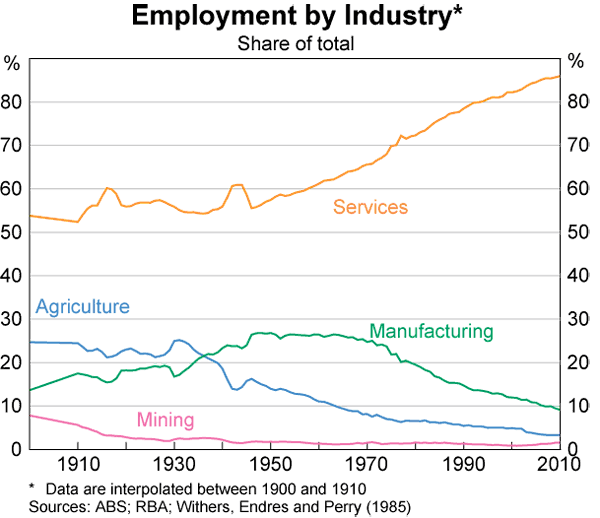
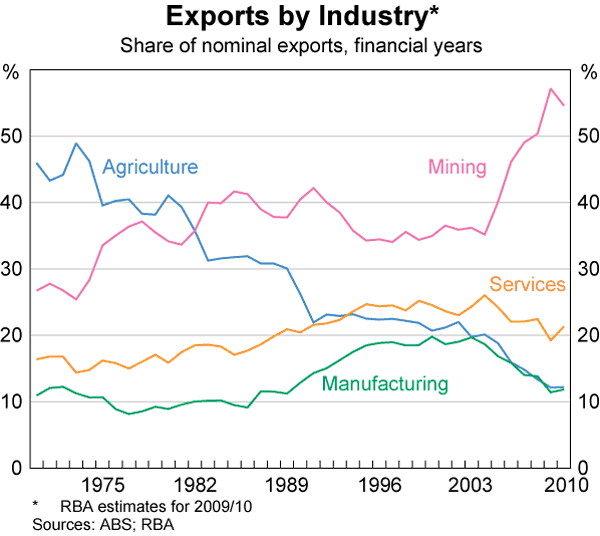
During his speech the governor referred to an RBA research paper, Structural Change in the Australian Economy which casts an interesting light on the comparative advantages in those “various services”.

That paper shows that service sector employment has risen to nearly 85% while its share of GDP has stayed around the same for the last twenty years, which to this non-economist’s mind implies the portion of national wealth is declining for service based workers and businesses.

Sleepwalking into the dutch disease

Of course those of us in the service sector could make it up by exporting but here again, service sector exports haven’t done much over the last decade which won’t be helped by the current high Aussie dollar — another aspect of the Dutch Disease we seem to have sleep walked into over the Howard and Rudd years.

Those same statistics show mining employment has declined over that period as well and if you’re considering sending your kids down the pit, or even packing in your own city job to drive a mining truck, you might want to read the interesting work being done by the University of Sydney’s school of robotics.

Generously, Governor Stevens didn’t completely write off the role of technology observing that, “in the old versus new economy stakes, it was probably in the use of information technology, rather than in the production of IT goods, that the gains would be greatest.”

Invest in, but don’t develop, technology

The Governor’s messages are clear to business people; our businesses have to invest in technology to be more efficient and we need to understand that government policy will be geared around the mining sector.

Most importantly, we need to understand that on a national level there is no Plan B.

In the last election it was clear both sides of politics based their policies, such as they were, on the assumption the China boom will last for the foreseeable future. Yesterday’s speech shows Glenn Stevens and the Reserve Bank share that outlook and no other alternative is being planned for.

That’s fine for Glenn, Julia, Tony and their colleagues as they have safe, indexed pensions when they deign to cease giving us the benefit of their visionary leadership.

In the business community we don’t have that luxury; a plan B is required just in case things don’t quite work out the way we hope. As the Governor says:

Succeeding in the future won’t ultimately be a result of forecasting. It will be a result of adapting to the way the world is changing and giving constant attention to the fundamentals of improving productivity. That adaptability is as important as ever, in the uncertain times that we face.

That’s excellent advice. How adaptable is your business in these uncertain times?