Tag: internet

  • Exciting but vague

    Exciting but vague

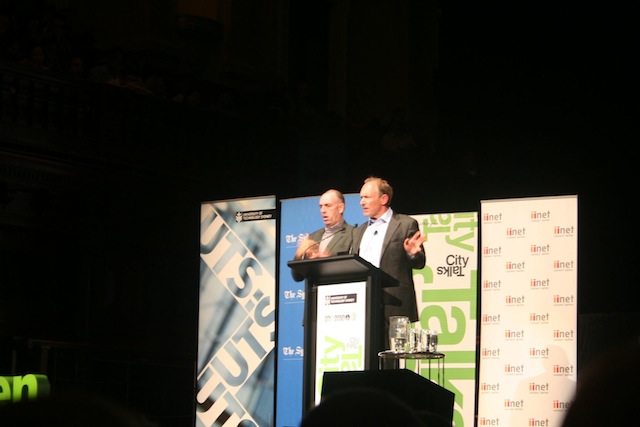
    On Tuesday Tim Berners-Lee rounded off his Australian speaking tour with a City Talks presentation before 2,000 people at a packed Sydney Town Hall.

    After an interminable procession of sponsor speeches, Berners-Lee covered many of the same topics in his presentations at the Sydney CSIRO workshop the previous week and the Melbourne talk the night before.

    These included a call for everyone to learn some computer coding skills – or at least get to know someone who has some, wider technology education opportunities, more women in computing fields and a warning about the perils of government over-surveillance.

    On government monitoring Internet traffic, Berners-Lee has been strident at all his talks and correctly points out most of our web browsing histories allow any outrageous conclusion to be drawn, particularly by suspicious law enforcement agencies and the prurient tabloid media.

    Who owns the ‘off switch’ is also a concern after the Mubarak regime cut Egypt off the Internet during the Arab Spring uprising. The willingness of governments to cut connectivity in times of crisis is something we need to be vigilant against.

    The web’s effect on the media was discussed in depth as well with Sean Aylmer, editor-in-chief of the Sydney Morning Herald, saying in his introduction that Berners-Lee’s invention had been the defining feature of Aylmer’s career.

    While the web has been traumatic for a generation of newspapermen, Berners-Lee sees good news for journalists in the data explosion, “how do we separate the junk from the good stuff?” Asks Tim, “this is the role for journalists and editors”.

    One person’s junk is another’s treasure though and the web presents one of the greatest opportunities for people to “write on their blank sheet of paper.”

    When asked about what he regretted most about the web, Berners-Lee said “I’d drop the two slashes,” repeating the line from Melbourne the night before.

    At each of his Australian speeches Berners-Lee has paid homage to his mentor at CERN, Mike Sendall. After Sendall passed away, his family found the original proposal for the Hyper Text Markup Language (HTML) which formed the basis for the world wide web.

    “Exciting but vague” was the note Sendall made in the margins of Berners-Lee’s proposal.

    Vague and exciting experiments was what drove people like James Watt and Thomas Edison during earlier periods of the industrial revolution. Tomorrow’s industries are today’s vague and strange ideas.


    Similar posts:

  • Necessity, innovation and the birth of the web

    Necessity, innovation and the birth of the web

    The man who invented the world wide web, Tim Berners-Lee spoke at the launch of the CSIRO’s Digital Productivity and Services Flagship in Sydney yesterday.

    In telling about how the idea the idea of web, or Hyper Text Markup Language (HTML), came about Berners-Lee touched on some fundamental truths about innovation in big organisations.

    In the 1990s the European Laboratory for Particle Physics (CERN) in Geneva had thousands of researchers bringing their own computers, it was an early version of what we now call the Bring Your Own Device (BYOD) policy.

    “When they used their computers, they used their favourite computer running their favourite operating system. If they didn’t like what was available they wrote the software themselves,” said Tim. “Of course, none of these talked to each other.”

    As a result sharing data was a nightmare as each scientist created documents using their own programs which often didn’t work on their colleagues’ computers.

    Tim had the idea of standard language that would allow researchers to share information easily, although getting projects like this running in large bureaucratic organisations like CERN isn’t easy.

    For getting HTML and the web running in CERN Tim gives credit to his boss, Mike Sendall, who supported him and his idea.

    “If you’re wondering why innovation happens, one of the things is great bosses who let you do things on the side, Mike found an excuse to get a NeXT computer,” remembers Tim. “‘Why don’t you test it with your hypertext program?’ Mike said with a wink.”

    There’s much talk about innovation in organisations, but without management support those ideas go nowhere, the story of the web is possibly the best example of what can happen when executives don’t just expect their workers to clock in, shut up and watch the clock.

    One key point Tim made in his presentation was that it was twenty years after the Internet was invented before the web came along and another five years until the online world really took off.

    We’re at that stage of development with the web now and with the development of the new HTML5 standard we’re going to see far more communication between machines.

    Berners-Lee says “instead of having 1011 web pages communicating, we start to have 1011 computers talking to each other.”

    These connections mean online innovation is only just beginning, we haven’t seen anything yet.

    If you want your staff to stay quiet and watch the clock, that’s fine. But your clock might be figuring out how to do your job better than you can.

    Tim Berners-Lee image courtesy of Tanaka on Flickr

    Similar posts:

  • 2UE Weekend Computers, 29 December 2012

    2UE Weekend Computers, 29 December 2012

    This Saturday from 3.10 pm Seamus Byrne and myself will be standing in for regular guest Trevor Long to discuss tech with John Cadogan on Radio 2UE.

    We’ll be taking calls on the Open Line, 13 13 32 or tweet to @paulwallbank while we’re on air.

    Some of the things we’ll be covering include the following.

    What type of smart phone?

    We have the iPhone, Android and Windows phones. Which ones are better?

    • The iPhone’s been dominating for the last few years, but now  Android is overtaking it. Why’s that?
    • Microsoft are pretty late with a mobile phone, can they catch up?
    • What’s happened to the other makes like Nokia, Blackberry and Motorola?
    • So what if you don’t want a smartphone, what if you just want something to make phone calls?

    Checking your phone and Internet plans

    There’s was story this week about how people are spending too much on their mobile phone and Internet plans. What should people be looking at and how often should they check their plans?

    Paying for stuff with your mobile

    You can use your phone as a boarding pass on some airlines, now Telstra and Vodafone are looking at ways to use your mobile to pay for groceries with your mobile phone.

    • How does the system work?
    • Who takes the money?
    • Is this safe?
    • How far is this away?

    Your views, comments or questions are welcome so don’t be shy about calling in.

    Similar posts:

  • Fiddling the prices

    Fiddling the prices

    Discriminatory pricing is nothing new, a good salesperson or market stallholder can quickly sum up a punter’s ability or willingness to pay and offer the price which will get a sale.

    Anybody who’s travelled in countries like Thailand or China is used to Gwailos and Farang prices being substantially higher even for official charges like entrance fees to national parks and museums.

    The Internet takes the opportunity for discriminatory pricing even further arming online stores armed with a huge amount of customer information which allows them to set prices according to what the algorithm thinks will be the best deal for the seller.

    Recently researchers found that the Orbitz website would offer cheaper deals for people searching for fares on mobile phones and prices would vary depending of which brand of smartphone people would use.

    Writers for the Wall Street Journal did an experiment with buying staplers and found the same thing.

    Interestingly, one of the factors Staples’ seems to take into account is the distance customers live from a competitors’s store – the closer you live to the competition, the lower the price offered.

    There’s also other factors at play; sometimes you don’t want a customer, or you don’t want to sell a particular product and it’s easy to guess the formulas used by Staples and other big retailers do the same thing.

    One of the great promises of the internet was that customers’ access to information would usher in a new era of transparency. In this case it seems the opposite is happening.

    Similar posts:

  • Did online democracy ever exist?

    Did online democracy ever exist?

    “Democracy is dead” proclaim online pundits as Facebook closes down their corporate governance feedback pages.

    The question though is whether democracy really exists online; the internet is largely a privately run operation which makes the hysteria about the International Telecommunication Union’s attempts to impose standards on the web all the so more fascinating.

    As a consequence of almost every internet service being run by private organisations, rights and concepts like “democracy” are pretty well irrelevant and have been since the first connection to ARPANET.

    When we use services like Facebook, or even our internet provider’s email account, we are only being allowed to do so within the companies’ interpretation of their terms and conditions.

    Often those interpretations are wrong or bizarre as we see with Facebook’s War on Nipples and often the results of misinterpretation are costly for businesses.

    But we have little recourse as these sites are private property and the owners can do pretty well what they like within the law.

    Just a like a shopping mall, if the managements of Amazon, Google or Facebook want you to leave their service then you have no choice but to do so.

    We can squeal about rights online, but in reality we have few.

    That’s something we should keep in mind when investing our time or business capital into any particular platform.

    Similar posts: