Tag: apple

  • They thought they didn’t have a problem

    They thought they didn’t have a problem

    As Apple fans howl about the about the new iOS6 Maps feature which replaces the old one driven by Google Maps, it’s useful to get a cartographer’s view of how Apple got things wrong.

    Michael Dobson’s analyis deep dives into the complexities of mapping which can be summed up in one phrase;  “their problem is that they thought they did not have a problem.”

    Those Rumsfeldian ‘unknown unknowns comes back to bite a company again.

    Like many things in life, mapping is a lot more difficult than it looks and assuming that a drawing or an older map is correct or the features unchanged is risky.

    This is not a job you just leave to machines sucking down data from various sources; details needs to be checked, validated and checked again before being added to a map.

    What’s worrying about Apple’s map snafu is this probably wouldn’t have happened under Steve Jobs as he’d have used the app himself and yelled at people when it didn’t work.

    Apple’s decision to run with a substandard service smells horribly of decision by committee and compromised products being release to suit managerial imperatives rather than delivering one perfectionist’s vision of what worked.

    We may well be seeing the beginning of Apple’s evolution into an anonymous corporation.

    One of the positives of that is we may also discover a less secretive or hubristic Apple.

    How Apple fix their map application is going to be interesting, they certainly have the funds to hire the best brains in mapping along with the 7,000 other employees Google are estimated to have in their mapping division, the question is should they?

    For Google, having a huge division building and improving their maps search as geolocation is a key part of their local services and search tools.

    Apple on the other hand doesn’t need a stand alone mapping division and while they can afford one, it certainly isn’t an effective use of their capital or management time.

    It may well be that Apple will have to swallow their pride and license the data feeds back from Google or even Nokia, or perhaps they could even put in a bid for Nokia just to mess with the minds of Microsoft’s management.

    Regardless of which way Apple decide to go, they’ve got themselves in an expensive mess which is going to take some time or money to fix.

    For now, I’m sticking with iOS5 on my phone as I like my mapping app too much, particularly the integrated public transit features. My guess is I’m not alone.
    Similar posts:

  • Salesforce’s place in the web’s walled gardens

    Salesforce’s place in the web’s walled gardens

    “Did he just say we’re at the half-way mark?” Whispered the ashen faced journalist beside me as Mark Benioff’s Dreamforce keynote reached the 90 minute mark.

    Benioff did and the presentation did indeed go three hours because Salesforce.com had a lot to announce with launches of new mobile apps, customer service programs and HR services.

    At the press conference later in the day, Benioff said “we are interested in collaboration and the customer. the reason we’re in marketing is because our customers want us to be in marketing.”

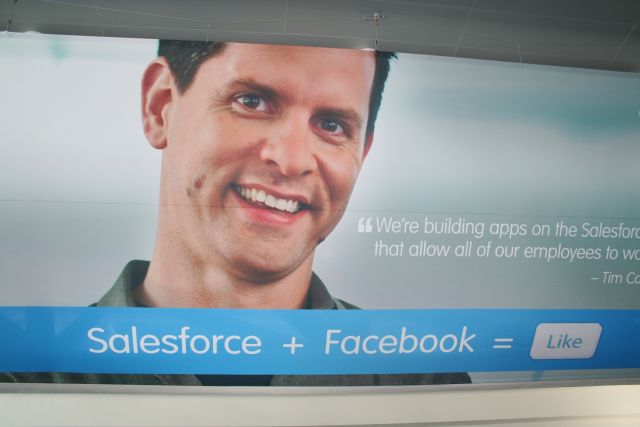
    An interesting part of this is the Facebook relationship, with the Buddy Media acquisition 10% of Facebook’s advertising revenue comes through  Salesforce. This in itself makes Salesforce a key Facebook partner.

    Facebook’s relationship goes deeper with Salesforce, at the media conference Marc Benioff mentioned that the company’s purchase of Rypple came about because of urging from Tim Capos, Facebook’s CIO.

    That deep relationship was on show in the opening keynote where Facebook were one of the strategic partners showcased by Benioff.

    Of the products showcased, one of the important points that kept being raised was Salesforce’s role as the enterprise social media identity service.

    A partnership between Salesforce and Facebook to provide online identity validation would effectively kill  Eric Schmidt’s aim of Google being the Internet’s identity service although Benioff was at pains in the media conference to emphasise there was room for more than one player.

    Google are also being challenged by Benioff’s announcement of Chatterbox, a secure online file storage and sharing service.

    While the focus with the Chatterbox announcement was on the threat this presents to Dropbox and Box.net, the bigger targets are Google Drive, Apple iCloud and Microsoft’s SkyDrive.

    Salesforce’s move into the various fields of HR, marketing, file storage and collaboration are part of the company staking its own position among the various web empires.

    With a strong enterprise position, it’s quite possible Salesforce could establish itself as the fifth of the Internet’s great empires.

    Every empire needs an army and a particularly strong claim Salesforce would have are the ranks of developers and supporters gathering around the service’s open APIs.

    The move to establish an independent position on the web would also explain Benioff’s commitment to HTML5 as this avoids locking the company into an Apple, Google or Microsoft dominated app environment.

    We’ll see over time how Salesforce establishes their position among the internet empires, right now though their range of services, customer base and partner ecosystem means they are well placed to compete with the big four currently dominating the web.

    Paul travelled to the San Francisco Dreamforce conference courtesy of Salesforce.com

    Similar posts:

  • ABC Weekend Computers – should you buy an iPhone 5?

    ABC Weekend Computers – should you buy an iPhone 5?

    With the usual hooplah, Apple announced their new iPhone last week. Should consumers drop their existing phones and buy the new iPhone?

    On ABC 702 Sydney Weekend computers this Sunday, September 16 from 10.15am Paul Wallbank and Simon Marnie will be looking at the choices in the smartphone market.

    Some of the topics we’ll discuss include;

    We love to hear from listeners so feel free call in with your questions or comments on 1300 222 702 or text on 19922702.

    If you’re on Twitter you can tweet 702 Sydney on @702sydney and Paul at @paulwallbank.

    Should you not be in the Sydney area, you can stream the broadcast through the 702 Sydney website and call in anyway. Everyone’s views are welcome.

    Similar posts:

  • Throwing down the gauntlet

    Throwing down the gauntlet

    The interesting thing with Apple’s announcement of  the new iPhone and iPod was the emphasis on gaming with two demonstrations showing off the capabilities of the new devices.

    While the iPod and iPhone can’t compete with gaming consoles in a straight out hardware comparison, customers like the idea of being able to play advanced games on their handheld devices.

    More worryingly for the console manufacturers is the pricing in the App stores. The traditional gaming model of expensive games subsidising devices starts to fall over when 99 cent, or even $19.99 downloads kill the fat margins.

    It’s not just games companies threatened by the iPhone and Android smartphones, probably the biggest threat from today’s launch is to Microsoft.

    Last week’s botched Lumia 920 launch throws into stark relief how Windows Phone is struggling to meet its October release date.

    The pressure is now right on Microsoft to deliver, the continued evolution of the iPhone is also leaving Blackberry and Motorola increasingly looking flat footed and vulnerable in a market that’s leaving them behind.

    Similar posts:

  • Goodbye to the electronics store

    Goodbye to the electronics store

    “Can Electronics Stores Survive?” asks the Wall Street Journal.

    The future doesn’t look good with the liquidation of Circuit City in the United States and the exit of Australian giant Harvey Norman from the electronics markets.

    Yet Apple Stores are growing and while it’s tempting to dismiss their sales training as brainwashing the truth is their staff are among the most profitable retail employees on the planet.

    The real problem is the Big Box category killer store featuring wide product lines but poorly trained staff motivated only by commissions is a business model whose time has passed.

    Customers can now go online, research website that are far more informative and honest than the staff at the megastore then get the appliance delivered and often installed for less than the shelf price at the mall.

    The earliest industry this has affected is the computer sector – long ago companies like Dell and Gateway changed how people shopped for PCs.

    Given the economics, it’s surprising the low margin big box stores survived as long as they could and the main reason they did was because appliances were an ideal channel for pushing profitable finance plans and extended warranties.

    Often the store and sales assistant made more money out of the “interest free 72 months” deal, the three year warranty and the connector cables than they did from selling a top end laptop or plasma TV.

    Now the easy credit era is over, those add-ons aren’t so profitable and with Amazon leading an army of e-commerce retailers changing customer expectations, those businesses locked into Big Box, easy credit way of doing things have to rethink how and what they are selling.

    Harvey Norman’s founder Gerry Harvey said recently that people would still buy big items from his store. The reality is they are moving across to sites like Winning Appliances where they can choose the items, have them delivered installed and the old appliance taken off, a godsend when you’re dealing with a 50Kg washing machine or fridge.

    Apple’s success shows retail does have a future. It just doesn’t lie in the low service, Big Box model that grew out of the easy credit and cheap energy economy of the late twentieth Century.

    Similar posts: