Should Australia pass a jobs act?

Can legal reform help Australian start ups?

Last week the US President signed the Jumpstart Our Business Startups (JOBS) Act into law.

The US law seeks to make funding easier for new businesses by lifting the burden of regulations like the Sarbannes Oxley Act (SOX) and various other financial rules.

One of the main planks of the reforms is it changes shareholder thresholds, for instance allowing 2,000 investors rather than 500 maximum before it has to go public, and allows companies to advertise their shares subject to certain restrictions.

Whether it achieves the stated aim of allowing new innovative businesses to raise funds or triggers a new generation of “boiler rooms” and investor fraud remains to be seen but it begs the question of should Australia pass a jobs act.

The funding crisis

There is no doubt Australia has a business funding crisis. Before the global financial crisis of 2008, it was difficult for smaller business to access finance.

In the aftermath of the GFC, it became even harder for businesses to raise funds as banks withdrew from the small business sector, increased their lending rates and tightened criteria.

While this situation has eased somewhat, partly due to the entrance of new angel and VC investment funds, financing of startup and small business is patchy and still tough.

An Australian Jobs Act would make it easier for business to raise funds and well crafted one might encourage both self managed and public superannuation funds to allocate some of their investments into the startup and innovation sectors.

A Scammer’s dream?

One of the big criticisms is that it reduces investor protections; while it restricts investors with less than $100,000 in annual income from punting more than 5% of their income, it’s quite clear in a full blown mania the Jobs Act will enable plenty of shoeshine boys and self funded retirees will do their life savings.

The question of course is how well the existing regulations protect investors or the community given the financial disastersof 2008.

Despite tough rules like SOX and the Basel Agreements, massive institutionalised fraud occurred and it’s surprising there have been no reforms in these rules given the huge and unprecedented costs of rectifying the problems.

In an Australian context, it’s clear local regulations aren’t working when thousands of investors are defrauded by their financial advisors in financial planner led scams like Westpoint. So reform is due.

While it’s clear the legislation isn’t working, it’s also clear the Australian financial planning industry doesn’t have the skills or ethics to advise clients should a local Jobs Act be passed.

Perhaps we should be accepting there is risk in investing and an Australian Jobs Act could help by simplifying business rules and improving transparency in accounts rather than bogging business and investors down in masses of unread paperwork.

Is the US experience valid?

Looking at the US Jobs Act it appears the Silicon Valley insiders are finding ways to extend their business models, whether this is successful creating new American jobs or just enriching the good folk of Sand Hill Road will pan out in the next few years.

For Australia it’s important we reform our laws to make business and innovation easier though we need to be careful we don’t ape the worst aspects of the Silicon Valley business model.

Playing with Dragons

We should be careful how we treat our customers.

Chinese manufacturing has been in the news recently with various exposes of factory conditions by the New York Times, the now discredited Mike Daisey and a fascinating look at US store chain Wal-Mart’s supply chain by Mother Jones’ Andy Kroll.

In his examination of Wal-Mart’s Chinese suppliers Andy Kroll interviews factory owners and managers with a common theme, they are all loath to be identified for fear of incurring Wal-Mart’s wrath.

This is wall of silence is familiar in Australia; the reluctance of local suppliers to speak about the conduct of the Coles’ and Woolworths’ policies has hobbled enquiries into the domestic retail market.

Another aspect Chinese and Australian have in common is how the retailers drive down costs with big buyers insist upon regular price reductions from their suppliers.

This is what happens when your business is a price taker that relies on one or two suppliers; you accept what you’re offered or lose a large chunk of your business.

With many of Australia’s industry sectors now dominated by one or two incumbents, this way of doing business is now the norm rather than the exception.

As a nation Australia’s finding itself in that position as well. Now our governments and business leaders have decided Australia will only dig stuff up with a few favoured, uncompetitive industries like car manufacturing being being protected, the entire country is in a position not dissimilar to a Foshan coat hanger manufacturer.

Having that dependency on one or two major customers is a risk and when the commodities boom turns to bust – commodities booms always do – our relationships with these customers will be tested.

When that test comes, the clumsy way the Federal government has banned Chinese companies from tendering to the National Broadband Network or blocked investment in mining projects may turn out to be mistakes.

This is the problem with being a price taker selling a commodity product, you become hostage to fortune and when the market turns against you there isn’t a great deal you can do.

In the early 2000s computer manufacturers like Dell and HP decided to sell commodity products then watched with despair as Apple captured the premium, high margin end of the market. Neither business has truly recovered.

Being trapped at the commodity end of a market is not a comfortable place to be, particularly if you don’t have a plan to move up the value chain.

If your business is currently selling low margin, commodity goods then it’s worthwhile considering what Plan B is should the market turn against you. You might also remember to be nice to your customers

At least you’ll show you have more forethought than our leaders in Canberra who seem to like to play with dragons without thinking through the consequences.

Competing in a high cost world

Business can compete when costs are high and currencies are strong

It’s often said that Australian businesses can’t compete and the nation can no longer can support manufacturing or high tech industries.

With the high Australian dollar, many economists, business leaders and politicians have said industries have to adapt to being an expensive economy. Interestingly, few of these experts explain how businesses should, or can, adapt.

At the recent Kickstart forum I had the opportunity to meet two Australian companies succeeding with high tech products and using the high dollar to their advantage.

David Jackman of Pronto Software, a thirty year old business intelligence company, is proud of the fact the business he leads does most of its development in Australia. As business owned by it’s employees – Pronto had  an employee buy out in the late 1990s – he sees his role as building the business to last centuries like some European businesses.

Linus Chang developed his Melbourne based business, Backup Assist, when he discovered the data backup tools built into Microsoft Windows weren’t very good. Taking the basic Microsoft products, he added the features that made these tools usuable at a fraction of the cost of bigger companies’ data backup software.

Today Backup Assist is sold in 124 countries with the US as the biggest market.

Both Backup Assist and Pronto find keeping the bulk of the software development in house in Australia makes sure they are producing high quality, effective products.

Software development isn’t the only sector dealing with the high cost evironment, David Jackman says Pronto has many customers in the Australian manufacturing industry who have adapted to a high cost environment with niche and high value added products.

Identifying these opportunities is where the challenge lies; what do our businesses do well that customers in international markets are prepared to pay for?

We also have an advantage in being a relatively open economy with first world standards. This is another reason why investment in new infrastructure like the National Broadband Network is important.

One thing is for sure, selling low priced commodity products with small margins is not where the future lies, even if the Aussie dollar collapses.

We have success stories and businesses adapting to being a high cost economy, it’s a matter of understanding how our industries can add value while  do this.

Why Dick Smith is wrong about overseas buyers

Foreign investors are desperately needed in Australian retail

Last week’s announcement that Woolworths will sell their Dick Smith chain of electronics stores wasn’t surprising and neither was the reaction of the chain’s founder to the idea of the business being sold to a foreign buyer.

For all his legitimate concerns about Woolworth’s growth model, Dick Smith is wrong about the sale of the stores. It’s almost essential for Australian consumers and business that the chain is sold to a foreign retailer.

When Dick sold his business to Woolworths in the early 1980s it was the beginning of a long consolidation process across Australian industry that now sees most business sectors dominated by duopolies or – at best – three or four incumbents.

In retail, the Coles and Woolworths duopoly dominates groceries, liquor and petrol. The power of these companies was illustrated yesterday with Coles’ announcement of price cuts to various greengrocery lines.

Having a new player enter the market is always an improvement; in neighbourhoods where foreign retailers like Costco and Aldi operate or where a keen, smaller operator decides to compete with the big boys the response is always better prices and service.

More importantly bringing in overseas owners will bring in fresh thinking and new ideas. New blood in the retail sector may even stem the brain drain where many young, innovative future business leaders are forced overseas because of the limited opportunities in the incumbent duopolies.

Where Dick is right is that the electronics retail business is dying as fat profits in the sector are a distant memory in what is now a tight margin, fast moving consumer goods industry. To make things worse, consumer electronics aren’t even fast moving in the post GFC economy.

Adding to the retailer’s pain the collapse in margins has happened at the same time commercial rents have risen dramatically with Sydney now being cited alongside Hong Kong, London and New York as the world’s costliest shopping strips.

While suburban shopping centres don’t have the same rents as the Pitt or Bourke Street Malls, they still have risen dramatically in the last decade, catching all retailers in a vice between rising costs and falling margins.

In order to maintain profits, training and staff development have been slashed. Once up a time, a customer would go to a Dick Smith or Harvey Norman store to get informed advice on the best gadget, those days are also long gone as poorly trained staff fight to sell the products with the best commissions.

Owners of the stores have made it harder to recruit and train motivated staff when employer consider hospitality and retail jobs to be temporary, low esteem positions with few prospects.

This deskilling isn’t just an issue for the retail industry – it’s something we’ve seen across the Australian economy in the last thirty years. As training and skills development has been seen as an unnecessary business cost.

Tourism Australia chairman Geoff Dixon’s recent comments about the Australian tourist industry having to accept being a high cost destination is a symptom of this disconnect. The local tourism industry has no chance of moving up the value chain when there is no service culture among staff and no long term management vision to develop one.

It would be unfair to just pick on any one individual or business for these problems. We have a structural problem in the Australian economy that’s fuelled by entrenched beliefs and habits of a stagnant senior managerial class.

We desperately need new people and ideas in Australian management to shake up the staid duopolies and oligopolies we’ve allowed to develop in the last three decades, that’s why Dick Smith is wrong to say a foreign owner for the electronics chain he founded would be bad for the country.

Image courtesy of Icelandit on SXC.hu

The saddest sign you’ll ever see

When a landlord takes possession of a business, there’s a lot of pain behind the signs.

The sign on an abandoned business announcing “Landlord taken possession” usually hides a pile of pain and distress.

It’s not cheap or easy for a landlord to take possession of a business premises and for most to do so it’s usually the end of long period of unpaid bills and broken promises.

Behind that sign is usually months, if not years, of stress and despair as a business owner has held onto a failing enterprise, bluffing their landlord, their suppliers, their staff, their own families and often themselves.

Almost every one of those signs has a story of failed relationships, destroyed friendships and ruined marriages.

Often they didn’t understand the cost of doing business and in many cases because they hadn’t consulted a bookkeeper or accountant earlier they didn’t understand their venture was always loss making despite what appeared to be a healthy cashflow.

When the truth about the businesses becomes obvious, life for the honest owner of a failing enterprise tries to bluff themselves and those around them that things will be okay, that the dream is still alive.

This is what worries me about many of the businesses that participate in group buying deals, they are desperate to keep their business afloat and believe the cashflow or publicity will save their failing venture. Even worse, many don’t understand how that “50% off” deal will affect their ability to pay staff and the landlord.

Even where the failed proprietor has been one the “two percenters” – the 2% of our society that runs their affairs with no regard for the pain and suffering of those they hurt – many people, particularly the smaller suppliers and low paid workers, have taken a hit as bills went unpaid and promises were not kept.

Most business owners though believe in their idea or vision and work long and hard in an attempt to achieve it. The majority of those who end up with the landlord taking possession are often those who ignored the signs and believed things would come good next season, next month or next week.

I’m always saddened when I see a “landlord taken possession” sign like the one near me in the window of what was an Italian restaurant until recently. What’s the saddest business sign you see?

Australia’s one trick economy

Businesses need fall back plans, particular when the nation doesn’t have one.

Earlier this week, Reserve Bank of Australia Governor Glen Stevens gave a speech to the Australian Industry Group on the world’s changing economic currents.

That presentation has a number of pointers for Australian businesses on how we use technology, our investments and, most importantly, where the Canberra sees our economy going.

Much of the Governor’s speech discussed how those of us who at the beginning of the century believed Australia’s economy had to diversify into new industry sectors — such as the IT sector — were proved wrong by the Dot Com Bust and the subsequent boom in the resources sector.

“Australia would probably do best, in its production structure, to stick to its comparative advantages in minerals or agriculture or various services.” Mr Stevens quoted from ten years ago, “but it was hard going trying to make sensible points against the barrage of market and media commentary.”

Perfect hindsight

It’s impressive the Governor had this perfect hindsight which can overlook the role of ramping the housing markets by the Rudd and Howard governments to avoid the 2001 and 2008 US recessions along with the sheer good luck of having a resources boom through the last half of the decade.

During his speech the governor referred to an RBA research paper, Structural Change in the Australian Economy which casts an interesting light on the comparative advantages in those “various services”.

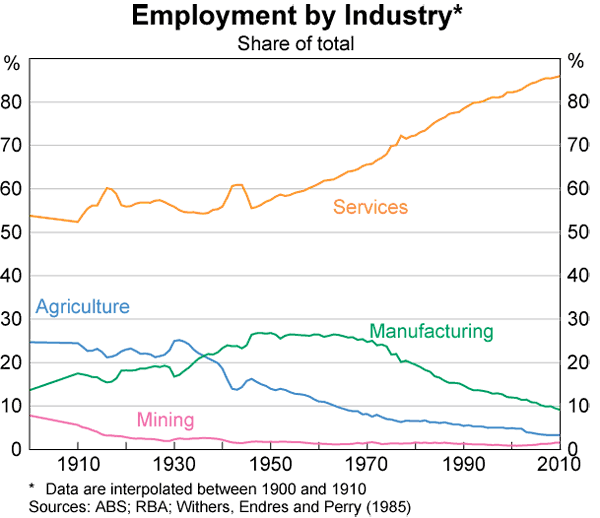
That paper shows that service sector employment has risen to nearly 85% while its share of GDP has stayed around the same for the last twenty years, which to this non-economist’s mind implies the portion of national wealth is declining for service based workers and businesses.

Sleepwalking into the dutch disease

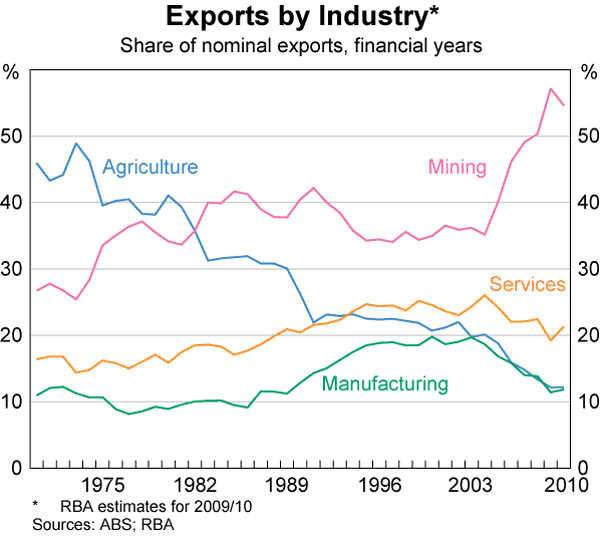
Of course those of us in the service sector could make it up by exporting but here again, service sector exports haven’t done much over the last decade which won’t be helped by the current high Aussie dollar — another aspect of the Dutch Disease we seem to have sleep walked into over the Howard and Rudd years.

Those same statistics show mining employment has declined over that period as well and if you’re considering sending your kids down the pit, or even packing in your own city job to drive a mining truck, you might want to read the interesting work being done by the University of Sydney’s school of robotics.

Generously, Governor Stevens didn’t completely write off the role of technology observing that, “in the old versus new economy stakes, it was probably in the use of information technology, rather than in the production of IT goods, that the gains would be greatest.”

Invest in, but don’t develop, technology

The Governor’s messages are clear to business people; our businesses have to invest in technology to be more efficient and we need to understand that government policy will be geared around the mining sector.

Most importantly, we need to understand that on a national level there is no Plan B.

In the last election it was clear both sides of politics based their policies, such as they were, on the assumption the China boom will last for the foreseeable future. Yesterday’s speech shows Glenn Stevens and the Reserve Bank share that outlook and no other alternative is being planned for.

That’s fine for Glenn, Julia, Tony and their colleagues as they have safe, indexed pensions when they deign to cease giving us the benefit of their visionary leadership.

In the business community we don’t have that luxury; a plan B is required just in case things don’t quite work out the way we hope. As the Governor says:

Succeeding in the future won’t ultimately be a result of forecasting. It will be a result of adapting to the way the world is changing and giving constant attention to the fundamentals of improving productivity. That adaptability is as important as ever, in the uncertain times that we face.

That’s excellent advice. How adaptable is your business in these uncertain times?

How broadband won the Australian election

building a new communications network was the difference between the two parties

In a dour and negative Australian election campaign, the National Broadband Network was the one issue separated the look alike policies of the two major parties. In the end, it decided the election.

Privately developed communications networks are rare in the nation’s history for a combination of factors including Australia’s population distribution and commercial appetites for investment risk.

Australian governments have always been critical to the development of regional communications, from the establishment of state operated railway networks, through the post office owned telegraph and telephone networks and eventually the road system.

So the National Broadband Network is typical of Australian communications development where the government provides the infrastructure framework and the private sector grows around it.

There’s no doubt regional communities understood the importance of being connected to the global economy, successive Federal governments have struggled with a patchwork of government programs such as the Universal Service Obligation and Broadband Connect in an effort to guarantee some level of service for all Australian communities.

The NBN itself was conceived in the realisation that any solution that relied wholly on private funding was not going to deliver a national solution. This was view that regional organisations such as Digital Tasmania had held all along when agitating for their communities not being left behind.

And Tasmania was were the vote mattered, the coalition failed to win any Tasmanian seats where three would have been won had the state followed the rest of the nation. Those three seats; Bass, Franklin and Braddon would have been enough to give the Liberal and National Parties power.

Had the coalition focussed on the legitimate criticisms of the NBN such as the government’s failure to quantify the $43 billion price tag or NBNCo’s failure to produce a business plan then they may well have won the election.

As the country Independents stated, the NBN was one of the key considerations in their decision to support the Labor government, so not getting their NBN policy right cost the coalition government in two ways.

Now the NBN is going ahead we need to focus on what it can deliver, along with a sensible discussion on the right mix of fibre and wireless infrastructure, the proportion of private and public investment and exactly how much the project is going to cost.

Now is the time to get on with building what will be the 21st Century equivalent of the roads and railways of the 20th and 19th Centuries.