Tag: mobile

  • Comparing Management costs

    Comparing Management costs

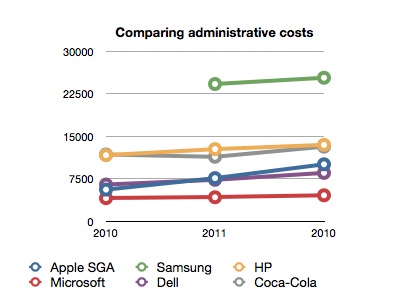
    Telecoms analyst site Asymco has a look at how much Samsung spends on marketing compared to other tech companies, particularly Apple, with Coca-Cola added as a sanity check from outside the bubble.

    While the results are stunning with Samsung dwarfing the others, the Asymco story also touches on the total cost of sales and general administration expenses with the observation that, as a proportion of revenue, Sumsung’s are soaring while Apple’s are declining.

    Teasing those figures out a bit more is interesting, when we track the sales and general administration costs of all the business we see that with the exception of Apple they’ve been remarkable flat in straight dollar terms over the last three years.

    Of course this comparison is a little unfair as this is an absolute number, not as a proportion of revenue and as Horace Dediu points out in the Asymco posts Apple’s expenses as a ratio to sales has fallen.

    For companies like HP, Dell and Microsoft where sales have been stagnant or falling it might be that the ratio is rising while spending is flat.

    We’ll tease these figures out over the next few days.

    In the meantime, the fact that Samsung is spending such an awesome amount on marketing should cause us to treat Android sales figures with caution as that spend in undoubtedly inflating their sales figures. More on that in the future as well.

    Similar posts:

  • Open Table and free mobile restaurant sites

    Open Table and free mobile restaurant sites

    One of the big challenges facing restaurants is how customers are moving to the mobile web, diners are using their smartphones to find establishments and expect to make bookings directly.

    To help their customers deal with this move to smartphones, restaurant booking service Open Table is offering a free mobile website for their clients so establishments can have sites that are usable on smaller screens.

    Whether this is worthwhile depends upon whether the restaurant is already using Open Table, the monthly fees are quite high at $200 per month plus a relatively low $1 commission per cover so it certainly isn’t worth subscribing to their service just to get a mobile optimised website.

    For restaurants already using their service it’s best to check if your existing website already has a mobile feature as having two online addresses is only going to confuse customers.

    Businesses using WordPress based sites just need to install a plug like WordPress Touch which detects when a smaller screen is viewing your site to change.

    Open Table itself is somewhat of an internet old timer having been founded in 1998, making it one of the Tech Wreck survivors, and listed on the NASDAQ market eleven years later.

    That a company like Open Table is recognising a mobile web presence is essential for hospitality businesses should be a further warning to restaurants, cafes and hotels that they need to take smartphones seriously.

    Just as thirty years ago it was essential to have a Yellow Pages listing, today you’re missing out on customers if they can’t find you on their phones.

    Regardless of whether you’re using Open Table or any other service, you need to have some form of mobile site working for you.

    Similar posts:

  • Can Microsoft beat the PC marketplace’s structural decline?

    Can Microsoft beat the PC marketplace’s structural decline?

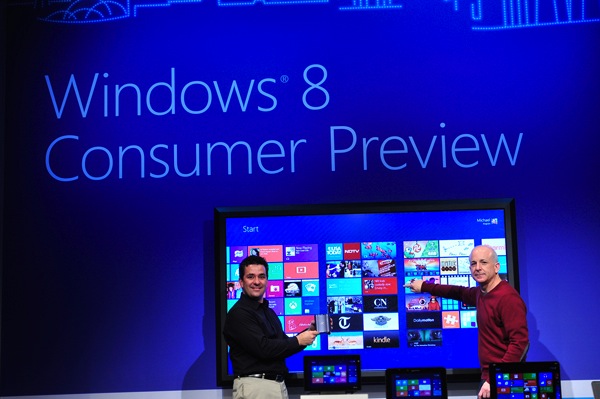
    In New York on Thursday Microsoft will have a marathon launch of their Windows 8 system and the futures of many of their hardware partners lie on the success of the new system.

    For Microsoft, Windows 8 could be the last throw of the dice for the desktop operating system that has sustained the company for thirty years.

    The figures aren’t good for Windows as Microsoft’s 2012 profit and loss shows, here are the figures broken out by operating unit segment from the company’s annual report.

    Year Ended June 30, 2012 2011 2010
    Revenue  bn $  bn $  bn $
    Windows & Windows Live Division 18,818 18,787 18,789
    Operating Income (Loss)
    Windows & Windows Live Division 11,908 11,971 12,193

    The core Windows & Windows Live Division has stagnant revenues and a slowly declining profit margin. We’ll leave the huge losses in the online division for a future post.

    Since the days of the first MS-DOS deal with IBM, Microsoft’s core business has been the licensing of operating systems to PC manufacturers and now that model is in trouble.

    For instance Dell had an 8% drop in revenue resulting in a worrying 22% drop in operating profit, their PC dominated consumer division suffered a fat 22% drop in sales and recorded a miniscule .5% profit margin. Similarly Asus had 25% drop in sales to record a 2011 loss.

    The pain being suffered by PC manufacturers’ sales and margins will almost certainly be shared by Microsoft as companies like Dell, HP and Asus simply can’t afford to pay the licensing fees which have sustained the Redmond business model for so long.

    Microsoft and their partners hope – or pray – that the PC decline is a temporary hiccup in computer sales similar to the traditional lull seen before the release of a new system.

    History’s not on their side with research company Asymco expecting sales of tablet computers to overtake PCs sometime in late 2013.

    This is not a cyclical trend – the PC industry is in structural decline; the traditional Windows upgrade cycle is dead and Google are running interference with their Chromebook networked laptops.

    Moving onto tablets and smartphones in this light makes sense for Microsoft and given the PC manufacturers have failed dismally to deliver decent tablet computers or phones over the last 15 years so it’s understandable the software giant wanted to develop their own hardware or team up with a struggling company like Nokia.

    The declining margins in personal computers means we’re seeing the end of the Windows desktop ecosystem. With the rise of the web and cloud computing the type of operating system we use is like arguing between Toyota and BMW drivers; one might be more prestigious but both will get you where you want to go.

    For Microsoft the challenge is to replace those Windows licensing rivers of gold with similar revenue streams through their phone and tablet products but with Apple and Google already dominating those fields, is it too late for the company that dominated personal computing? The next six months will tell us.

    Similar posts:
  • ABC Weekend Computers – should you buy an iPhone 5?

    ABC Weekend Computers – should you buy an iPhone 5?

    With the usual hooplah, Apple announced their new iPhone last week. Should consumers drop their existing phones and buy the new iPhone?

    On ABC 702 Sydney Weekend computers this Sunday, September 16 from 10.15am Paul Wallbank and Simon Marnie will be looking at the choices in the smartphone market.

    Some of the topics we’ll discuss include;

    We love to hear from listeners so feel free call in with your questions or comments on 1300 222 702 or text on 19922702.

    If you’re on Twitter you can tweet 702 Sydney on @702sydney and Paul at @paulwallbank.

    Should you not be in the Sydney area, you can stream the broadcast through the 702 Sydney website and call in anyway. Everyone’s views are welcome.

    Similar posts:

  • Enter the Dragon

    Enter the Dragon

    Once up a time our parents laughed at the tinny little Japanese cars – in the 1960s companies with silly names like Toyota and Mazda could never threaten world giants like Chrysler, Ford and General Motors.

    Within two decades the Japanese had moved their products up the value chain leaving their American and European competitors running scared while governments in western countries offered the new leaders of the manufacturing industries bribes to set up plants in their towns and states.

    It was always obvious China would follow the same course as the Japanese, particularly given the country’s position as the world’s cheap labor supplier had a time limit thanks to the demographic effects of the 1970s One Child Policy.

    So it’s no surprise that Alibaba, China’s biggest e-commerce service, has built its own mobile operating system to compete with Google’s Android.

    If Aliyun follows the Japanese development path, the first version is terrible but within five years – the development cycle of software is a lot quicker than that of cars – Alibaba will be a viable competitor to Google and Android.

    Chinese developers moving into the mobile market is terrible news for the also rans like Microsoft and Blackberry. As Apple dominate the premium mobile sector and Android the mass market, it’s very hard for those running third or lower to achieve the critical mass needed to be competitive. Aliyun makes it much harder for them to gain any traction in high growth developing markets.

    An interesting aspect of the Wall Street Journal’s story is how Aliyun is aimed at the domestic Chinese market for the moment. This is part of China’s economy moving away from being overly reliant on exports, having locally made products that meet the needs and aspirations of a growing domestic economy is an important part of this process.

    Exports though will remain an important part of the Chinese economy for most of this century and value added products like Aliyun will be important for China as the cheap labour advantage erodes over the next two decades.

    Businesses who think their markets are protected because their quality is better than their Chinese competitors may be in for a nasty shock, just like the 20th Century auto makers who dismissed the Japanese were in the 1970s.

    Whether Aliyun is successful or not, we’re once again seeing many of the facile assumptions about Chinese growth being tested as the country’s economy and society evolves.

    Similar posts: