Tag: technology

  • Our evolving view of robots

    Our evolving view of robots

    Ahead the Ovations Speaker Showcase on Tuesday, I’ve been looking at robots as one of this decade’s trends.

    What’s interesting is how our perception of robots has evolved over the last half century.

    The idea of Robots in the 1950s and  60s were ones with human shapes – four legs, a torso, two arms, shoulders and a head – otherwise known as anthropomorphic. Lost in Space and the Day the Earth Stood Still are two good examples of those human like machines.

    How robots looked in the 1950s
    1950s robot chic – the day the Earth stood still

    Today’s robots have much more utilitarian shapes, like the Winbot window cleaner pictured at the beginning of this post.

    Many of the robots look like the machines we use today, mainly because they are today’s technology with the driver or operator replaced. A good example being the Google self driving cars.

    google self driving car

    The idea of a robotic car isn’t completely new though; the 1980s action series Knight Rider featured KITT, a robot car with an almost equally mechanical David Hasslehof as its sidekick.

    The Hoff and KITT

    More interesting still are the tiny robots who look, and act, like insects. Wait until these guys infest your internet fridge.

    All of these technologies had to wait until computers became small and cheap enough to fit into the systems. In the 1980s a computer with the capabilities to run KITT or a Google Car would be the size of a large warehouse, today it can fit inside a cigarette packet.

    Of course the real power for robots comes when computers talk to each other and form a collective intelligence. This is the Internet of machines.

    The terminator
    Skynet has told The Terminator to destroy us all.

    Which brings us to Arthur C. Clarke’s and Stanley Kubrick’s 2001: A Space Odyssey and the 1980s vision of Skynet which gave birth to the Terminator.

    Hopefully those visions of the future of network connected robot are just as misguided as those of 1950s movies.

    If they aren’t, we’re in a lot of trouble.

    Similar posts:

  • 15 years of radio and technology

    15 years of radio and technology

    I used to be a cranky radio listener.

    One morning in early 1998 I was listening to my local ABC station, then 2BL, when stand in breakfast host Bob Hughes was interviewing a “Y2K expert” who had the standard spiel designed to scare people into buying expensive consulting services.

    Irritated by the expert’s shoddy advice, I dashed off a quick “with respect” fax to the radio station – the ABC didn’t have publicly facing email addresses at that time – and expected it would be ignored.

    A few weeks later Bob Hughes invited me on his regular Sunday spot to talk about Y2K and computers in general. He didn’t mention we’d spend most of the time taking listeners’ calls.

    After a few minutes of ‘umming’ and ‘aaahing’ with lots of bluffing, Bob finished with “we’ll see you next month Paul.”

    So it began.

    Over time the segments moved from 702 Weekend on Sunday mornings to regional spots and the national Tony Delroy nightlife segment

    Looking at the sadly neglected PC Rescue website, the programs have ranged from the mundane to the mad, bad and ugly.

    At the ugly side, the Windows virus epidemic of the early 2000s looms large. At one stage almost every caller had a virus problem, the only ones that were didn’t were Mac users calling in to crow about their not having this problem.

    We enjoyed the various platform wars as Microsoft consolidated its strength and then saw it ebb away as first Firefox started chipping away at its browser dominance, Google at its Internet strategy and then Apple came roaring back into relevance.

    The radio shows track the rise of the web as we started talking about the various online services that were changing computing.

    One of the critical things, which still hasn’t changed, was billing problems.

    Through the early 2000s Australian telcos had shocking charges for data and mobile services. Calls from listeners distressed at big bills was common and the TIOs contact details would be among our most frequent answer.

    It was Telstra’s decision to stop stunting Australian internet growth and offer reasonably priced plans, albeit with criminally tiny data allowances, that kick started consumer adoption of broadband plans.

    Today the questions revolve around social media, online security and the merits of Android versus Apple smartphones and tablets, it’s quite notable at how Microsoft has moved from dominating the program to being almost irrelevant.

    How the next 15 years will pan out are anyone’s  guess, although one suspects pervasive computing, the cloud and the internet of machines will be among the trends we’ll see.

    Last week Tim Berners-Lee said that innovation is only just beginning, it’s going to be an interesting, wild ride.

    I’m still a cranky radio listener, but these days I have a lot more sympathy for producers and announcers.

    Similar posts:

  • 2UE Weekend Computers, 5 January 2013

    2UE Weekend Computers, 5 January 2013

    This Saturday from 3.10 pm I’ll be discussing tech with John Cadogan on Radio 2UE as the stand in for regular guest Trevor Long who’s in the US for the Consumer Electronics Show.

    We’ll be taking calls on the Open Line, 13 13 32 or tweet to @paulwallbank while we’re on air. 2UE can be heard online or on 954 AM in the Sydney region.

    Some of the things we’ll be covering include the following which we’ll be covering after John speaks to Trevor Long in Las Vegas.

    R18 + video games

    An adult’s only rating category for computer games has come into effect across Australia. The new R18+ will make it illegal for people under 18 to hire, buy or view any games given the rating, while it will be illegal for retailers to sell R18+ games without the new markings.

    The new laws bring computer games into line with the classification system for films and other material and make Australia more consistent with international standards.

    Google is working on an X phone

    Google is working with Motorola on a handset code-named ‘X Phone’ that’s aimed at grabbing market share from Apple and Samsung.

    Google acquired Motorola in May 2012 for $US 12.5 billion to bolster its portfolio as its Android operating system competes with Apple and Samsung.

    It’s believed that the handset will feature an imaging and gesture-recognition software developer. The new handset is due out next year.

    The first civil lawsuit against Instagram

    A Californian Instagram user has levelled breach of contract and other claims against the company.

    The lawsuit, filed by Finkelstein and Krinsk, says that customers who do not agree with Instagrams terms can cancel their profile, but they then forfeit their rights to photos they had previously shared on the service.

    Instagram, which allows people to add filters and effects to photos and share them easily on the Internet, was acquired by Facebook earlier this year for $US 715 million.

    It announced its revised terms of service last week and also announced its mandatory arbitration clause that forces users to waive their rights to participate in a class action lawsuit except under very limited circumstances.

    Easing of restriction on Internet use on flights

    The Federal Communications Commission (FCC) has approved an application process for airlines to obtain broadband Internet licenses aboard their planes. Previously airlines have been granted permission on an ad-hoc basis.

    Airlines need the FCC’s permission to tap into satellite airwaves while in flight so that passengers can connect to the Internet.

    They also need permission from the Federal Aviation Administration, which oversees the safety of inflight Internet systems.

    The death of Netbooks

    Netbooks have been overtaken by tablet computers and vendors are seeking to push more expensive items to their customers.

    The Internet’s TCP/IP language celebrates its 30th birthday

    Known as ‘flag day’ January 1, 1983 was the first time that the Us Department of Defence-commissioned ‘Arpanet network’ fully switched to use the Internet protocol suite communications system.

    It began as a military project in the U.S in the late 1960’s and it paved the way for the arrival of the World Wide Web.

    Summer sales of mobile phones are creating e-waste stockpiles

    Over a third of Australians have bought or will consider buying a new mobile phone over Christmas and the summer sales.

    This is contributing to the 22 million old mobile phones in Australia.

    If these 22 million phones were recycled, they would divert nearly 120 tonnes of plastic from landfill.

    Four out of 10 Australians have two or more old mobile phones lying around the home father dust.

    Mobile Muster is the official recycling scheme of mobile phones.

    You can drop your mobile phone off at a Mobile Muster Collection Point or pick up a reply-paid environment at any Australia Post store and post it in.

    Your views, comments or questions are welcome so don’t be shy about calling in on 13 13 32 and Trevor Long will be back next week.

    Similar posts:

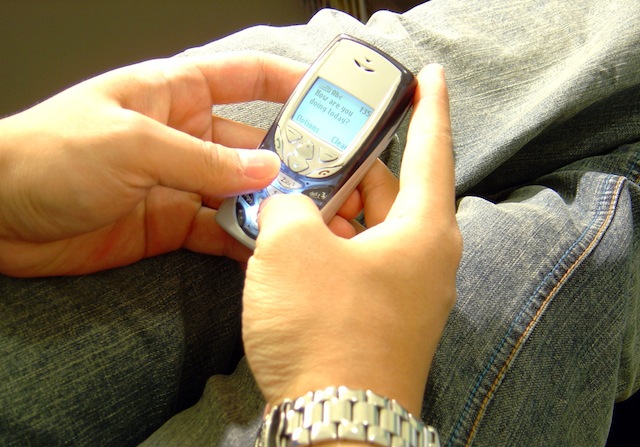
  • Twenty years of text messages

    Twenty years of text messages

    When the mobile phone arrived we thought that text, particularly those clumsy pagers people used, would be dead.

    Little did we know that an overlooked part of the newer digital cellphone technology would see short messaging become a key part of the phone system and a major income generator for telephone companies.

    Short Messaging Services – or SMS – was an add on to the digital Global System for Mobile communications (GSM) standard which became the second generation (2G) of mobile phones.

    While intended as a control feature on the phone networks, SMS took off as a popular medium in the mid 1990s and soon became a major profit centre for mobile carriers.

    The Twentieth anniversary of the first SMS being sent passed last week and the BBC has a great interview, conducted by text message, with Matti Makkonen who came up with idea.

    One of the notable things in the interview is Matti’s humility – he doesn’t like being called the inventor or founder of text messaging as he explains,

    I did not consider SMS as personal achievement but as result of joint effort to collect ideas and write the specifications of the services based on them.

    We can only imagine what would happen if the idea of SMS messaging was invented today, there’d be an unseemly struggle over patents while hot young Silicon Valley entrepreneurs would pitch venture capital firms with plans for niche services that will make a billion dollars when sold to Yahoo! or HP.

    As it was, SMS services were insanely profitable for the telcos. In the early days, text messages were being charged at over a dollar each – for a service that cost the carrier almost nothing.

    Over time those handsome profits have been eroded as SMS became bundled into all-you-can-eat packages and then the internet introduced new mediums to send short messages.

    While SMS isn’t going away while mobile phones are an important part of our business and personal lives; the service isn’t going to be as critical, or as profitable as it was over the last twenty years.

    Short Messaging Services are a great example of how individual technologies rise, evolve and fade with time. They are also a good lesson on how quickly a premium, highly profitable service can become commodified.

    Similar posts:

  • Digital maturity and the profitable business

    Digital maturity and the profitable business

    “The advantages of Digital Maturity”‘ a paper recently released by researchers at the MIT Sloan school of management looked at how different businesses adopted technology and the effect this had on the companies’ profits.

    The authors of the paper, George Westerman, Didier Bonnet and Andrew McAfee, defined ‘digital maturity as a combination of a company’s level of technology investment and the management skills to implement that technology. From this they classify businesses into four categories – the beginners, conservatives, fashionistas and digirati.

    Wallowing in the bottom right are the beginners, who have little idea of how to use technology and as a consequence don’t apply tech to their business. While they’ll use computers and will almost certainly use tools like ERPs and accounting software, they won’t implement them beyond their immediate needs.

    This could describe thousands of big and small businesses who have learned just enough to do what they need but don’t really understand, or care, about what their IT systems can do for the way they work.

    Above the beginners sit the fashionistas, the businesses who like shiny tech things but don’t really have a strategic understanding of technology or how to apply it effectively. As a consequence the digital tools are underused and fashionistas don’t use them much more effectively than the beginners.

    More effective users of technology are the conservatives and digerati, the latter are like the fashionistas except their managements understand how to integrate technology into their business.

    The conservatives are probably the most typical business, slow to adopt new technology but when they do, the management ensures it is used effectively.

    Of the four groups, MIT’s researchers found that the digerati and conservative categories earned between 9 and 26% more profit than their peers.

    The use of technology makes a difference as well with the fashionistas getting a 16% better return on assets than the conservatives which is something worth noting about the adoption of tech in a business.

    What the researchers concluded was that businesses who aren’t adopting technology are falling further behind in skills as well as profit noting that attaining ‘digital maturity’ takes several years.

    It’s worthwhile reflecting on how digitally mature your business is and reviewing exactly how you’re using technology in your organisation. With the tools available for today’s business, there’s no reason to be playing with the beginners.

    Similar posts: