Tag: paypal

  • Activating main street

    Activating main street

    The future of retail is being fought out on three fronts believes eBay’s Michael Camplin  — global, local, mobile and data.

    At eBay’s Commerce Innovation Showcase at its San Jose head office Champlin shows visiting partners, media and government officials part of the payments giant’s vision for that future.

    “It’s about connecting buyers and sellers across the globe,” says Champlin. “Local is important for us because even with the growth of the online ecommerce revolution that we’re in the middle of right now we still see 75% of commerce happens within fifty miles of the customer and 90% of that happens in bricks-and-mortar stores.”

    “So to be able to connect buyers and sellers in those local stores is a major push we have at eBay.”

    paypal-innovation-tour-003

    The first presentation in the tour demonstrates a day in the life of an eBay customer from the bedroom of a fictional customer, Reese McLaren, a funky young guy shopping for new equipment ahead of a camping trip. Champlin illustrates how Reese can order, pay and collect through a store’s integrated online service from his home.

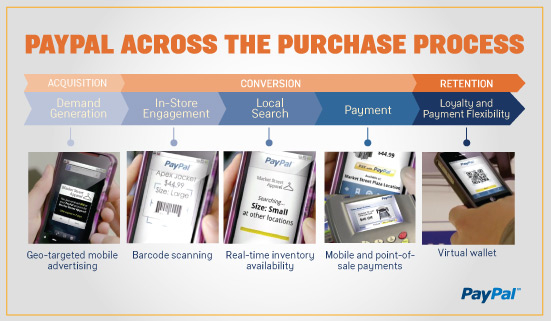
    On the other side of the transactions, store employees use the PayPal apps like Red Lazer and Braintree to complete the order. A key part of that is using beacon technologies to log a customer into the store to alert staff that a customer has arrived to collect an order.

    paypal-innovation-tour-015

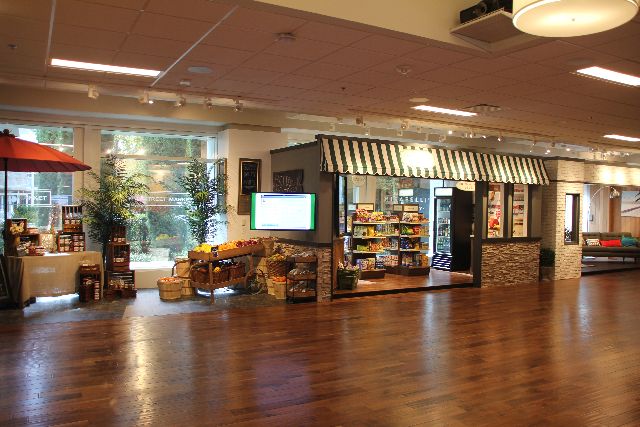
    At the next stage of the tour, we visit some demonstration stores; first we start with the Burger Bistro where eBay’s Eric Armstrong shows how restaurant’s point of sale system is integrated with PayPal services, showing waitstaff who is logged in through the company’s app.

    Integrating PayPal’s services into the establishment’s point of sale system means customers can order through the PayPal Wallet service and waitstaff know if a customer has paid through the app.

    paypal-innovation-tour-012

    The app also speeds up settling customers’ bills as diners can pay the check through their phone and not bother with using cash or swiping credit cards.

    One key point with PayPal Wallet is that users can enter any payment form that suits them and choose whichever option suits them at the time including direct bank transfers and credit cards.

    paypal-innovation-tour-006

    Another area that PayPal are pushing out are coupon offers. At present the company is subsidising them as they test how the services work. The objective is to offer a digital equivalent of everything people currently have in their wallets.

    For staff, eBay are offering the ability to bring your own device for point of sale systems with cloud base apps turning staffs’ tablets and smartphones into POS terminals.

    paypal-innovation-tour-028


    Tying into the Point of Sale capability is the PayPal Now service that allows establishments to swipe credit cards directly into the app through a dongle that reads the chip or stripe. Despite the rise of online payment services, swiping credit cards is still the main way US customers pay their bills.

    paypal-innovation-tour-031

    Despite the continued popularity of credit cards, eBay are hoping to move customers over to the online services through ease of service; the one stop authentication service means customers are logged into the payment platform as soon as they check into a location.

    One area PayPal sees great opportunity in stadiums and major events where attendees automatically check in and can then access food and souvenir stands without having to re-authenticate or authorise each purchase they make.

    paypal-innovation-tour-039

    A key part of eBay’s retail strategy is the use of beacons to monitor customers entering establishments. The one illustrated is the PayPal beacon that was a limited release earlier this year. The device doesn’t have its own battery, instead relying on a USB socket for power.

    Two weeks after this tour Apple launched its Pay service with its range of integrated APIs to offer many of things shown in this showcase. eBay and its Braintree subsidiary was conspicuously missing from the listed partners.

    For PayPal and eBay the field has suddenly become more competitive, this is a sector that is now at the forefront of the battle between today’s internet empires.
    Similar posts:

    • No Related Posts
  • Tipping and mobile payments

    Tipping and mobile payments

    This post is the second in a series of four sponsored stories brought to you by Nuffnang.

    During the recent switch over to chip and pin payments, many in the restaurant industry feared that tips would fall and waitstaff would lose jobs, the reality is somewhat different claims PayPal.

    Last week I had the opportunity to tour the PayPal Innovation Centre in San Jose where they showed off the work they are doing in the retail and hospitality industries to change payment systems.

    One of the products they showed was their Pay At Table app that integrates into a café or restaurant’s point of sale system and allows customers to pay their bills immediately.

    The immediate reaction to this has been resistance from restaurant managers who were worried customers to skip without paying. For waitstaff, the worry was they could be replaced by an app.

    It turns out the technology has had a different effect, the productivity of floor staff in the establishments where the app has been trialled has improved substantially.

    “In a typical café it takes around ten minutes to get the check,” says the lead demonstrator of the Innovation Center, Michael Chaplin. “We find that freeing waitstaff up to help customers and letting them pay their bills faster means everybody is happier.”

    With that ten minute per table improvement, management have found customers’ satisfaction has improved and the waitstaff have seen tips improve – partly because diners are happy and also because the tipping is integrated into the payment, calculating an appropriate gratuity is always a hassle in the United States.

    That ease of payment from mobile phone and table apps is rolling across industries, it’s not just limited to the hospitality sector. Increasingly these technologies are being used by tradespeople, retailers and across the service industries

    Increased productivity is more than just saving money and reducing staff numbers, it’s about giving the customer a more seamless and easy experience.

    All business need to think carefully about how they can use technology to improve their service and increase revenues.

    Similar posts:

    • No Related Posts
  • Retail and the internet of machines

    Retail and the internet of machines

    Online retail and payment giants Ebay and PayPal hosted a media lunch in Sydney yesterday to publicise their Australian Business Update.

    While eBay dominates the online selling market, PayPal’s position in the payment market place is extremely powerful with Internet monitoring company Comscore reporting in their Digital Wallet Roadmap how PayPal dominates the US market and does likewise in other markets like Australia.

    PayPal's US market lead

    Their update confirms the trends which have been obvious for some time, particularly in how mobile devices are now driving retail. eBay’s research indicates properly implemented multichannel strategies drives six times more sales than just having an online presence.

    What was particularly notable with eBay’s presentation was how the Internet of Machines is changing the retail and logistics industries as smartphones and connected point of sales systems are cutting out jobs and middle men.

    Paypal are particularly proud of their US partnership with cash register manufacturer NCR that integrates smartphone payments with the point of sales systems in restaurants, convenience stores and gas stations.

    eBay illustrated this with their examples of coupon offers being tied to smartphone payment systems so people paying for gas with their smartphone get a voucher offer for various up sells.

    Studies in the US have found a $10 offer can result in sales of up to $100. A pretty compelling deal for most merchants.

    With these technologies, we’re seeing how connected machines are changing even the most mundane business tasks.

    It may well be that the days of the service station cashier are numbered; it’s quite possible that in one generation we’ll have gone from full staffed gas stations to totally automated facilities.

    The example of gas station attendants and cashiers is just one example of how automation is changing many retail and sales tasks. It would be a brave person to say their job isn’t safe.

    Similar posts:

  • PayPal struggles with the Soviet customer service model

    PayPal struggles with the Soviet customer service model

    CNN reports that internet payment giant PayPal is looking at an “aggressive changes” to its fraud detection systems which see thousands of customers accounts frozen every year.

    PayPal’s announcement follows last year’s promise by CEO David Marcus to institute a “culture change” at the company,

    Our intention has always been to protect our customers. Not to mess around with our merchants.
    I want to share two things with all of you:

    #1 — there’s a massive culture change happening at PayPal right now. If we suck at something, we now face it, and we do something about it.

    #2 — you have my commitment to make this company GREAT again. We’re reinventing how we work, our products, our platforms, our APIs, and our policies. This WILL change, and we won’t rest until you all see it. The first installments are due very soon. So stay tuned…

    Screwing around merchants and buyers has become synonymous with PayPal and their parent company eBay who together are the poster children for the Silicon Valley Soviet Customer Service Model.

    Reader comments to the CNN article cited at the beginning of this post give a taste of just how bad the problem is at PayPal.

    Once your business attracts the attention of PayPal’s algorithms, you’re locked into a Kafkaesque maze of dead ends and arbitrary, made up rules.

    To be fair to PayPal and eBay this problem isn’t just theirs, it’s shared by Google, Amazon and almost every major online company. Their view of customer service is to shoot first and ask no questions, they certainly won’t answer anything from their victim beyond a trite passive-aggressive corporate statement.

    Part of the current Silicon Valley mania around web and app based services is that, along with providing free content, users will provide support for each other and that customer service is an unnecessary overhead which should be kept to a minimum.

    In this respect, many of these new businesses are little different from the legacy airlines, telcos and declining department stores who have spent the last thirty years stripping away customer service with the result of locking them into shrinking commodity markets.

    That failure to value customer service is the biggest weakness for companies like eBay, Amazon and Google. The very forces that favour them, the reduction of the entry barriers, also makes it easier for more customer orientated businesses to grab market share.

    Just as Silicon Valley’s new businesses has challenged a whole range of incumbent operators, they too are at risk from upstarts who value their customers. This is something PayPal’s management can’t afford to forget.

    Similar posts:

  • Transferring risk to the customer

    Transferring risk to the customer

    AirBnB is one of the poster children for the “collaborative consumption” model of internet businesses where people can put their spare resources, in this case rooms, out into the marketplace.

    Like most web based businesses though the customer service is poor and the proprietors try to push responsibility for the platform’s use back onto the site’s users.

    A good example of this is an article this week in the New York Times where AirBnB hosts risk fines and eviction for breaching their leases or local accommodation laws.

    When Nigel Warren rented out his New York apartment while he was out of town, he returned to find he was facing eviction and up to $40,000 in fines. Fortunately he avoided both but AirBnB did little to help him except to point him in the direction of the terms and conditions which required him to obey all local laws.

    The New York Times asked AirBnB for comment and received corporate platitudes about how their service helps struggling home owners but no real response to the risks of falling foul to local government, landlords, building owners or insurance problems by sub-letting their residences.

    Failing the customer service test is not just AirBnB’s problem, Vlad Gurovich was scammed by a buyer on eBay and now he finds PayPal is chasing him for outstanding money.

    This is a pretty typical problem for PayPal and eBay customers – as Vlad has found, the various seller protections often prove to be useless when dispute resolution favours scammersand PayPal’s philosophy of shutting down accounts unilaterally and without appeal exposes sellers to substantial risks.

    Interestingly, PayPal’s president David Marcus claimed earlier this year that he was trying to change this culture within the company. It seems that’s not going well.

    PayPal, eBay and AirBnB are alone in this of Soviet customer support model – Amazon, Google and most web2.0 businesses have this culture.

    In many ways it’s understandable as dealing with customers is hard. In the view of the modern business world, cutting deals is glamorous while looking after customers is a grubby, low level task that should be outsourced whenever possible.

    Pushing the risks onto users also makes sense from a business perspective, that makes the billion dollar valuations of these services look even better.

    For the founders of these services, none of this is a problem. By the time the true costs and risks are understood, the founders have made their exit and the greater fools who bought the businesses have to deal with the mess.

    While the greater fools can afford to carry the costs, the real concern is for users who may found themselves out of money and out of a place to live.

    That’s why the founders of these businesses need to be called to account for their ethical lapses.

    Similar posts: