Tag: design

  • The limits of today’s technologies – day two of Autodesk University

    The limits of today’s technologies – day two of Autodesk University

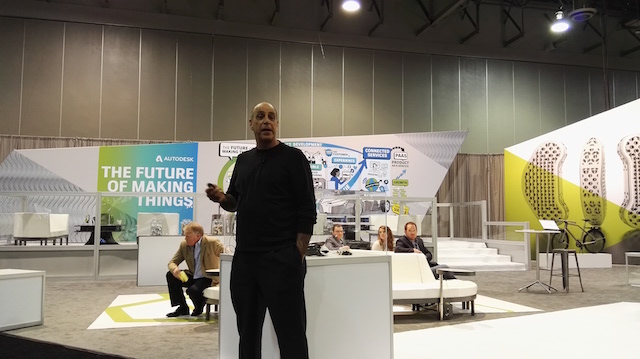
    The second day of Autodesk University 2015 in Las Vegas continued the focus on innovation and changing industries, the afternoon innovation session was particularly focused on some of the opportunities being realised in drones, pre-fabricated buildings and lampshades made out of fungus.

    Brooklyn based designer Danielle Trofe gave a great demonstration of how she’s using fungus to create a range of sustainable light shades. Interestingly in a conversation earlier in the day with Autodesk CTO Jeff Kowalski the topic of growing products out of Mycelium, the vegetative part of a fungus that Trofe uses, was discussed in terms of smart packaging and biodegradable products.

    Growing products out of organic material is one of the themes explored in Mercedes Benz’s Biome concept car which proposes to grow the chassis out of seeds. While realising that concept is some way off, Trofe’s Mush-Lume idea shows some products are already at that stage.

    Rethinking prefab buildings

    Following Trofe was Jos Mulkens, the CEO of Dutch building company Voorbij Prefab, who described how by using sophisticated design tools and 3D printing to make prefabricated building panels they had reduced to the time to fabricate elements from days to hours.

    Mulkens gave a good insight into how design and production workflows are being accelerated with modern technology, particularly in replacing manual form makers to make the moulds for the precast panels. Voobij Prefab are flagging a lot of disruption heading for the building industry.

    At one the media breakout sessions a group of senior Autodesk managers discussed the trends in design and materials engineering. This turned out to be an interesting session on the limits of current technologies.

    Composite technologies

    Max Moruzzi, Autodesk’s Principal Research Scientist, is a passionate believer in composite materials and the benefits they promise. However he conceded when challenged by his colleague Steve Hobbs, who joined Autodesk last year with the acquisition of  UK based Computer Aided Manufacturing company Delcam, about the structural properties of composites that we still have a lot to understand about how they behave and fail.

    Bringing a touch of English scepticism to the panel, Hobbs pointed out almost all metallic components made by 3D printing require some sort of mechanical, subtractive finishing such as milling or polishing.

    Hobbs went onto warn that we risk introducing a “hairball of complexity” into the design and manufacturing industries as people experiment with developing products with materials and techniques they don’t fully understand.

    All the panel, which also included Carl White – Autodesk’s senior director of marketing for advanced manufacturing – and Benjamin Schrauwen who leads the company’s Spark 3D printing division, agreed that applying current design and manufacturing methods need to be rethought in the light of new methods being developed.

    The limits of 3D printing

    It was notable in the panel Q&A around the revelation that 70% of 3D printing projects fail, the panel put this down to the relative immaturity of software and machinery along with the technologies currently being poorly understood. Hobbs observed that for GE to 3D print their jet engine parts they rebuild and reprogram the printers they buy to their own higher specifications.

    For the final session CEO Carl Bass and CTO Jeff Kowalski faced a Q&A from analysts and the media, that session was interesting in exploring some of the directions Autodesk sees industry and business heading and I’ll write more about that tomorrow.

    Overall, the Autodesk University has been an interesting insight into the future of design and manufacturing along with the effects this has on other industries. With these technologies at an early stage, it’s a field that is going to evolve rapidly.

    Paul Wallbank travelled to Autodesk University in Las Vegas as a guest of Autodesk.
    Similar posts:

    • No Related Posts
  • The future of making things – Autodesk University Day One

    The future of making things – Autodesk University Day One

    “With technology I’m free,” says Hugh Herr of MIT Media Lab in the finishing segment of the Autodesk University 2015 opening keynote.

    Herr was describing how he overcame losing both his legs to frostbite at age 17 after being caught in a blizzard. Determined to continue his passion for climbing he started developing better prosthetics, studied mechanical engineering and became the leader of MIT Media Lab’s Biomechatronics Group.

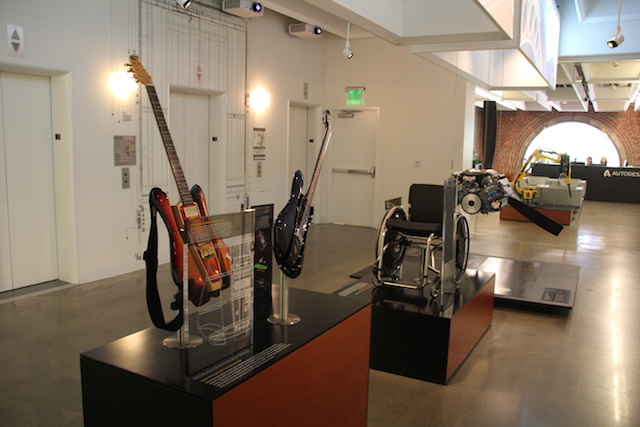
    Prosthetic design is one of the aspects highlighted by Autodesk in their San Francisco Demonstration Gallery with good reason given the life transforming potential along with the imperatives of designing and manufacturing durable devices.

    Design and manufacturing are naturally the key things for Autodesk with CEO Carl Bass outlining some of the possibilities in the opening keynote for the Autodesk University conference in Las Vegas yesterday.

    Bass had some thoughts on the current buzzword of innovation, “it’s not one dramatic improvement of everything that came before, it’s most often combination of pragmatic improvements combining and refixing things in really new ways.”

    “It’s about doing the really hard work, the often unsexy work, of packaging it all up and making it successful.”

    The McGyver IoT

    Bass illustrated this view of innovation with a story of  troubleshooting his home lathe by duct taping his smartphone to the machine and using the microphone and gyroscope to detect when the cutting tip was becoming blunt.

    As Bass pointed out, his “McGyver concoction” of a phone and duct tape is a good example of a basic Internet of Things application where sensors, this time built into the smartphone, detect the state of a machine. It’s a small step from there to developing lathes that change their own cutting tools when required.

    Combining the IoT into design where a product’s design changes on feedback from its environment was a key part of the day’s discussions and touched upon Skylar Tibbit’s work on intelligent materials.

    Autodesk CTO Jeff Kowalski took the longer view of how the shift from passive to generative design methods will change the way we work stating boldly, “in the next twenty years we’ll see more change in the nature of work than we’ve seen in the last two thousand.”

    Rethinking manufacturing

    Kowlaski pointed out how the way of working where a craftsman has to point a tool at materials to form them is now being left behind as we start to see materials, and machines, that can manufacture themselves.

    For the present design and manufacture by humans remains the way we do things and in the media sessions one of the case studies was Airbus’ bionic partition where the company’s Bastian Schaefer and Autodesk’s David Benjamin described the process of redesigning a basic aircraft part.

    The results of a combination of 3D printing – in this case laser sintering of a metal alloy – and generative design resulted in a partition 45% lighter and eight percent thinner, savings not insubstantial when every kilo in an airliner costs its operator 106Kg of kerosene each year.

    An age of reduced consumption

    Reducing the resources being used was a key part of Andrew Mcafee’s keynote presentation where he describes a ‘dematerialising’ economy where a modern society is using less in the way of resources and energy while still improving living standards.


    Overall, the first day of the Autodesk University conference was an interesting exploration into how design and technology is changing lives both on the societal level and for individuals, as Hugh Herr’s story attests.

    Paul travelled to Las Vegas as a guest of Autodesk

    Similar posts:

    • No Related Posts
  • Touring the Autodesk demonstration gallery

    Touring the Autodesk demonstration gallery

    What is the future of design and manufacturing in an age of 3D printing and powerful software? Computer Aided Design company Autodesk gives us some clues at how the world of design is changing.

    Sitting in what was once the Southern Pacific Railway’s headquarters at the beginning of San Francisco’s Market Street is design software company Autodesk’s demonstration gallery showcases how design and manufacturing are going to radically change in coming years.

    The first exhibit in the exhibition, which is open to the public three days a week with guided tours on Wednesdays, is a scale model of the Shanghai Tower that illustrates the power of simulations and the value computers add to the building and architecture industries.

    Shanghai_tower_scale_model_autodesk_gallery

    Currently China’s tallest skyscraper and the second highest in the world, one of the notable features of the Shanghai Tower is how the designers were able to extensively model the shape of the building to reduce the loads on the structure. The cost and weight savings enabled the developers to create a far more lightweight building with a reduced environmental footprint.

    For architects, builders and designers the Shanghai tower is an example of how desktop prototyping can be used to experiment with competing schemes to see what designs meet the needs of those using the building or product.

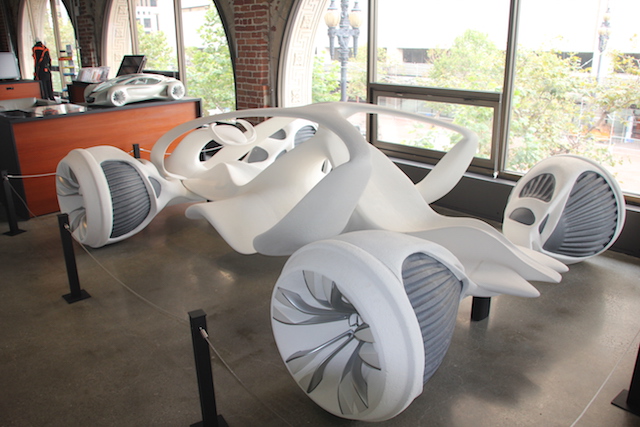
    The biggest exhibit in the hall is the Mercedes Biome concept car chassis. First unveiled at the 2010 Los Angeles Car Show, the idea behind the vehicle’s design is an organic form similar to an animal’s skull to create a strong but lightweight structure.

    Mercedes_biome_concept_car_chassis

    Adding to the Biome’s exotic design is the proposal to ‘grow’ the car’s chassis out of genetically modified seeds. Essentially the vehicle’s structure wouldn’t be manufactured in our current understanding of the word at all.

    Mercedes_Benz_Biome_Concept_Car_model

    While the Biome or similar vehicles won’t be seen on the roads in the near future – Mercedes predict the vehicle is at least 60 years away – the idea behind ‘growing’ industrial items is one that may well become commonplace in the near future for smaller items.

    lego_dinosaur_autodesk_demonstration_gallery

    The other big exhibit in the gallery is the Lego dinosaur. Made up of 62,000 custom designed pieces, the dinosaur was assembled in at the company’s Czech Republic facility before being shipped to California.

    One disappointing aspect of the dinosaur for some of the attendees is that these models aren’t made of solid Lego. Instead an internal brace is made that supports the structure. Again this is a feature of the design software that allows the creators to accurately calculate the weight and build a model that won’t collapse under its own mass.

    At the other end of the size range, but no less important, is the display of 3D printed prosthetic limbs. It’s now possible to scan the remaining limb and create a device that closely replicated the lost limb.

    3D_printed_prosthetic_leg_autodesk_gallery

    Again, using 3D printing allows those limbs to be quickly made to the custom specifications, the design also allows weight saving features to be incorporated into the prosthetic. This exhibit shows just how life changing modern technologies can be.

    Finally, one of the most intriguing devices is the The SOCCKET power generating soccer ball designed to promote physical activity and help children in developing nations access light to study by.

    Uncharted Play Sokket ball

    The SOCCKET charges up as kids play with the ball, in the evening an energy efficient LED lamp can be plugged into the ball. The Soccket retails for 99 US Dollars and for ball sold one is donated to a third world community.

    Products like the Soccket, the prosthetic limbs and many of the other displays in the Autodesk Demonstration Gallery show the potential of a world where new ways of manufacturing join with modern design tools. It’s worth a visit to appreciate some of the ways our world is going to change in coming years.

    The gallery is open to the public every Monday, Wednesday, Friday from 10 a.m. to 5 p.m., with a guided tour at 12:30 p.m. every Wednesday. Admission is free.

    Similar posts:

    • No Related Posts
  • Designing and the IoT

    Designing and the IoT

    A piece I wrote for IoT hub looks at how the design industry is changing as every day devices, even clothes, can start communicating with the world.

    In researching the piece, it was interesting just how broad the possibilities are, particularly when we start considering main devices will be able to change their roles depending on the commands they receive or the environment they detect.

    What’s clear is the design industry is facing a world of opportunities, and challenges, as not only do objects start talking to each other, but also new materials and manufacturing processes start changing how we think ordinary items should be made and used.

    Similar posts:

    • No Related Posts
  • How design will change the world of business

    How design will change the world of business

    “I always believe small companies usually illustrate big shifts faster than larger companies. In many ways big companies are responding to the shifts being driven by smaller businesses,” says Andrew Anagnost, the Senior Vice President of Industry Strategy and Marketing at Autodesk.

    Anagnost was talking the Dreamforce media contingent after a tour of his company’s San Francisco Gallery where possibilities of today’s design and manufacturing tools are displayed.

    Those possibilities are changing business, not just in design but across most industries as the means of financing and building new projects changes along with consumer demand as production methods change.

    Anagnost breaks these changes into four major trends – the way things are designed, how they are produced, the nature of demand in a world where things can personalised and the very notion of what a product is.

    “What people expect in from products today is very different.”

    A supercomputer at your fingertips

    “Every generation brings something new to design,” says Anagnost. “Imagine the generation that grew up with social media, online gaming, all the things that previous generations did not grow up with.”

    This generation will be more collaborative and the idea of working in fluid, unstructured groups where many of the members will never physically meet anywhere.

    Cloud computing is the other factor Anagnost sees as changing design as “it puts a supercomputer behind every screen”, which brings to the desktop great power in testing designs. “The designer gets a chance to explore options they couldn’t access before.”

    That supercomputer at your fingertips changes all businesses, giving them processing power to carry out complex analytical tasks and modelling in all industries.

    Financing the change

    Another change to the production process is how people are financing their products. Increasingly platforms like Kickstarter are creating new ways for entrepreneurs to raise funds and also to test the market for a product before investing money and time.

    “Before people would have to pitch their ideas to a larger manufacturer, an investor or a VC but now they can pitch it to anyone,” says Anagnost. “The means of financing products is now changing.”

    The new means of production

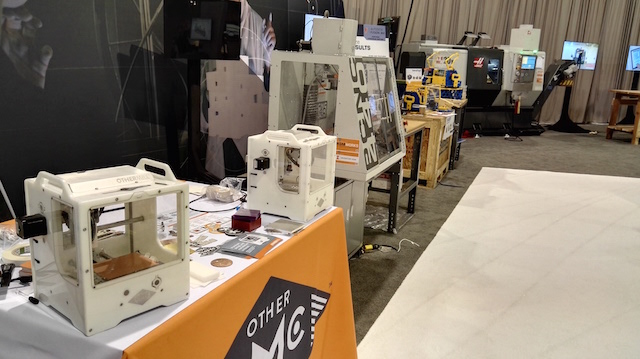
    ‘Fabless manufacturing’ promises to change manufacturing by reducing the need for massive factories as micr0-factories start to change the economics of making products. These miniaturised robot factories are easily configurable and can be located locally rather than across the country of oceans.

    Coupled with 3D printing, again it becomes cheaper and quicker to bring products to market and changes the dynamics of getting goods to market. “When it gets cheaper to deliver a complex product, the field gets levelled and more people can deliver innovative products to market,” says Anagnost.

    The other trend within manufacturing is prefabricated assembly. While nothing new, improved design tools and manufacturing methods are making it easier and more efficient to assemble things like buildings onsite, coupled with 3D printing this is going to see massive changes in sectors like the construction industry.

    Generational changes

    Changing manufacturing and designs creates changed consumer expectations, as design becomes more accessible and personalisations easier customers are increasingly going to want products that meet their specific tastes and needs.

    Another aspect to this is generational change, where younger consumers expect personalised products and don’t identify the same way with major brands as their grandparents and parents did.

    “We’re going to see a move from rampant consumerism to a more selective consumerism,” says Anagnost.

    This means markets are going to be far more volatile as the brand loyalty erodes in the face of a demanding customer. You’re only as good as the last conversation you had with your customer and if they aren’t happy they’ll go elsewhere.

    Connected devices

    The final factor Anagnost sees is the world of connected devices, increasingly consumers will demand products that have online functionality built in.

    Increasingly we’re seeing this with motor cars and in the near future we’ll be seeing devices as diverse as motorcycle helmets and light bulbs being shipped with networked capabilities.

    “Everything in your home is going to be connected in some way and people are going to have that expectation they will be,” says Anagnost. “Sensors are getting cheaper and cheaper and cheaper. There’s an assumption of connectivity.”

    What Anagnost and Autodesk are flagging is business is changing, barriers we thought were unsurmountable are increasingly falling. For every industry, easily accessible computing and manufacturing power is changing the competitive landscape.

    Paul travelled to San Francisco as guest of Salesforce.

    Similar posts: