
Tag: starbucks

  • Daily links – Chinese tourists, mars landers, Zappos management

    Daily links – Chinese tourists, mars landers, Zappos management

    Where do Chinese tourist like to travel to? One of today’s links looks at where the modern PRC tourist likes to go. Other links include how jaywalking became a crime, Samsung’s attack on the low end Indian smartphone and how disguised Starbucks may be popping up in your suburb.

    Kicking off today’s links is an examination of how Zappos’ CEO and founder Tony Hsieh is carrying out a daring experiment on the management structures of his company.

    Zappos’ strange management experiment

    No-one can accuse Zappos’ founder Tony Hsieh of thinking inside the box, his experiment with new form of management called holacracy is another example of how he tries to do things differently. Whether it will be successful or not remains to be seen.

    How Jaywalking became a crime

    Vox tells of how cars took over our cities’ streets during the early Twentieth Century. It’s an interesting description of the political, social and economic forces at work as the effects of the automobile started to be felt by our communities.

    Lost spacecraft found on Mars

    “It was a heroic failure.” Britain’s Beagle space mission to Mars ended in mystery when the lander vanished just before Christmas 2002. Now it’s been found. I find this story quite touching.

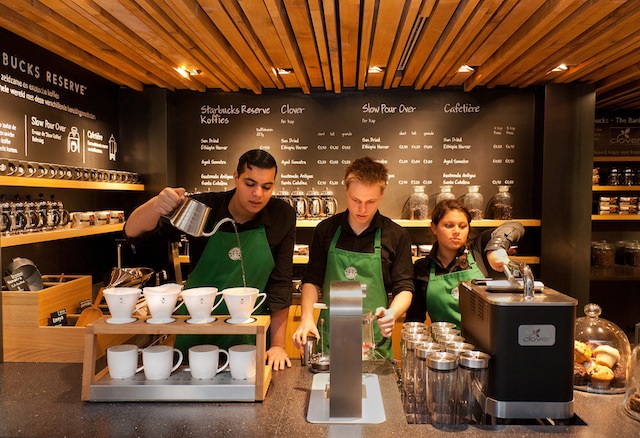
    Your local cafe might be a stealth Starbucks

    Like McDonalds, Starbucks is facing structural changes in its market. One of the ways both companies are responding by launching experimental new stores. Some of which might be near you without you knowing.

    Samsung launches a sub $100 Tizen phone in India 

    Just as the car changed the Twentieth Century the smartphone may well be one of the critical technologies that shapes this era. Cheap phones in emerging markets are the equivalent of the Ford Model T a hundred years ago.

    Samsung’s move is a response to the Chinese manufacturers who are dominating that market. That Samsung is using their own Tizen operating system rather than Android which most of the Chinese companies use is something worth watching.

    Where are Chinese tourists going

    As Chinese manufacturers look to emerging markets as their economic future, the country’s tourists are exploring the world. This article laments how those PRC travellers are ignoring London and the UK but also has some interesting observations about the destinations they prefer.

    Similar posts:

    • No Related Posts
  • Starbucks Coffee as a digital innovator

    Starbucks Coffee as a digital innovator

    USA Today has an interesting interview with Starbucks CEO and founder Howard Schultz.

    It’s worth watching as he maps out where the coffee chain is heading and the importance of innovation and relevancy to his business.

    Schultz’s view about the coffee store of the future is intriguing – he knows it will be different but he doesn’t know in what way and that’s why his business is experimenting with different ways of doing things.

    “Sure, we’re doing work now on the store of the future,” says Schultz. “It is not only linked to the physical but the digital experience.”

    It’s not only the use of digital tools, social media and mobile payments that Schultz is exploring, it’s how does such a huge chain remain relevant to its customers.

    “We have to answer the question in the affirmative about how to maintain relevancy. Relevancy can’t only be in the four walls of our stores, we have to be as relevant with our customers where they work, play and even on their phones.”

    Relevancy is something that can’t be taken for granted by any business – becoming irrelevant to customers is a death-knell for most enterprises. This is something that challenging the media industry as its struggles to find its role in changed society.

    On the same day that story was posted, IBM’s CEO Virginia Rometty made a pointed address to her 434,000 employees on where the company has fallen behind.

    “Where we haven’t transformed rapidly enough, we struggled,” The Wall Street Journal reports. “We have to step up with that and deal with that, and that is on all levels.”

    “Our performance reminds us that there are profound shifts under way in our industry.”

    That the world’s biggest coffee chain is dealing with those profound shifts better than one of the biggest technology companies is a notable point about the times we live in.

    Similar posts:

  • Who will build the next Barnes and Noble?

    Who will build the next Barnes and Noble?

    As US bookseller Barnes and Noble shrinks its store network, Mark Athitakis has a tribute to the once ubiquitous chain in The New Republic.

    Barnes and Noble was never popular among US independent booksellers because of the perception, probably true, that the chain drove locally owned stores out of business.

    What it offered though was a safe, comfortable place for booklovers to gather in suburban shopping malls. As Mark points out, it created a community.

    Its stores were designed to keep people parked for a while, for children’s story time, for coffee klatches, for sitting around and browsing. That was a business decision—more time spent in the store, more money spent when you left it—but it had a cultural effect. It brought literary culture to pockets of the country that lacked them.

    In recent years that community moved to coffee shops, in the United States B&N’s role was taken by Starbucks, at the same time our reading habits changed and the business of selling books and magazines became tougher.

    Now that community is changing again, as the online societies like blogs, Facebook and Twitter become important, the coffee shops have responded with free wi-fi which is a perfect example of how the online and offline world come together.

    That need to create communities, either physically or online, is a driving human urge.

    Online that role is being catered to with social media platforms and sites like food, mommy or tech blogs where like minded people can gather.

    Down at the mall, Barnes and Noble catered for that need in the 1980s and Starbucks in the 1990s. What will follow them may be the next big success in the retail or hospitality industry.

    Image courtesy of Brenda76 on SXC

    Similar posts: