Tag: salesforce

  • Marc Benioff’s five key business questions

    Marc Benioff’s five key business questions

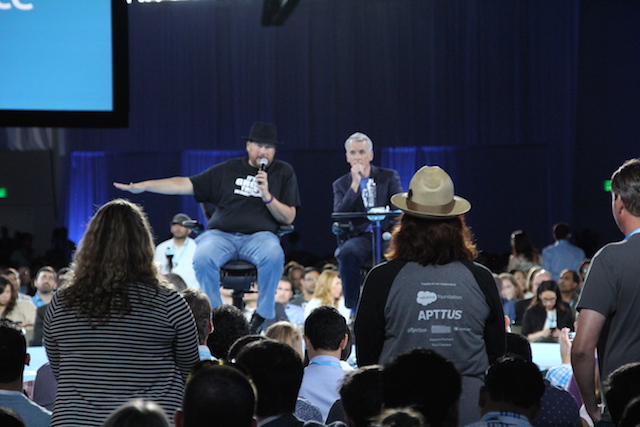
    Probably the best regular session of the annual Dreamforce conference is the final session where Salesforce founders Marc Benioff and Parker Harris answer questions from the attendees.

    As with any open microphone session, some of the questions are silly but many highlight frustrations Salesforce’s customers have and some give the opportunity for an insight into Parker and Benioff’s thoughts away from the scripted glitz of the main keynotes.

    One questioner asked Benioff and Parker what their advice would be to someone in their position of 16 years ago with a new business.

    Forget the tech

    “Don’t think about the tools or the technology,” said Harris. “Thing about the problems you can solve. Stay focused and work hard and build a great company.”

    While Parker also emphasised a great team is another important element, Benioff flagged an element of luck in building a successful business, “we got the timing right.”

    Ultimately though it came down to making the jump from a comfortable, if frustrating, corporate job to a risky startup.

    “I remember I was working in a big company for a long time, very unhappy.” Benioff recalled and noted the decision to strike out on your own is very much a personal decision, that can only be done when you are convinced it is time.

    The five questions of business

    Knowing when that time has arrived comes down to five questions, Benioff believes.

    “It all starts with you, you have to get clear about what is it that you really want, what is really important to you, how are you going to get it, how will you know when you’ve got it and what is preventing you from having it.”

    “When you can answer all those five questions you’ll have clarity in your direction. The problem with most small businesses – and big businesses – is they can’t answer those questions.”

    “If you can answer those questions then you can break out.”

    Ultimately Benioff and Parker flag focus as the key individual attribute and being able to focus on answering those five questions is a very good first step to having a successful business.
    Similar posts:

    • No Related Posts
  • Reinventing Microsoft in the age of cloud computing

    Reinventing Microsoft in the age of cloud computing

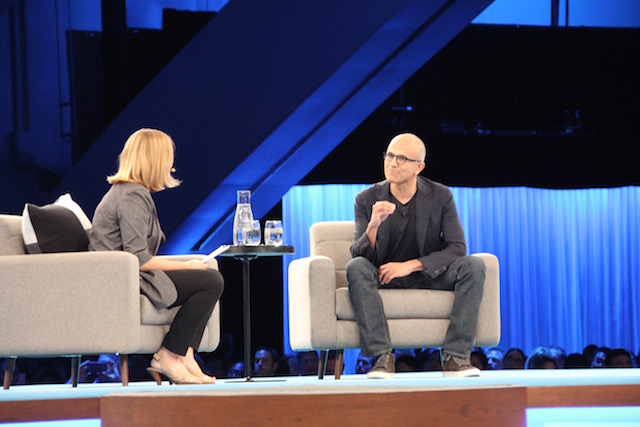
    “Why does Microsoft exist?” Asked the company’s founder Satya Nadella at the Dreamforce 2015 conference.

    Nadella has asked this question before and his answer at the San Francisco event was that Microsoft exists to empower people through technology, something that Bill Gates and Paul Allen envisaged in the mid 1970s when they founded new startup.

    To show how he sees Microsoft’s position in the modern workplace, Nadella gave a not completely flawless demonstration of Microsoft’s integration with Salesforce.

    The products Nadella pushed were Windows Phone and Windows 10, which he claims to be part of a major change in businesses with data transforming the way we work.

    Interestingly, he framed the Windows 10 IoT strategy around endpoint security. While there are millions of vulnerable devices, it’s not clear shipping them with Microsoft’s firmware will resolve the problem.

    “What’s the big technology shift? It’s how we use the data.” Nadella proclaimed in laying out how he sees a data culture transforming the places we work.

    A Grand Pivot

    Microsoft itself is dealing with a cultural transformation with the company shifting across to cloud based subscription services. “The thing that it’s done for us is it’s not a one-for-one move. It’s not like we’re just moving Exchange on premise to Exchange as a Service, it changes the value proposition for the customers.”

    Nadella sees those cloud services as an opportunity to sell more products – and add more value – to customers, particularly small businesses.

    The CEO’s role

    A business’ success relies upon its culture and Nadella sees the role of the CEO as being about curating that culture, “I always ask what it is that defines us.”

    Part of that culture is about becoming customer focused which involves thinking outside of one company’s products or silos, “how is our industry going to succeed? It’s going to succeed if we can add value our customers. Our customers are going to make choices that aren’t homogenous.”

    Those varied choices are what’s driving Microsoft’s current push into alliances.  “If we are going to realise the power of technology, then these partnerships will amplify that,” says Nadella.

    While there were nuggets of truth in Nadella’s presentation, there was also a lot of truisms and somewhat meaningless slogans. While Microsoft’s push onto the cloud and into alliances that were once considered unholy might be genuine, it’s hard not to think there’s still a lot of marketing speak wrapped around it.

    Similar posts:

    • No Related Posts
  • Managing the data stream

    Managing the data stream

    One of the world’s biggest tech events – if not the biggest of the vendor shows – is Dreamforce, Salesforce’s annual spectacular that this this year attracted a 150,000 attendees to San Francisco’s Moscone Center.

    Every year sees the company – which now holds the title of the world’s fourth biggest software company – and its CEO, Marc Benioff, defining the direction of the company in the face of a rapidly changing market. Despite being a pioneer in cloud computing, the company is as vulnerable to disruption as anyone else in a rapidly changing marketplace.

    This year, the focus is on analytics and automation along with a strong leaning towards the Internet of Things and app development on the Lightning platform they announced last year.

    With the Thunder platform, Salesforce is offering a service that allows businesses to connect devices onto their platform where users can build up rules based business automation. One notable part of this is the integration with Microsoft Office 365, another example of Microsoft’s reaching out to previously hostile companies.

    For Automation, Salesforce is building upon its RelateIQ acquisition from last year, now branded as SalesforceIQ. The company says “Relationship Intelligence technology that utilizes advanced data science to analyze company relationships and drive actions.”

    The Wave analytics service, which was also announced at last year’s Dreamforce, is a key part of the the business automation and IoT services in providing the insights into the data being collected. In many respect, Wave is going to be the glue that holds most of the products being announced this year.

    Complementing the Wave, Thunder and SalesforceIQ products is the Lightning platform, again announced last year, that allows users to use the company’s AppCloud to quickly build business applications.

    For Salesforce, the direction being laid out from this Dreamforce conference is in making helping customers deal with the masses of data coming into the enterprise. As Tod Neilsen, the company’s Executive Vice President of the App Cloud says, “we’re look at making the data usuable for spreadsheet users.”

    As businesses struggle to manage and understand the masses of data flowing into their organisations, this may well be a powerful selling point for Salesforce.

    Paul travelled to Dreamforce 2015 in San Francisco as a guest of Salesforce

    Similar posts:

    • No Related Posts
  • Towards the zero defect economy

    Towards the zero defect economy

    At 2.03 in the morning of July 11, 2012, a Norfolk Southern Railway Company freight train derailed just inside the city limits of Columbus, Ohio.

    The resulting crash and fire caused over a hundred people to be evacuated, resulted in over a million dollars in damages and created massive disruption throughout the US rail network.

    Could accidents like this be avoided by the Internet of Things? Sham Chotai, the Chief Technical Officer of GE Software, believes applying sensor technology to locomotives can detect conditions like defective rails and save US railway operators around a billion dollars a year in costs.

    “We decided to put the technology directly on the locomotive,” says Chotai in describing the problem facing railroad operators in scheduling track inspections. “We found we were mapping the entire railway network, and we were mapping anything that touched the track such as insulated joins and wayside equipment.”

    This improvement in reliability and its benefits to business is something flagged by then Salesforce Vice President Peter Coffee in an interview with Decoding the New Economy in 2013.

    “You can proactively reach out to a customer and say ‘you probably haven’t noticed anything but we’d like to come around and do a little calibration on your device any time in the next three days at your convenience.’”

    “That’s not service, that’s customer care. That’s positive brand equity creation,” Coffee says.

    Reducing defects isn’t just good for brands, it also promises to save lives as Cisco illustrated at an Australian event focused on road safety.

    Transport for New South Wales engineer John Wall explained how smarter car technologies, intelligent user interfaces and roadside communications all bring the potential of dramatically reducing, if not eliminating, the road toll.

    Should it turn out the IoT can radically reduce defects and accidents it won’t be good news for all industries as John Rice, GE’s Global Head of Operations, pointed out last year in observing how intelligent machines will eliminate the break-fix model of business.

    “We grew up in companies with a break fix mentality,” Rice says. “We sold you equipment and if it broke, you paid us more money to come and fix it.”

    “Your dilemma was our profit opportunity,” Rice pointed out. Now, he says engineering industry shares risks with their customers and the break-fix business is no longer the profit centre it was.

    A zero defect economy is good news for customers and people, but for suppliers and service industries based upon fixing problems it means a massive change to business.

    Similar posts:

    • No Related Posts
  • Shifting the cloud business model

    Shifting the cloud business model

    “What’s the biggest risk to your business?” was one of the questions asked of Netsuite CEO Zack Nelson during a post keynote discussion at the Suiteworld event in San Jose yesterday.

    Nelson’s response was the shift to transaction based businesses and cited cloud based human resources company Zenefits as an example.

    The transactions model can work two ways with either a fee being charged for each transaction – something that data analytics Splunk does – or Zenefit’s model of taking third party commissions.

    A commission driven business

    Zenefits doesn’t charge for its software instead making money from commissions paid by companies they refer users to. When a client needs workplace insurance or a new benefits package, the service gets a fee from the provider.

    Investors love the idea with the company yesterday raising $500 million in a round that values the business at $4.5 billion dollars after just two years since being founded.

    Regulators however don’t like its less than transparent commissions with the service in trouble in a number of US states and it’s clear to see how such a revenue model would hit problems in countries with strong disclosure rules.

    Both of the transaction models present a threat to current cloud computing software businesses such as Netsuite and Salesforce that charge fixed license fees based on the number of users and the features they want. Both Splunk and Zenefits on the other hand give their software away.

    Disrupted disrupters

    Just as the cloud providers’ licensing model disrupted the traditional massive negotiated contracts for enterprise software and the fixed cost box model for small business, the online companies themselves might be facing their own disruption to the way they make money.

    For executives like Zach Nelson, shifting from one lucrative model to another more uncertain revenue source will be something keeping them awake for a while longer.

    Similar posts:

    • No Related Posts