Tag: sports

  • Social media and sports data

    Social media and sports data

    A few days ago we looked at how sports organisations such as the Australian Open tennis tournament are increasingly treating their data as an asset almost as valuable as broadcasting rights.

    Now Facebook has entered the space with its own Stadiums sports data service that it hopes to become an online centre for fans following major events.

    How enthusiastic sports organisations will be in sharing their data and audiences with the social media service remains to be seen.

    Sports have been a priority of the social media services in their quest to attract audiences, however unlike television broadcasters Twitter, Google Plus and Facebook have found their cosying up to contests and stars has been less than successful.

    It may be statistics are what’s needed to attract fans and certainly Facebook is well placed to be a destination for fans however it is early days for social media and the model that works is yet to be found.


    Similar posts:

    • No Related Posts
  • Redefining sports media

    Redefining sports media

    Over the last 50 years the relationship between professional sport and television broadcasters has been defined by broadcasting rights. Like most other media business models that relationship is now under threat.

    Touring the Australian Open tennis tournament this week, it was striking how the relationship between sports organisations and broadcasters has changed as the internet changes distribution models and data starts to become a valuable asset in itself.

    A tour of the data infrastructure behind the tournament as a guest of sponsor and service provider IBM showed how sporting organisations are hoping to use data to improve their fans’ experience and add value for sponsors and competitors.

    Last year the Australian Open collected 23 Terabytes of data, a 136 percent increase on 2014, which the organisers distribute on their MatchCenter web platform along with analysis through their Slamtracker system.

    Using IBMs Bluemix development platform and the company’s Watson artificial intelligence service, the Australian Open website analyses factors ranging from the audience’s social media sentiment through to predicting competitors’ performance based on historical data.

    This wealth of data gives the event organisers a great platform to engage with statistics hungry fans and it was notable when talking to the Australian Open staffers how they now see the television broadcasters as much as their competitors as their partners.

    When coupled with the changes to broadcasting rights – like most sports organisations the Australian Open has moved to the model pioneered by Major League Baseball of providing their own video feeds rather than engaging a host broadcaster to record the events and distribute the video – this has put the television and pay-TV networks in a far less powerful position.

    For the sports organisations those broadcast rights deals are still by far the most lucrative income stream they have but the days of the host broadcasters holding power over the events are slipping away.

    One telling statistic was the shift to mobile platforms. Kim Trengrove, the digital manager for Tennis Australia, pointed out how in 2015 online traffic was split equally between desktop and mobile use while in 2016 it was appearing to be 60% mobile. That change in itself has major ramifications for the market.

    In the future as the data becomes more valuable and the video feeds can be distributed across web browsers and even artificial reality headsets, the late Twentieth Century broadcast model becomes even more tenuous.

    For the television networks it means their power and income is reduced while those collecting, processing and distributing data become more important. However it may be the software companies managing the information aren’t able to pay the immense sums the broadcasters have been able to offer for the last fifty years.

    One thing a tour of the Australian Open did show was how business model of professional sports is dramatically changing. A data driven world is going to be very different to that of the last fifty years.

    Similar posts:

  • Taking the pain out of sporting venues

    Taking the pain out of sporting venues

    “We’re trying to take the pain out of visiting a stadium,” says John Paul, CEO of smart stadium service provider Venue Next in an interview with Robert Scoble.

    Scoble as usual gets the better stories than we do as this site’s visit to a smart stadium was somewhat underwhelming. Compared to the Sydney Cricket Ground, Santa Clara’s Levi Stadium is several degrees more advanced – one might suggest a generation ahead.

    The Santa Clara stadium has a comprehensive offering with everything from parking, where guests can purchase spaces through the app, and transport integrated and right down to ushers monitoring the restroom queues.

    Having one app to control the various feature is a benefit, “we can’t expect people to use multiple apps at a venue.” Paul says and adds the observation that venues can use the gathered intelligence enables the stadium management and concession holders to more efficiently deploy resources.

    This is a problem at the SCG where a plethora of agencies and outsourcing deals puts barriers in the way of introducing smart apps, at present a user who wants to check seat availability or buy parking has to deal with different service providers.

    One of the big problems facing Australian stadiums are the ticketing agencies where the two major operators – Ticketmaster and Ticketeck – have exclusive deals with the venues that dynamic pricing and upselling is difficult.

    Upselling tickets was one of the benefits of the smart stadium cited by Mike Caponigro, Cisco’s head of Global Solutions Marketing for Sports and Entertainment when Decoding the New Economy interviewed him last year.

    Having multiple providers with mismatching or inaccessible data sets is going to be a barrier for businesses trying to implement apps like VenueNext and information access is going to be an essential part of subcontracts and outsourcing agreements.

    Ultimately this is about making things as easy as possible for the fans. By adding features they are able to spend more money and have an enjoyable time.

    What’s notable with the VenueNext applications is the focus on the fans’ experience. By making the services more accessible and reducing the hassles of attending a major event, it’s more likely to attract more spectators.

    The sports industry is leading the way on using apps to enhance customers’ experiences, something other industries such as the restaurant or conference sectors can learn from.

    Similar posts:

    • No Related Posts
  • Cisco and the connected stadium

    Cisco and the connected stadium

    One of the challenges facing sports administrators and leagues around the world is that the quality of broadcast coverage has become so good it’s become increasingly harder to get fans out to the games.

    Coupled with the constantly improving television coverage, fans are also expecting more as they go to games with their smartphones and tablets. Part of the solution for venue managers is to roll out smart stadium facilities that enhance spectators’ experience at the games.

    Mike Caponigro, Cisco’s head of Global Solutions Marketing for Sports and Entertainment, sees the smart stadium as complementing the ground experience and Cisco are working with over three hundred venues in thirty countries around the world.

    Improving the live experience

    “Live is always going to be best,” states Caponigro. “You can’t replace that tribal passion of the crowd. No matter how excited I get in my living room or with some friends in a pub you’re never going recreate that enthusiasm.”

    However the expectations of sports fans are changing Caponigro points out citing how HD television and the internet is changing the experience for spectators outside the stadium, “fans don’t want to be removed from that action.”

    Cisco started their Connected Stadium program when the Oakland Athletics were looking at moving home stadiums seven years ago. While Oakland decided to remain at their existing stadium the company realised the market for connected stadiums was potentially huge, “it really pushed our thinking on how could we service an industry sector that hadn’t been well served.”

    Accelerating innovation

    “Arguable you’ve seen more innovation in that last seven years in the sports and live entertainment field than in the five decades prior to that,” says Caponigro who attributes the rate of change to consumer adoption of smartphones. “Now we’re working with three hundred properties in thirty countries around the world.”

    “What fans are saying is that in order to continue to go to events there are things that need to be tweaked around the experience,” Caponigro states. “We did a study two or three years ago that found seventy-five percent of fans bring a smartphone to the venue. In the latest studies we’re finding ninety percent.”

    Those fans are expecting a reliable signal to share information and access data. At last year’s Superbowl the crowd consumed 6Tb of data, half of which was outward traffic. “That just reinforces that fans aren’t just consuming services but it’s also become an increasingly social environment.”

    Improving revenues

    One of the areas Caponigro sees as an opportunity for connected stadium administrators is in seat management citing the Golden State Warriors NBA team that have used BlueTooth beacons to drive their seat upgrade application to generate $300,000 in additional revenue.

    Fans have two frustrations with attending live games says Caponigro, is the convenience of getting to and from the game and not getting a good view of the play from their seats.

    The ‘single seat experience’ as Caponigro describes it, uses the stadium’s smart vision TVs and the apps on spectators’ phones to give fans the same access to replays and stats that viewers watching the game on TV or the internet can access.

    Making transport easier

    Getting to and from the game is another advantage the smart stadium technologies offer both spectators and stadium administrators, by giving real time information on parking and public transport status crowds can be better managed and fans can have a smoother experience travelling into and away from the event.

    In the future, Caponigro sees the next wave of innovation integrating back of house services into the connected stadium giving administrators greater understanding of concession sales and crowd movement.

    Another opportunity lies in bringing player biometrics to the spectators, “you might find out if Ronaldo is really as cool as he looks when he takes a penalty” grins Capringo.

    While it’s still early days for the connected stadium, like many Internet of Things applications businesses are exploring the limits. For sports fans, they can expect a richer experience being delivered to their smartphones and seats.

    Similar posts:

    • No Related Posts
  • Delivering on the promise of the connected stadium

    Delivering on the promise of the connected stadium

    Once a year I come out of the closet in Sydney and admit I support Carlton in the Australian Football League. This usually ends in humiliation as Carlton hasn’t beaten Sydney in the last twenty years.

    This year’s ritual humiliation coincided with an offer by Telstra to review their smart stadium rollout at the Sydney Cricket Ground’s rebuilt MA Noble stand following a tour of Etihad’s stadium earlier this year.

    Late last month I interviewed Mike Caponigro, Cisco’s head of Global Solutions Marketing for Sports and Entertainment, around how smart stadiums are being rolled out around the world, including the Sydney Cricket Ground.

    Caponigro sees the smart stadium as complementing the ground experience and Cisco are working with over three hundred venues in thirty countries around the world.

    “Live is always going to be best,” states Caponigro. “You can’t replace that tribal passion of the crowd. No matter how excited I get in my living room or with some friends in a pub you’re never going recreate that enthusiasm.”

    However the expectations of sports fans are changing Caponigro points out citing how HD television and the internet is changing the experience for spectators outside the stadium, “fans don’t want to be removed from that action.”

    So how does the connected stadium experience stack up for a punter who’s used to being in the cheap seats and often wonders if buying that ticket along with putting up with the hassles of getting to the ground, being overcharged for bad food and water down beer is worthwhile compared to staying at home and enjoying it on TV?

    A limited App

    Like all the smart stadium rollouts, the SCG’s revolves around the onscreen displays and the spectators’ smartphones. Once downloaded the 35Mb app isn’t spectacular. The sports news focuses on cricket – somewhat irrelevant in a Sydney winter – while the transport map front ends into Google Maps.

    Probably the biggest disappointment with the app is the venue map which is a detailed PDF lacking any interactive capabilities which successfully manages to pack a lot of information, like the location of light towers, without actually telling you anything useful.

    In seat ordering is one of the attractions of the app. Unfortunately we were unable to test it as the collection points are within the members section of the Noble stand which we didn’t have access to.

    The lack of real time information about seating, transport and ground information makes the app at best ornamental, indeed there are opportunities missed in upselling such as offering spectators seat upgrades or merchandising offers.

    In stadium connectivity

    Where the SCG smart stadium shines is in the Wi-Fi connectivity. Mobile connections over 3 and 4G services have always been problematic during match breaks. During the game, the connection was flawless, the only gripe being that the login screen reappeared for a moment everytime the phone was bought out of sleep.

    Again though it’s hard not to think the ground management are missing opportunities with the Wi-Fi as the login screen asked for an email address but didn’t give the option of providing an SCG or Swans membership number rather than just an email address.

    Not so smart screens

    The biggest boast of smart stadiums are the connected screens, the previous tour of Melbourne’s Etihad Stadium showed what could be done but the SCG game was an opportunity to see the videos in action.

    Smart-stadium-action-shot

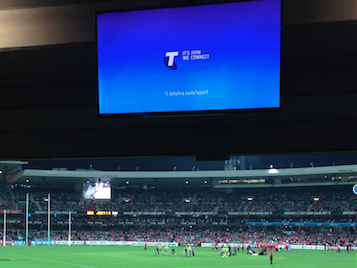
    Unfortunately the screens actually detracted from the experience. While the main scoreboards were showing game details and replays the smaller screens were showing the SCG members in ground advertising which added nothing for spectators.

    Even during the match play, the screens carried the Channel Seven television feed with food outlet advertising wrapped around it. Disappointingly the screens didn’t give any updates on the match play, the goal kicked by Swans’ debutante Dan Robinson (who played for my local junior club) didn’t receive a mention at all.

    Overall the spectator experience from the SCG’s smart stadium rollout is underwhelming. This isn’t a result of Telstra and Cisco’s technology but of its implementation with a focus on low value advertising rather than adding value for spectators.

    Leaving money on the table

    The smart screens need to be delivering more relevant information to fans in the stadium while the smartphone app has to be giving dynamic and useful data to help spectators before during and after the game.

    At the moment, it seems there’s a lot of money being left on the table as opportunities beyond pushing advertising onto spectators aren’t being explored.

    smartscreen-connected-stadium

    It’s hard not to think that right now the smart stadium is a solution in search of a problem. Certainly for fans to take anything except the improved Wi-Fi service seriously there ground managements have to offer more than continuous ads for chicken outlets and expensive private schools.

    Then again, maybe I’m just bitter as once again us Carlton fans were humiliated by another hundred point loss. For Blues supporters it was another dismal night at the footy ground.

    Similar posts:

    • No Related Posts